


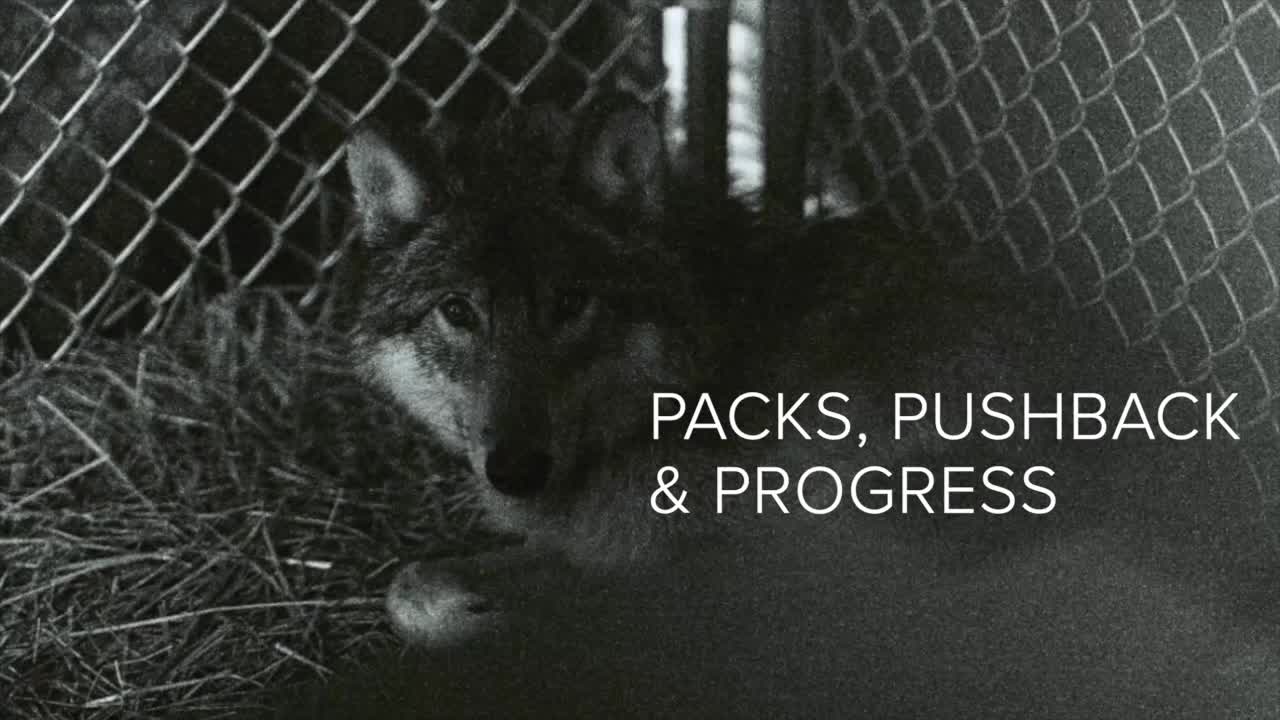


As we near the end of the year, 2025 has proven to be another 12 months of tumultuous activity for Colorado's gray wolf reintroduction program.
In the above Denver7 special "Packs, Pushback and Progress: The Realities of Colorado's Wolf Reintroduction," we explored the dozens of stories we covered in 2025, ranging from in-depth interviews with ranchers to conflict minimization tools Colorado Parks and Wildlife (CPW) is working to perfect.
Denver7 reporter Colette Bordelon, photographer Adam Hillberry and digital journalist Stephanie Butzer put the special together.
Timeline of Colorado's wolf reintroduction
Denver7 has been following Colorado's wolf reintroduction program since the very beginning, and you can explore all of that reporting in the timeline below. This starts with our most recent story.
In this story, we will briefly go over what happened this year in the program. For more details on each story, click on the hyperlinks or explore the above timeline.
Our first story of the year revolved around a dead wolf. A necropsy found that the adult male wolf of the Copper Creek Pack, which died shortly after CPW's effort to relocate the pack following a string of depredations, had a gunshot wound, which led to its death. The U.S. Fish and Wildlife Service says this is an "illegal killing," as gray wolves in Colorado are protected by the Endangered Species Act, and it is illegal to kill them without federal authorization.
That case is still under investigation.
Within the following two weeks, the CPW Commission voted 10-1 to deny a petition from ranchers to pause the reintroduction program and by Jan. 11, CPW announced it had started efforts to capture gray wolves in British Columbia. By Jan. 19, 15 of them had been translocated to Eagle County and Pitkin County.
Within the following few months and ahead of the spring calving season, CPW worked to ensure ranchers were aware of the resources the state had available, including range riders, who can haze the wolves. The range riders were placed at various locations beginning in April through September and their pay was supported by the sales of Colorado's wolf license plates. Other resources include fladry, fox lights, fencing, carcass removal management, and guard dogs, CPW said.
At the end of February and into early March, CPW and the commission reviewed two high-value claims made by ranchers who lost livestock to wolves in 2024. CPW recommended that the commission approve the claims in late February, and the commission did so in early March. One of the claims was nearly $300,000.
- Read the full Colorado Wolf Restoration and Management Plan
On March 20, a reintroduced Canadian wolf that had wandered into Wyoming was killed by Wildlife Services after it was found close to a property where multiple sheep had been killed. That same day, Colorado Gov. Jared Polis signed a bipartisan bill that CPW says "more or less codifies existing practice" for the state's wolf damage program by ensuring all personal information is kept confidential for an individual who requests compensation for destruction caused by wildlife. While the bill stemmed from wolf depredations on livestock over the past year, this new law encompasses damage by any wildlife.
Two other wolves that were translocated from British Columbia died in April — one in Wyoming and another in Rocky Mountain National Park, the latter of which died of an apparent mountain lion attack. A fourth from Canada died in mid-May, due to likely trauma from a lawful foothold trap for coyotes, and a fifth died in late May, likely after it was hit by a car. Another wolf from British Columbia died in November.
In early May, the CPW Commission again talked through two wolf depredations claims. They approved one — which was for $32,768 — and tabled another. The tabled one was paused because the rancher had included his labor costs and care prescribed by a veterinarian to ensure the attacked heifer did not die of her injuries. He said he calculated his labor costs at $15 an hour. The commission discussed the idea for a while before deciding to pause it for another time. This tabled claim was brought up again in October and ultimately approved.
On May 30, CPW made a historic move and killed a reintroduced gray wolf in Pitkin County. The wolf was believed to be involved in a series of attacks that killed two livestock calves and injured three more calves and one cow in Pitkin County, meeting CPW's criteria for "chronic depredation" that it had finalized in January 2025. The killed wolf was part of the Copper Creek Pack. This was a move that ranchers had long called for.
As spring began to turn to summer, CPW confirmed they had spotted new wolf pups, and Denver7 broke the news on July 16 that CPW had confirmed three new wolf packs: the One Ear Pack in Jackson County, King Mountain Pack in Routt County and Three Creeks Pack in Rio Blanco County.

Local
VIDEO: Wolf pups in new CO pack seen on trail cam, shared with CPW Commission
The following day, CPW shared visuals of the pups with the CPW Commission. During that same meeting, commissioners agreed to settle two more wolf depredation claims.
In July, Denver7 took a roadtrip out to Snowmass in Pitkin County to speak with two ranchers who were dealing with livestock losses and impacts after the Copper Creek Pack was relocated near their livestock.
They shared why they love ranching and what called them to Colorado and said while they have not shied away from obstacles related to their chosen careers, the re-release of a pack of gray wolves nearby — especially a pack with a history of depredations — has been a particular challenge.
The two ranchers also had a slew of questions for the head of CPW, who, at the time, was Director Jeff Davis.
After spending an afternoon with the ranchers, Denver7 sat down with Davis to bring their concerns to him.
In that interview, which you can watch in full above, we touched on various topics surrounding livestock producers and this wolf pack, including transparency within the agency, the level of Gov. Polis' involvement in the program, efforts to pause future releases, and the single problem animal within the Copper Creek Pack.
A solid chunk of August's wolf news surrounded new legislation — Senate Bill 25B-0010 — that aimed to pause the gray wolf reintroduction program and reallocate some of the funds to address health insurance costs through a state program. This was part of this summer's special session. The bill ultimately passed, but with amendments that allowed the wolf program to continue.
September began with CPW trying to lethally remove another wolf — this time in Rio Blanco County. That wolf was believed to be responsible for the deaths of six sheep in less than a month, so CPW began planning how to kill it. However, the Lee Fire was burning in the region and paused the effort. While exact details aren't available, CPW said they tried to kill that wolf after evacuations for the fire had lifted, but were not sure if they were successful.

Politics
Trump administration tells Colorado wolves must come from the U.S., not Canada
CPW hit a new obstacle in October as they continued to prepare to reintroduce new wolves to Colorado: The Trump administration told Colorado to stop importing gray wolves from Canada. About a month after this, CPW Director Davis stepped down from his position, with plans to move into a new role at the Colorado Department of Natural Resources. A few days later, we confirmed that based on a settlement document that Denver7 obtained, Davis had resigned to avoid being fired.
As 2025 began to come to a close, Denver7 took another roadtrip to southwest Colorado to visit two ranchers in the Gunnison area. This is included in the region chosen as the location for the next wolf reintroduction. However, as of publishing time, it's not clear if Colorado will release new wolves in 2026.
There, two ranchers told us about their properties and cattle, how they are preparing and what they are concerned about it.
They are both wary of the improvements CPW says it has made to reduce conflicts between wolves and livestock.
Watch that in-depth report in the video below.
Denver7 will continue to follow the latest wolf reintroduction news as we head into 2026.
Editor's Note: Denver7 is no longer updating this list, and the final change was made on Aug. 31, 2026.
Denver7 in-depth wolf coverage
The below list outlines an overview of the known wolf population in Colorado:
- Four wolves surviving from the original 10 that were released in December 2023 (one died of a likely mountain lion attack, a second died from injuries sustained prior to his capture as part of the Copper Creek Pack relocation effort, a third wolf became sickly and died, a fourth died in Wyoming, a fifth died during a re-collaring operation in February 2026, and a sixth died in northwest Colorado the following month)
- Three wolves surviving of the five wolf pups born in the spring of 2024 (one male was killed by CPW after multiple depredations in Pitkin County and a second male was shot for the same reasons in September 2025, which it survived, and again in June, when it was killed)
- Eight wolves surviving from the 15 that were released in January 2025 (one was shot and killed by Wildlife Services in Wyoming, a second died of unknown causes in Wyoming, a third died in Rocky Mountain National Park, a fourth died in northwest Colorado, the fifth died in northwest Colorado after it was likely hit by a car, a sixth died in southwestern Colorado, and a seventh died in northwest Colorado)
- At least 14 pups born in four packs in 2025: Two in the Copper Creek Pack, four in the King Mountain Pack, five in the One Ear Pack and three in the Three Creeks Pack
- One of the pups born into the One Ear Pack was lethally removed by CPW on Aug. 4, 2026 after multiple depredations on calves in Jackson and Grand counties
- Two wolves that moved south from Wyoming several years ago have been collared and are now members of the One Ear Pack