


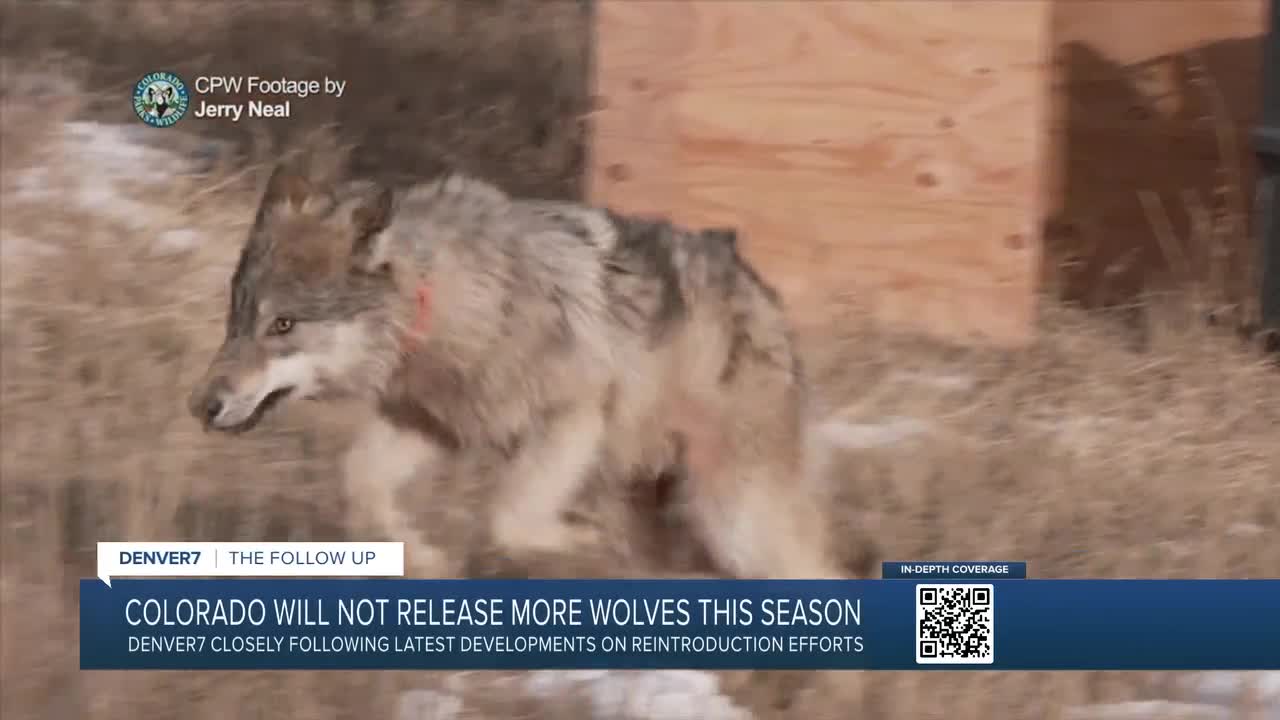


DENVER — A third round of gray wolves expected to be reintroduced into the state this winter won’t be coming to Colorado after all, state wildlife officials announced Wednesday — a move that could hamper the agency’s goal of achieving a self-sustaining wolf population in the long term.
The announcement from Colorado Parks and Wildlife (CPW) comes a month after the federal government sent a letter to CPW, in which they said the U.S. Fish and Wildlife Service (USFWS) would take over Colorado’s wolf reintroduction program unless the state addressed what the feds described as “compliance issues.”
CPW officials told Denver7 Thursday they had cooperated with that request.
Luke Perkins, a spokesman for the agency, said the decision to halt reintroduction for the remainder of the season came after Colorado struggled to find other sources to secure enough wolves for the season.
Under a previous agreement between CPW and the Biden administration, Colorado would secure 10-15 wolves from Canada each winter for reintroduction. But USFWS officials under the Trump administration told Colorado in October to stop reintroducing from wolves from Canada and instead rely on northern Rocky Mountain states for the reintroduction effort.
Most of those states — including the Yellowstone region states of Idaho, Montana and Wyoming, where wolves from Canada were reintroduced in the 1990s — have said they don't want to be part of Colorado's reintroduction. That left Colorado in a bind for the remainder of this season.
Laura Clellan, the CPW’s acting director, said in a statement her agency will continue to meet with producers and other stakeholders, including the USFWS, to “explore how to maximize the restoration effort” next winter while protecting both livestock and wolves.
In the meantime, state wildlife officials said they would continue working with producers to implement tactics outlined in the Wolf-Livestock Conflict Minimization Program Guide while building on what they described as “significant conflict mitigation milestones this year.”
The now-canceled reintroduction this month was destined for southwestern Colorado, where cattle ranchers there spoke to Denver7 last fall about their concerns with bringing the predators into their lands.
- Hear directly from two cattle ranchers in Gunnison County about what the wolf reintroduction program would mean for their livelihood in the video player below:
Though CPW has confirmed successful reproduction in four wolf packs over the summer, an estimate of the number of new pups has not yet been confirmed, officials said Wednesday. That, coupled with the current wolf population’s fatality rate of about 50% since they were reintroduced starting in 2023, could increase “the risk of failing to achieve a self-sustaining wolf population in Colorado,” CPW Wolf Program Manager Eric Odell said Wednesday.
Agency officials said they would continue making all management decisions on a case-by-case basis after evaluating circumstances, the state’s wolf restoration and management plan, and relevant law.
“This is a complicated effort and I want to encourage all stakeholders to continue to work together as we move toward the goal of creating a self-sustaining population of wolves in the state, while at the same time minimizing conflict with livestock,” said CPW acting director Clellan.
Rob Edward, the president of the Rocky Mountain Wolf Project, a nonprofit dedicated to the restoration of gray wolves in the Rocky Mountain West, told Denver7 via email the decision means the USFWS "has gone back on their commitment to Colorado and their legal obligation to the Endangered Species Act."
"Given we cannot bring more wolves in this season, it means that every wolf on the ground is doubly valuable," he said. "Colorado Parks & Wildlife will need to redouble their efforts to prevent conflict between wolves and livestock, and go hard on investigating any illegally caused wolf deaths."
In a statement, a spokesperson for the Colorado Cattlemen's Association said the decision by CPW was "a constructive step that reflects the need for the state to pause and address the ongoing concerns raised by livestock producers and rural communities."
“A pause in releases must not mean a pause in action,” said Curt Russell, president of the Colorado Cattlemen’s Association. “Producers are living with wolves today, and effective management tools, compensation, and responsiveness from the state are critical during this period.”
Denver7 has been following Colorado's wolf reintroduction program since the very beginning, and you can explore all of that reporting in the timeline below. The timeline starts with our most recent story.
Editor's Note: Denver7 is no longer updating this list, and the final change was made on Aug. 31, 2026.
Denver7 in-depth wolf coverage
The below list outlines an overview of the known wolf population in Colorado:
- Four wolves surviving from the original 10 that were released in December 2023 (one died of a likely mountain lion attack, a second died from injuries sustained prior to his capture as part of the Copper Creek Pack relocation effort, a third wolf became sickly and died, a fourth died in Wyoming, a fifth died during a re-collaring operation in February 2026, and a sixth died in northwest Colorado the following month)
- Three wolves surviving of the five wolf pups born in the spring of 2024 (one male was killed by CPW after multiple depredations in Pitkin County and a second male was shot for the same reasons in September 2025, which it survived, and again in June, when it was killed)
- Eight wolves surviving from the 15 that were released in January 2025 (one was shot and killed by Wildlife Services in Wyoming, a second died of unknown causes in Wyoming, a third died in Rocky Mountain National Park, a fourth died in northwest Colorado, the fifth died in northwest Colorado after it was likely hit by a car, a sixth died in southwestern Colorado, and a seventh died in northwest Colorado)
- At least 14 pups born in four packs in 2025: Two in the Copper Creek Pack, four in the King Mountain Pack, five in the One Ear Pack and three in the Three Creeks Pack
- One of the pups born into the One Ear Pack was lethally removed by CPW on Aug. 4, 2026 after multiple depredations on calves in Jackson and Grand counties
- Two wolves that moved south from Wyoming several years ago have been collared and are now members of the One Ear Pack


Denver7 is committed to making a difference in our community by standing up for what's right, listening, lending a helping hand and following through on promises. See that work in action, in the videos above.