



DENVER — A new map shows more gray wolf activity along the Front Range than previous records, with at least one animal — if not more — exploring central Boulder County and northern Jefferson County.
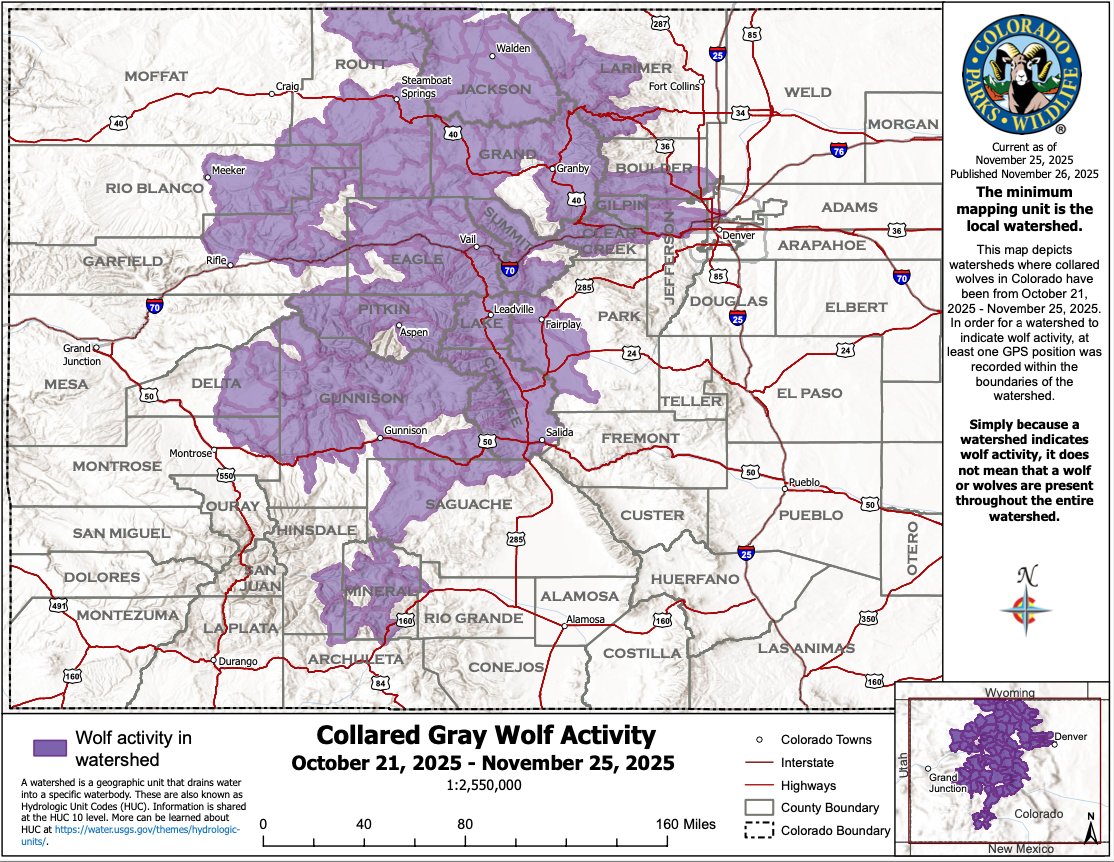
According to the latest wolf movement map released by Colorado Parks and Wildlife on Wednesday afternoon, the wolves have been moving around the watersheds northwest of the Denver metro area up toward Boulder and appear closer than ever to the Front Range.
The below map shows watersheds outlined in purple. If it is filled in, it means that at least one collared wolf was within the boundaries for some amount of time between Oct. 21 and Nov. 25. It does not indicate that the wolves are still there.
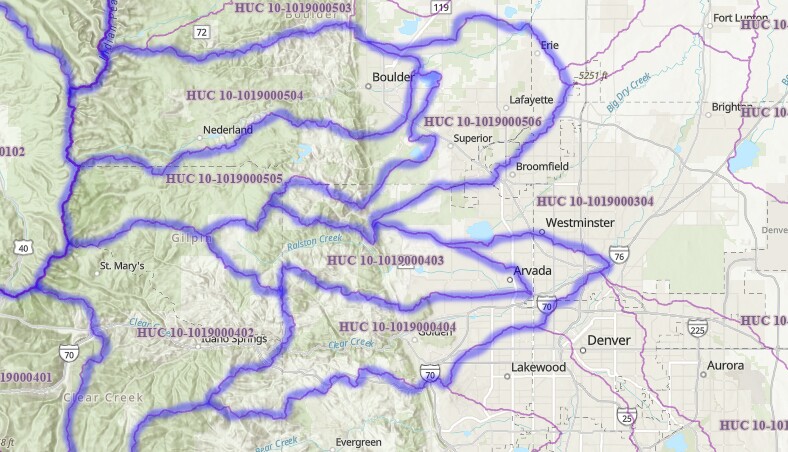
Denver7 zoomed in on the area around the metro to show the watersheds that wolves have entered. However, the watershed boundaries have thick outlines in the above map, so to clear up the lines, Denver7 compared CPW's map to a USGS watershed map, and drew blue lines around the watersheds that had seen a wolf or wolves in the past month.
Since the May 2023 approval of the Colorado Wolf Restoration and Management Plan, CPW has said that wolves are expected to expand widely over the years, including to the Front Range.
Two previously released wolf movement maps also revealed wolves nearing the Front Range — March-April 2025 and May-June 2025 — however the animals did not appear to be exploring the region as heavily during those times compared to Wednesday's new map.

In addition, wolves were detected near tribal lands in Colorado, CPW said on Wednesday. CPW has a memorandum of understanding with the Southern Ute Indian Tribe, the agency said, and it addresses the potential impacts of the wolf reintroduction program on the reservation and Brunot Treaty Area in southwest Colorado.
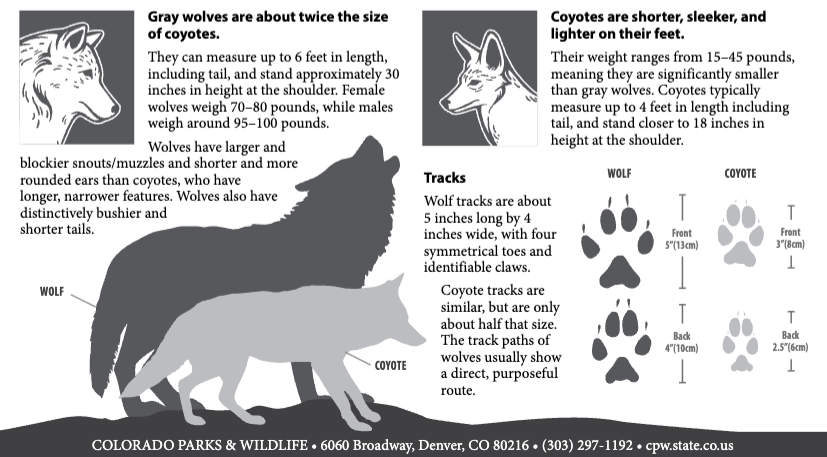
CPW encourages anybody who has seen a wolf to alert CPW through a form on its website here. It said photos and videos are helpful, and if you are recording a paw print, place an item next to it for size comparison. Coyotes are often mistaken as gray wolves, but the latter are about twice the size and have much larger paw prints — typically 5-inch-long front paws and 4-inch-long back paws.
CPW is planning a third round of gray wolf reintroductions in January 2026.

Environment
Gunnison County ranchers bracing for planned 2026 gray wolf reintroduction
Denver7 has been following Colorado's wolf reintroduction program since the very beginning, and you can explore all of that reporting in the timeline below. The timeline starts with our most recent story.
Editor's Note: Denver7 is no longer updating this list, and the final change was made on Aug. 31, 2026.
Denver7 in-depth wolf coverage
The below list outlines an overview of the known wolf population in Colorado:
- Four wolves surviving from the original 10 that were released in December 2023 (one died of a likely mountain lion attack, a second died from injuries sustained prior to his capture as part of the Copper Creek Pack relocation effort, a third wolf became sickly and died, a fourth died in Wyoming, a fifth died during a re-collaring operation in February 2026, and a sixth died in northwest Colorado the following month)
- Three wolves surviving of the five wolf pups born in the spring of 2024 (one male was killed by CPW after multiple depredations in Pitkin County and a second male was shot for the same reasons in September 2025, which it survived, and again in June, when it was killed)
- Eight wolves surviving from the 15 that were released in January 2025 (one was shot and killed by Wildlife Services in Wyoming, a second died of unknown causes in Wyoming, a third died in Rocky Mountain National Park, a fourth died in northwest Colorado, the fifth died in northwest Colorado after it was likely hit by a car, a sixth died in southwestern Colorado, and a seventh died in northwest Colorado)
- At least 14 pups born in four packs in 2025: Two in the Copper Creek Pack, four in the King Mountain Pack, five in the One Ear Pack and three in the Three Creeks Pack
- One of the pups born into the One Ear Pack was lethally removed by CPW on Aug. 4, 2026 after multiple depredations on calves in Jackson and Grand counties
- Two wolves that moved south from Wyoming several years ago have been collared and are now members of the One Ear Pack
