

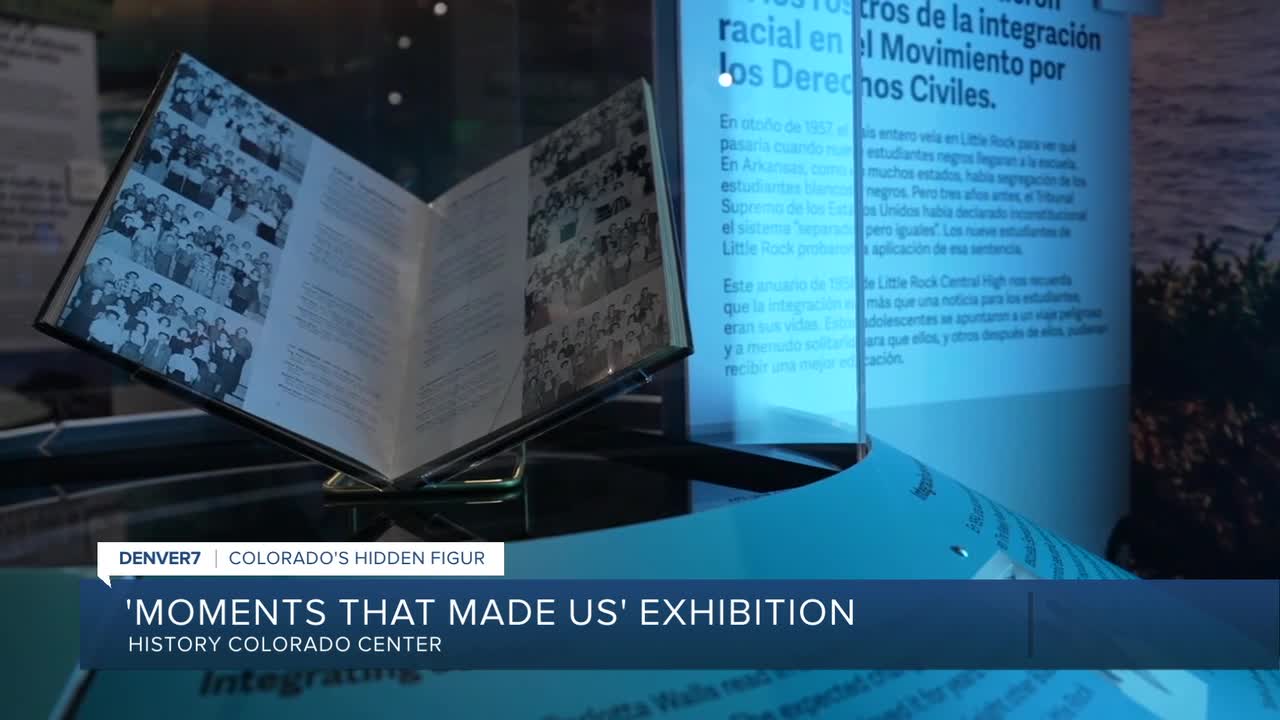


DENVER — History Colorado’s America 250 Moments that Made Us Exhibition, featuring 50 artifacts that witnessed significant moments in United States history, includes a display honoring the Little Rock Nine and member Carlotta Walls LaNier, who lives in Colorado and was the youngest member.
The Little Rock Nine were a group of Black students in Little Rock, Arkansas, who were some of the first Black students to desegregate an all-white high school in the United States.
“It's a significant moment in national history for a number of reasons. The Brown vs. Board of Education decision from the Supreme Court had come in 1954 but it, of course, it takes a while for Supreme Court decisions to always affect how we live our lives daily as Americans throughout the country. What happened in Little Rock became so prominent in our story, in part because of the role of national news and media and the fact that this was a very visible event for the entire nation,” said Dr. Gwen Lockman, History Colorado senior exhibition developer and historian. "This wasn't something that the city of Little Rock experienced on its own. This became a very national moment. These nine students, the Little Rock Nine, were integrating a very new, very well-resourced school that had been only open to white students until that 1957-1958 school year."
Lockman said that of the 118 Black students who signed up to attend Little Rock Central High School, just nine were selected to enroll.

Black History Month
The Little Rock Nine's Carlotta Walls LaNier shares her story of resilience
“Little Rock, of course, and Arkansas, being in the American South, being very much a charged space when it came to segregation, and it was pretty well known in the community that this was going to be a real challenge for these students. They were not only risking what would become their high school experience, but also the safety of their families,” Lockman said.
LaNier’s story is featured prominently in the exhibition.
“Carlotta is featured in a couple of different ways. I'll start with an object that's really central to how we've organized this exhibition. We were able to work with the Little Rock Central High School National Historic Site through the National Park Service to get this yearbook from the 1958 school year. So this would have been the spring of Carlotta’s sophomore year, and we decided to open the yearbook to her homeroom photograph page,” Lockman said. “Carlotta was alone in her class, as all of the Little Rock Nine were separated into different classrooms that the predominant makeup of the school was still white students. She's the only Black student who appears out of these eight classrooms.”


LaNier said she is honored to be featured in the exhibit.
“Well, I'm very pleased when I see the civil rights history being seen by everyone, and that is one of the reasons I gave my memorabilia to the National Museum of African American History and Culture. My dress and my report card and my diploma is housed there and exhibited there for our kids, Black, white, brown, yellow, whatever, to understand what took place in in this civil rights era. It is very important to me to be, I guess, identified by the Little Rock Nine, and what we accomplished is actually great. It really is because hopefully they will understand why they sit in a classroom with other kids that don't look like them because we were successful at that time,” LaNier said.
Lanier is also sharing her own story. She recently published a children’s book called "Carlotta's Special Dress: How a Walk to School Changed Civil Rights History."

