



DENVER — Over the years, Denver7 has listened to countless families who have lost loved ones on Colorado roads and believe the penalties for vehicular homicide and other related charges are too lenient.
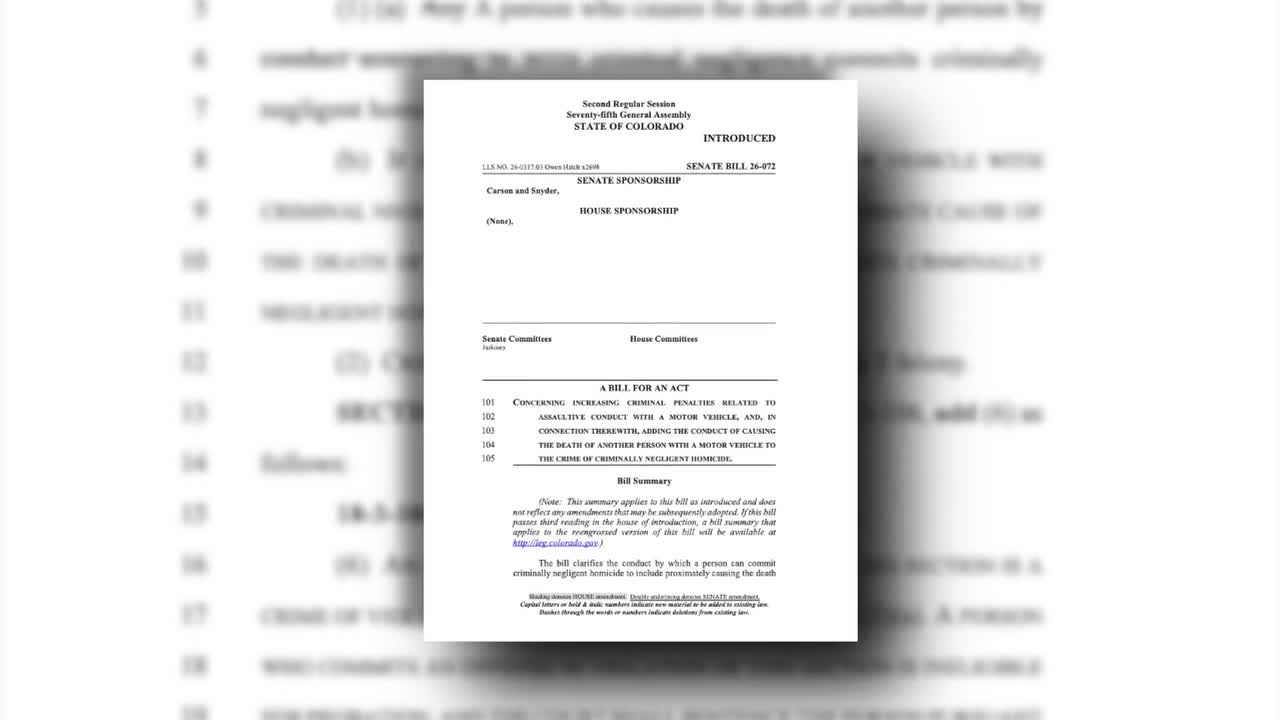
On Monday, state lawmakers voted unanimously to advance a bill that would give district attorneys the option to charge negligent drivers who kill someone with a Class 5 felony — a step above the misdemeanor charge of careless driving resulting in death, and a step below vehicular homicide.
Supporters argued Senate Bill 26-072 will fill a gap in Colorado law, where district attorneys must choose between a Class 1 misdemeanor or Class 4 felony in certain cases. The bipartisan bill also removes language from state statute that automatically classifies a crime where a driver hits and kills another person, while at the same time using a cell phone, as a Class 1 misdemeanor.
According to the bill language, such an offense committed while a driver is using their cell phone would be considered criminally negligent homicide, meaning it could be punished as a Class 5 felony.
► Watch Colette Bordelon's report in the player below:
But, the original proposal went even further — attempting to categorize vehicular homicide and assault as crimes of violence — an idea that was stripped from the legislation with an amendment made on Monday. The change eliminated a hefty, multi-million dollar fiscal note that prime sponsors called a "bridge too far this year," as lawmakers work within a staggering budget deficit in Colorado.
“This is not an amendment that we particularly want to offer. We’d prefer not to offer it," State Sen. John Carson, R — District 30, told the Senate Judiciary Committee.
Carson's co-prime sponsor, State Sen. Marc Snyder, D — District 12, told the committee it is with "no sense of joy" that they cut the crime of violence portion out of the legislation. Still, the sponsors said the bill is a step in the right direction, and families who deeply understand the impact of such a change agree — even if they believe there is more work that needs to be done.

Jill and Michael White have been to the Colorado State Capitol a number of times this year already, advocating for vulnerable road users in honor of their son, 17-year-old Magnus White.
“He had this type of magnetic personality that couldn't help but draw people into him," Michael White said. “He made everything, every mundane thing, just fun and memorable.”
Their son was an acclaimed cyclist who had already made a name for himself when he was hit and killed by a driver while on a training ride in Boulder County in the summer of 2023. The driver, Yeva Smilianska, was convicted of vehicular homicide and sentenced to four years in prison in 2025 after admitting to passing out behind the wheel.
The Whites have told their story to the Senate Judiciary Committee before when testifying in support of Magnus' Law, which is currently under consideration in the Colorado House of Representatives. That piece of legislation is about what did — or did not — happen at the crash scene. SB26-072 is about what happened afterwards in the criminal justice system.
“We've been here a lot. For some reason this bill, testifying on this bill, for me personally, has been the hardest," Jill White told Denver7. “It's reliving what happened to Magnus. It's the violence of what happened. How he was killed."

In Nov. of 2025, the Whites received a notice from the Colorado Department of Corrections (DOC) informing them that just months into Smilianska's four-year prison sentence, she was being considered for placement in a halfway house — a residential facility where inmates are transferred before being fully released into their communities.
It's standard protocol under Colorado law, which states offenders who were not convicted of a violent crime can be placed at a Community Corrections center 16 months prior to their parole eligibility date. If vehicular homicide were classified as a violent crime, that timeline drops to six months before a parole eligibility date.
“The state, this nation, we have to start treating these crimes with the gravity of what was lost," said Michael.
That sentiment was repeated by a number of other people who testified on Monday, who do not believe the punishment in Colorado fits the impact of such crimes.
One of the individuals who testified was Josh Stewart, the father of 13-year-old Liam Stewart, who was hit and killed by a driver while riding his bicycle to school on October 17, 2023. Liam Stewart was only minutes away from Euclid Middle School when he was struck in a roundabout.
The woman who killed Liam Stewart took a plea deal and was sentenced to two years of probation in April of 2024.
Josh Stewart told lawmakers there must be a place for justice, even in forgiveness. He continued to say that for his family, "Liam's death is forever, and for an offender so is a felony."
Originally, the Colorado Criminal Defense Bar was the only organization registered in an opposing position to this bill, but they changed their stance to neutral after the amendment made on Monday.
SB26-072 heads to the Committee of the Whole for consideration next.



Denver7 is committed to making a difference in our community by standing up for what's right, listening, lending a helping hand and following through on promises. See that work in action, in the videos above.


