




DENVER – As voices grow demanding the City of Denver rethink its decision to scrap the original plan to fix Alameda Avenue — one of Denver’s High Injury Network (HIN) corridors — the controversial topic will again take center stage Wednesday.
Executive Director Amy Ford, who leads Denver’s Department of Transportation and Infrastructure (DOTI), will face skeptical councilmembers who, just days ago, sent her and Denver Mayor Mike Johnston a letter questioning the sudden change to a partial lane reduction plan from the full lane proposal.
“We are writing to express our grave concern about recent changes to the scope and detail of the Alameda Lane Repurposing Project,” began the pointed letter which was signed by eight council members (six district and two at-large), adding, “We strenuously oppose these changes because they walk back desperately needed safety measures.”

Council members questioned not only the city's motives in making the change, but the wisdom of spending money to do it in an already-challenged budget environment, arguing it happened “without any community involvement at all after intervention begun by a high-profile Denver resident and her paid lobbyist,” according to the letter.
They’re referencing Jill Anschutz, who this summer through her group Act for Alameda, began pushing back on the full lane plan through letters and meetings with city leadership to successfully get the plan changed.
Anschutz in June wrote to DOTI Director Ford expressing concern about the Alameda Lane Repurposing plan.
She wrote that she had not heard of the plan, that she talked to “dozens of residents in this area and not a single person is aware of the plans.” She feared reducing lanes on Alameda Avenue would increase dangers on adjacent neighborhood streets.
That happened after notices were already posted in April in the Alameda neighborhood announcing summer construction was set to begin on the full lane repurposing plan.
In September, Anschutz told Denver7:
"We think that if you make congestion a lot worse, you frustrate drivers and you force them into these neighborhood streets that are narrow and are highly used by kids and pedestrians, and that's what we mean by we think you're just going to create new safety issues rather than really completely resolving the concerns,”
The original Alameda Lane Repurposing plan would have reworked the four-lane road to two lanes with a dedicated center turn lane along with buffer space between the street and curb.
This was to counter the danger for any driver on Alameda attempting to turn left across 2 lanes of oncoming traffic. It’s a danger highlighted in the council’s letter.
“Residents have been fighting diligently for safety protections on Alameda for over a decade. They report flipped cars, drivers plowing into houses. and children being hit on their way home from school,” the letter read.

The new, partial lane repurposing design includes some of the elements of the original plan.
It would rework a westbound lane to create a center turn lane while maintaining the current configuration of the two eastbound lanes.
It was an abrupt change announced to the public in a press release in November of last year titled: “DOTI listens, responds to community input…”
“Providing left turn lane pockets on this stretch is anticipated to reduce vehicle crashes. Vehicle volumes on Alameda Ave. are lower westbound compared to eastbound, so the potential for congestion and traffic diversion is lower with the lane repurposing in the westbound direction, while the addition of turn lane pockets will increase safety,” wrote DOTI in the news release.
DOTI said keeping the two eastbound lanes would “reduce the potential for congestion eastbound and diversion to the side streets.”
But with the majority of council members adding their names to the list supporting the original full lane repurposing plan, including Councilmembers Kashmann (District 6) and Alvidrez (District 7) who both represent the Alameda corridor, the question arises: How will DOTI stand by its decision to go with a partial lane reduction plan if the majority of voices in the public debate seem to demand otherwise?
Additionally, advocates are calling into question how DOTI can be certain that the partial Alameda lane repurposing plan is as effective in reducing crashes as they surfaced internal emails through CORA requests, which they argue show DOTI scaled back its safety analysis of the partial lane repurposing plan.
It’s a claim that DOTI's Ford denies.

Denver7 Traffic
Whatever happens with Alameda, advocates say public trust in DOTI needs repairs
Transportation advocate David Mintzer in an email to city council members cited internal DOTI emails and documents to contractor Kimley-Horn that he said appeared to “drop the full safety analysis” of the partial lane reduction plan.
“DOTI's directive to drop the full safety analysis was well-documented in their own emails,” wrote Mintzer, referencing a line from a city engineer’s September 19 email to the contractor to “remove all data collection and majority traffic safety analysis and evaluation.”
Mintzer also pointed to an amended project agreement from the city to Kimley-Horn, which stated:
“Kimley-Horn will utilize the previously developed Synchro model without any re-calibration to re-evaluate the alternative identified in the Project Understanding. The analysis will consider delays along the corridor only. The analysis will not consider anticipated traffic diversion, queuing, individual intersection spot treatments/interventions, Virginia Ave & Downing St, crash and safety analysis, or impacts to the project corridor/intersections/adjacent facilities.”
The council’s letter to Ford reinforced the allegation.
“Open records act requests filed by members of the public show that in developing new plans, DOTI instructed its traffic engineer not to reanalyze risks to pedestrians or crash risks, but only to focus on reducing any delay to drivers — directly prioritizing the ability for cars to move more quickly rather than slowing traffic to protect lives and property,” the letter reads.
AT NO POINT (all caps in Ford’s letter) had “DOTI instructed its traffic engineer not to reanalyze risks to pedestrians or crash risks, but only to focus on reducing any delay to drivers — directly prioritizing the ability for cars to move more quickly rather than slowing traffic to protect lives and property.” As noted, DOTI continued a safety analysis of the impact on the partial lane reduction (information shared in the links) as well as a safety review of the diversion of traffic along neighborhood streets.”
In addition, Ford responded back to council to “clarify some of the inaccuracies cited in your letter and reinforce our intent to continue public engagement and safety review as we progress the design of the project,” she wrote. “The current partial lane reduction design was made with care and deliberation. Under no circumstances was it intended to compromise safety, but rather to take a comprehensive look at the entire project’s impacts on the neighborhood as well as on the Alameda corridor."
Ford continued: “We recognize the strong public interest in this project, with hundreds of people in our community expressing both support and concern about the design and its implications. We felt it important to continue to engage the public given the robust feedback and evaluate the approach to achieving our safety goals.”
You can read both the council’s and Director Ford’s full letters below.
COUNCIL LETTER TO FORD, JOHNSTON
DOTI DIRECTOR FORD’S RESPONSE TO COUNCIL
Denver7 on Tuesday reached out to DOTI for additional response to the concerns cited in the council's letter and allegations from advocates about dropped safety analysis.
Spokesperson Nancy Kuhn wrote in full:
“In proposing the alternative design for that stretch of Alameda, we used the previous safety analysis, and then conducted work internally, bringing that in-house, reducing the scope for the contractor to have them provide the support we needed for the design considerations.
Both alternatives proposed for Alameda looked at historic crash data and how each design might prevent those same crashes from happening in the future.
Before we made a decision to go with the alternative design, we went a step further than we’d gone before – doing work to analyze the impacts of vehicle diversion to the side streets.
In doing that additional analysis, we learned we had a crash picture happening at Virginia and Downing that could be exacerbated by diversion. We are now proposing safety improvements at Virginia and Downing, too, to address what we see happening there. The plan is to provide bulb outs to reduce pedestrian crossing distances and add protected left turns with green arrows that reduce the potential for conflicts between cars and with pedestrians.
In addition, we’ve committed to doing additional safety analysis as we bring the design for the partial lane purposing option forward. We’re exploring what that additional safety analysis will look like.”
Denver7 has previously reported on the timeline and controversy on how the original plan changed. You can read deeper in this story.

Denver7 Traffic
Neighbors continue protesting Denver’s change to Alameda safety project
As Ford prepares to face council on Wednesday, she already has faced vocal critics over the last few months following the change of plans.
Amy Kenreich, a Denver crossing guard and pedestrian advocate who lives in the area and has represented West Wash Park, has been an outspoken voice in favor of the full lane plan.
She told Denver7 that DOTI: “Refuses to conduct a true safety analysis that explains how keeping 4 lanes of traffic on Alameda Ave in any way improves safety. The original plan -- one lane each direction -- improves the safety and efficiency of the corridor, helping to reduce driver speed with "the pace car effect."
Kenreich continued: “I hope the public sees clearly what happened here. The administration is trying to distract from the real reason Alameda was changed behind the community’s back. The mayor denies involvement, but CORA documents show his legal counsel forwarded the Anschutz email within ten minutes of receiving it in July 2025.”

She is referencing a July 31 email from Anschutz to Mayor Johnston “on behalf of 300 concerned residents and business owners along the Alameda corridor” expressing “serious concerns about the proposed changes to Alameda Avenue…”
Denver7 reached out to Mayor Johnston’s office to ask about the council's letter which urged him and DOTI to “reconsider these changes and immediately begin construction on the originally adopted, well-vetted, and shovel-ready Alameda Corridor Safety Plan."
Spokesperson Jon Ewing responded back: “Mayor Johnston was not involved in discussions regarding the Alameda project. However, we are supportive of DOTI’s efforts to better protect pedestrians, cyclists, and drivers on Alameda without the unintentional effect of new and significant safety issues on side streets.”
Ewing wrote: “Lost in this conversation is that this is a compromise in the truest sense of the word. It satisfies requests on both sides without giving either side entirely what they asked for. DOTI has explained its reasoning in exacting detail, and we are confident this direction is in the city’s best interest.”
Denver7 also asked if the mayor’s office could provide transparency to the public on what happened in the November 6 meeting referenced in the council letter between DOTI officials and a representative from Johnston's team.
Here’s what the council letter stated:
“Not coincidentally, during this time, “Act for Alameda ", a newly formed group led by Jill Anschutz, was lobbying DOTI and the Mayor’s office to cancel the planned improvements. The Denver Gazette recently reported that a November 6, 2025 meeting “with DOTI officials and a representative from Mayor Mike Johnston’s office yielded substantial changes in what had been a plan to cut the flow of traffic from four lanes to two.””
Ewing replied:
“The assertion that the Nov. 6 meetings played a role in the Alameda design is untrue. Those meetings, one of which was held with the Act for Alameda organization and one of which was held with West Washington Park, were held to explain the decision DOTI had already come to regarding the design. The decision had been made before either party walked in the door.”
In Ford’s written reply to council, she added about the Nov. 6 meetings:
“DOTI held one 30 minute meeting with the Act for Alameda organization represented by Jill Anschutz AND one 30 minute meeting with West Washington Park represented by Amy Kenreich to explain the analysis and the evaluation of the design. DOTI also communicated directly with Councilmembers Kashmann and Alvidrez’ offices and the information was shared with the public the next day. DOTI has since joined public meetings with neighborhood associations and others to discuss the project.”
Ewing ended:
“Finally, I would push back on the suggestion the loudest voice is the most representative of public feedback. Our job is to find a solution that increases safety without creating more problems than we solve. We trust DOTI’s expertise in this process.”

DENVER TRAFFIC: THE BIG PICTURE
All of the twists and turns of the Alameda debate are happening in the broader context of how Denver is doing in its overall approach to reaching its Vision Zero goals.
As the calendar flipped to 2026, Denver just saw its highest traffic fatality number in years, reporting 93 deaths in 2025, according to the city’s Vision Zero dashboard.
That means Denver has only four years to find solutions to reverse the trend if it hopes to attain zero traffic deaths by 2030.
Those solutions will need to address not only infrastructure needs but other stressors like growth, changing vehicle design and the roles technology and human behavior play in the dangers on Denver’s roads.
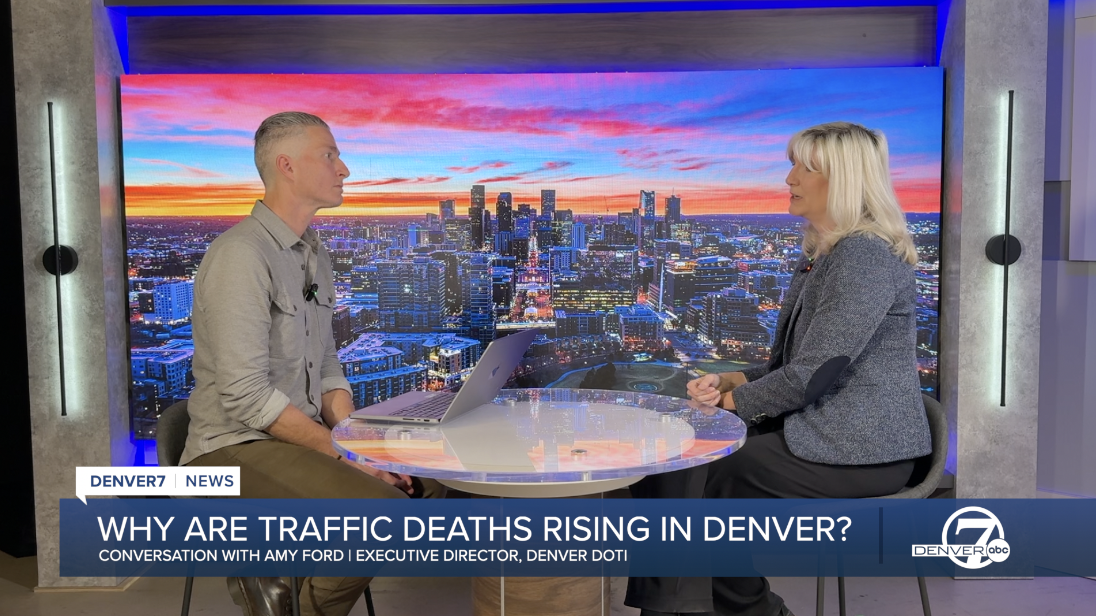
These are topics and questions Denver7 recently pressed Director Ford on during an almost two-hour conversation spanning traffic deaths, Vision Zero, trust with advocates, and the future of Alameda.
In the sections below, you can read portions of the Q&A and Denver7 will also post videos of the questions and Ford’s full answers from our Dec. 30 interview.
Denver7 in this infographic is tracking the city's Vision Zero goals. Advance the slide to view the vulnerable road user trends.
HOW DOTI VIEWS SAFETY ON BOTH ALAMEDA PLANS
Q: From a data perspective, how can you ensure Denverites that the partial lane plan is safe — as safe as the full lane repurposing?
A: “When you do sort of the planning, you look at the current condition, then you make a plan that compares against that current condition. And when we were doing the initial analysis of the plan, we ran both — we ran both the full and the partial — and we looked at it, and we looked at all of the impacts and the tradeoffs,” said Ford.
“The primary crash reduction goals of this project were about vehicle crashes. So, how do you reduce vehicle crashes? You create the opportunity for left-hand turns, so you get people out of the main lane of traffic and into the left-hand turn lanes. And both projects do that – that is where the crash reduction stays virtually the same,” said Ford, who added, “And that change from a crash reduction factor was about five-ish percent.”
▶️ Watch the full conversation in the video player below.
Advocates like Kenreich have argued the volume of traffic on Alameda runs under 25,000 vehicles per day which they say “makes it a perfect candidate for a 4-3 conversion” via the U.S. Department of Transportation which touts the safety benefits.
FOR AND AGAINST THE FULL LANE DESIGN: WHO ARE THE VOICES?
I received an email from a Denver7 viewer asking that we lay out the different voices in the Alameda debate.
Chester C. wrote to us: “I don't think I've seen a single news article that pulls together all the pieces of support there is for the original 3 lane design for Alameda lane repurposing. I think it would be great to see an article that includes all of the pieces, so that the public can more easily understand how unanimous the support is.”

The public debate hasn’t been unanimous. Starting last summer, Act for Alameda along with Jill Anschutz, delivered a petition signed by over 300 people asking the city to change the plan.
But it does appear more voices have come out in support of the full lane design including the West Wash Park Neighborhood Association — representing 17,000 residents — which was recently followed by the East Wash Park Neighborhood Association. The group Safe Alameda was formed and a petition was signed by more than 1,000 Denverites supporting the original plan.
Also supporting the full lane repurposing design is the majority of the Denver City Council and DOTI’s own Advisory Board.
One of the central questions raised by critics is whether DOTI listened to the broader community when it changed course.
During our interview, Denver7 asked Ford how the DOTI reconciles its “listening and responding” messaging with the fact that many of the most organized voices support the original plan.
Q: "Isn't the community in this moment saying, ‘We want the full lane plan to go back to what it was?’”
A: “As we went through the process over the summer, obviously, several hundred people were weighing in — people who live in the community, who are directly on Alameda, people who live a couple blocks off, people who commute the corridor, people who ride buses on the corridor, people who walk the corridor, from all perspectives,” said Ford.
She continued: “We took all of that input and feedback. We took the petitions that people signed, both the ones that were done over the summer, the ones that were then done post-our decision. Both of those petitions had information that was not all fully accurate. Both of them.”
Ford added, “Design isn't necessarily also, you know, a process where the people with the highest votes wins or the other votes doesn't. If that were the case, frankly, we'd have very few bike lanes built in Denver.”
▶️ Watch Ford's full answer in the video player below.
Denver7 also asked what would change DOTI’s mind on Alameda? As the city presses forward on solutions to make Alameda Avenue safer, some advocates continue to push for the reinstatement of the original full lane repurposing plan.
▶️ We asked Director Ford if there was anything that could change the plan.
FORD ON 93 TRAFFIC DEATHS IN DENVER IN 2025
(The interview was recorded on December 30, 2025 and before the city’s Vision Zero dashboard reflected a full year’s worth of data.)
“So this year (2025) we've hit close to 90,” Ford said. “Of the fatalities on our roadway, pedestrian fatalities went up. One area that it specifically went up in was deaths on interstates.”
Ford called the increase unusual, noting there were eight pedestrian deaths on interstates in 2025, compared to one or two in most previous years.
In total, 35 pedestrians died in Denver in 2025, which is up 34% from the 27 reported killed in 2024.
In 2025, eight people died riding a scooter in Denver, which is the highest number since that category was added to the report.
“We look at every single crash and every single fatality that happens,” said Ford. “We have a team of engineers and others who go in and look and say, ‘What could be done that would have solved for that fatality, or that we could fix, or we could change that would have changed that outcome?’ We then go in and try to make improvements in those areas.”
▶️ In the video player below, Watch Ford’s full response to Denver’s traffic fatality trends and what more needs to be done.
While Denver’s Vision Zero dashboard notes a decrease in serious bodily injury crashes — down 13% in 2025 from 2024 — Ford acknowledged traffic deaths are moving in the opposite direction.
“Our numbers are going up,” she said, while adding that DOTI has launched targeted speed reduction programs and is preparing to roll out automated speed cameras in high-injury corridors.
Vision Zero calls for Denver to reduce traffic fatalities by 50% on its High Injury Network (HIN), which are roadways that account for 56% of all traffic deaths. Federal Boulevard, Colorado Boulevard and Alameda Avenue are on the list.
DOTI has pointed to early success from its SPEED Program on Federal Boulevard and Alameda Avenue, which focused on signal timing changes, pedestrian timing, and speed feedback signs.
“We’ve seen results that have actually driven down our crash rates and our serious bodily injury in both of those corridors by 20% in some areas,” Ford said.
She added that late-night crashes in particular dropped sharply.
“In fact, even overnight, upwards of 40% in like late-night crashes,” she said.
While Denver continues to see fatalities on Federal Boulevard, Ford said, “they were reduced to zero on the Alameda Corridor” during the period studied.
You can learn more about Denver's SPEED program and the changes drivers can expect, at this link.
▶️ In the video player below, watch Ford talk about how DOTI plans to expand the SPEED program and why it could be a solution to reduce crashes.
IF DENVER DOESN’T REACH ZERO TRAFFIC DEATHS BY 2030, WHAT WILL HAVE BEEN THE REASON?
With 2030 fast approaching — and traffic fatalities moving in the wrong direction — Denver7 asked DOTI Executive Director Amy Ford why the public should have confidence the city can still meet its Vision Zero goal, and what she believes would be the reason if it falls short.
Q: “We’re four years away, and it just doesn’t seem like it’s an attainable goal. If we don’t hit that goal — which it just doesn’t seem likely, looking at where we’re at today — what do you think are the reasons why we won’t hit that goal?”
In her response, Ford pointed to a combination of human behavior, the limits of existing infrastructure, and how quickly the city can fund and implement safety improvements.
▶️ Watch Ford’s full response in the video player below.
As Ford prepares to face council on Wednesday, the question remains: What will drivers face on Alameda Avenue in a year from now?
Will they have the option to enter a dedicated left turn lane on either side of the street? Or will the partial lane reduction plan be constructed?
Denver7 asked Ford what happens if the partial lane design doesn’t deliver results.
▶️ Her answer to that, in the video player below.
Is there a potential for a short term compromise before the construction starts? Last month, Denver7 shared the perspective of community voice Chris Nicholson, who sits on RTD’s Board of Directors. He offered an idea that could buy time to to give both sides of the Alameda debate a chance to better understand the two plans.
“If it were just up to me, I'd pick the original design but that’s because I don't drive and the original design is better for pedestrians. But it isn’t just up to me. The process intentionally cares a great deal about what the neighborhood and the broader community thinks. And DOTI needs to take the time to let people consider and weigh in on the two options side-by-side, rather than simply moving forward with the new proposal as a compromise,” said Nicholson. “Failure to give both plans equal public scrutiny will lead rightfully to distrust and the perception that city government has been rigged to benefit the rich. To be clear, I don't believe that’s the case here. I think DOTI staff are just doing their best to balance a ton of competing interests. But I get how it looks.”
Denver7 took RTD’s Chris Nicholson’s idea to pause before making a final decision to DOTI Director Ford.
▶️ Watch her response in the video player below.
Update: During a meeting of the Denver City Council's Transportation Committee meeting on Tuesday, Director Ford said DOTI would perform a "demonstration deployment" of either the full or partial lane plan. "We will do a temporary demonstration, deployments here over the next several months where we will then work and analyze and validate the data that we see," Ford told councilmembers. "We’re in the process of actually sitting and developing what we think the demonstration could be and what it could look like and actually want to reach out and engage with you all as we do that."
Ford said she wasn't sure if DOTI would test the full or partial lane plan on Alameda.
"We’re going to sit and work on it and we want to come back to you all and engage and talk about how we want to run that demo and whether we do it as the full first and then maybe the partial or we do the reverse," said Ford who added she wasn't sure if DOTI would "do it along the full length of the corridor" or perform the demonstration along a portion of Alameda Avenue.

As the debate rages, Denver7 asked Kenreich about her message to city leaders.
“If DOTI continues to ignore the clear majority of residents and safety experts calling for the original plan, I hope Denver voters remember whose voices this administration chose to prioritize — and whose safety it chose to compromise,” said Kenreich.
“Accountability starts with being honest about what went wrong,” she continued. “Denverites respect transparency more than perfection. The community understands that leaders can be shaken by outside pressure, but we cannot accept decisions that put people’s safety at risk or a refusal to correct them.”

As part of Denver7’s ongoing coverage of the city’s efforts to make our streets safer – and in an effort to better understand what’s working and what’s not – we asked three road safety advocates to answer 3 questions about potential solutions.
Alejandra Castañeda is Pedestrian Dignity advocate and 2026 Denver Bike Mayor.
Jill Locantore is Executive Director of Denver Streets Partnership which according to its website, envisions an “equitable and vibrant Denver where human dignity is the guiding principle for our transportation system and communities, with living, public spaces that allow everyone to thrive and connect to what matters most to them.”
Amy Kenreich is a Denver crossing guard and pedestrian advocate and supporter of the full lane Alameda repurposing plan.

Q: If Denver could change or implement just one thing right now to start reversing the rise in traffic deaths, including pedestrian fatalities, what should it be — and why?
Castañeda:
“I believe most street-safety advocates agree that speed and red-light cameras (automated enforcement) are the most cost-effective and quickest way to make a life-saving difference. If money was no issue, I’d love to see a redesign of deadly roads, like S Federal Blvd, and the standard implementation of raised/continuous pedestrian crossings. No more costly and ineffective Rectangular Rapid Flashing Beacons (RRFBs), which have been sold to Community as an effective road-safety intervention.”
Locantore:
“Fund and expedite substantial street design changes on major arterial streets, including the originally planned Alameda road diet, and repurposing general traffic lanes into dedicated bus lanes on Federal Blvd, Colorado Blvd, and other other priority transit corridors identified in Denver Moves Transit, most of which are also on the High Injury Network. These are the streets where the lion's share of traffic fatalities are happening, and the data is clear that making these streets safer means reducing the amount of space for cars and reallocating that space for people walking, taking transit, and biking.”
Kenreich:
“DOTI should lower speed limits and install speed humps on arterial streets. Cities like Cincinnati have done this and are already seeing real reductions in serious injuries and deaths. Speed is the single biggest factor in whether a crash is survivable, and this is a proven, immediate fix. DOTI should also follow their own policies listed on their homepage: prioritize safety in street design, realize mode shift, prioritizing people, and environmental sustainability.”

Q: What does DOTI need to do differently to rebuild trust with the community as it works toward Vision Zero?
Castañeda:
“Faithfully and consistently follow its own policies of Safety First, People Priority and Mode Shift, executing on existing plans that have received wide community support, like Denver Moves Everyone. Best practices are well known and used by city/state transportation and elected officials with the political will to achieve Vision Zero. We’re not reinventing the mythical wheel here.”
Locantore:
“Spend less time and money doing endless studies and community engagement before implementing street design changes. Move quickly to make the changes, then do community engagement and studies AFTER the changes are made, to ensure both real and perceived safety is improved, and continue to make tweaks to the design until this outcome is achieved.”
Kenreich:
“First, stop telling communities one thing and then doing another after plans are finalized. Second, stop prioritizing the convenience of the most powerful residents over the safety of everyday people who use our streets. And third, restore the Transportation and Mobility Special Revenue Fund to its original purpose, which would free roughly $15 million a year for Vision Zero, Safe Routes to School, and pedestrian, bike, and transit infrastructure. Finally, stop using the language of “balance” to justify last-minute reversals. Changing a finalized safety plan to appease powerful voices is not balance. It is a failure of leadership.”

Q: What do you think is the single biggest obstacle preventing Denver from reaching its Vision Zero goal?
Castañeda:
“Car culture and politicians who lack the courage to stand up to it.”
Locantore:
“Lack of political will, in the face of pushback from people who are more concerned about the convenience of driving than they are about safety.”
Kenreich:
“Denver has a lack of political will at the top. The mayor has cut Vision Zero funding, completely gutted the Safe Routes to School program and allowed safety projects to be rolled back. Time and again, safety is compromised for driver convenience, and Denver is paying for it with our lives”
To share your voice on the plans to make Alameda Avenue safer or on Denver’s overall approach to reduce traffic crashes as it aims to reach a vision of zero roadway deaths, use the form below to get in touch with Denver7.
You can also leave a voicemail message on our hotline by calling 303-832-0207.
You can also learn more about Denver7's On Two Wheels coverage which focuses on the dangers Colorado cyclists face and solutions to help make streets safer for vulnerable road users.
