



BOULDER — As cyclists rode through Valmont Bike Park on Thursday, they celebrated a change made to Colorado law that advocates believe will protect vulnerable road users across the state.
Gov. Jared Polis gave his seal of approval to Magnus' Law, named in honor of 17-year-old Magnus White, who was hit and killed by a driver in the summer of 2023 in Boulder County.
"Magnus, we did it," his father, Michael White, said in front of the crowd gathered at the bike park his son loved.
▶️ Watch: Denver7 Colette's Bordelon covers what the law's signing means to Magnus' family
The law, Senate Bill 26-132, mandates law enforcement offers voluntary breathalyzer tests to drivers involved in crashes where someone is seriously injured or killed.
"Evidence at a crash scene is the most fragile thing in the world. It exists for a moment, and then it is gone," Michael White said. "Alcohol and drugs leave the bloodstream, and if you do not capture the truth at the scene, you may never capture it at all, and families like ours may never know the real reason why their loved one is dead.”
It was a pitfall in the law, Michael said, that meant the driver who killed his son was never tested for possible intoxication at the scene of the crash.
“It took 20 months for the truth to come out in a courtroom. 20 months to find out why our son was dead," Michael White told the crowd. "The gaps in the system are responsible for the 20 months it took to find out — but one question at the scene could have told us that afternoon.”

Magnus White spent hundreds, if not thousands of hours, at Valmont Bike Park. His parents, Michael and Jill White, said the park felt fitting for his memorial service three years ago, and again this year for the law being signed in his name.
“I'm actually wearing the same suit that I wore to my son's memorial service," Michael White told Denver7. "So, getting dressed this morning was very emotional, very anxiety-inducing... Brought back a lot of that — even though we're here for more of a celebratory, full circle, something positive coming out of something so tragic — still brings back a lot.”
The driver who killed Magnus White, Yeva Smilianska, was convicted of vehicular homicide and sentenced to four years in prison in 2025 after admitting to passing out behind the wheel.
During the trial, the Whites were infuriated to learn Smilianska was never tested for drugs or alcohol at the crash scene.
“That was one of the immediate things that has to change. That's not okay," said Jill White.
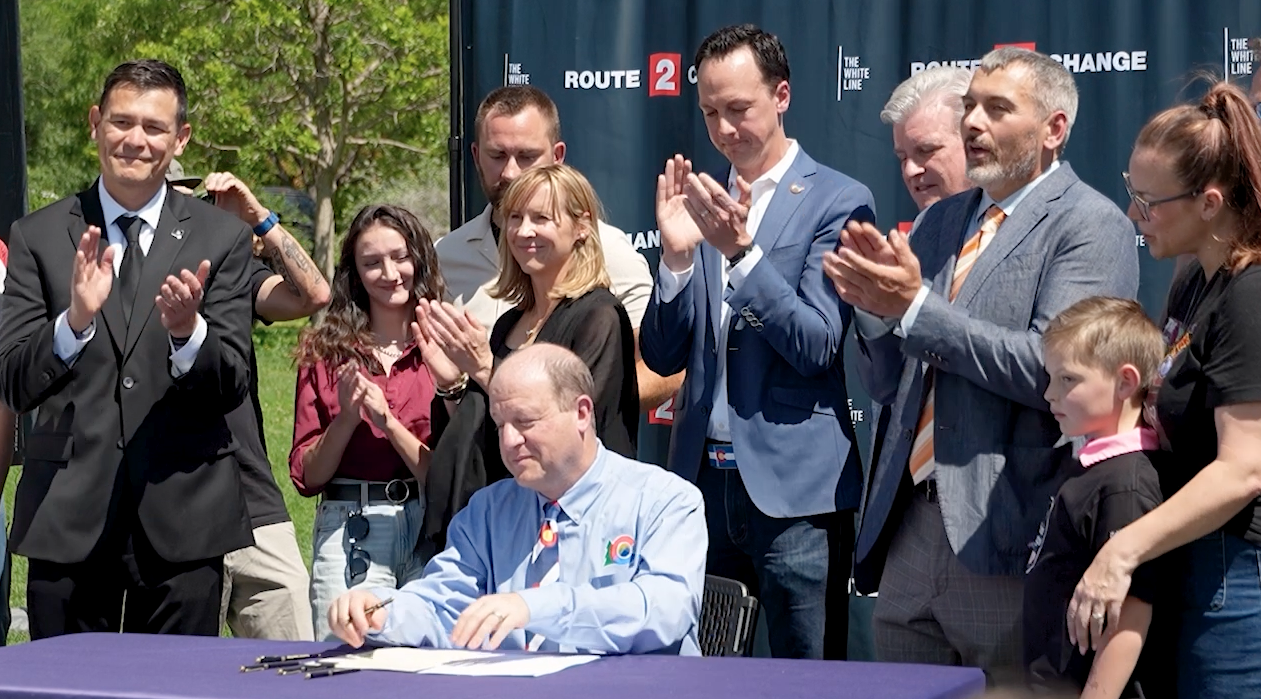
State Sen. Dylan Roberts, D — District 8, said this was one of the most challenging and fulfilling pieces of legislation of his career.
"I'm a former deputy district attorney myself, and I've worked with victims of tragedies, and I know how important it is to have as much evidence as possible from the scene of a crime," Roberts said. "Magnus didn't get to have that. Magnus, his parents, family and community didn't get to have that, but in his honor, we're making sure that no more in Colorado will that oversight happen at these terrible crash scenes.”
His co-sponsor in the Senate, State Sen. John Carson, R — District 30, referenced an incident from earlier this week when three pedestrians were hit by a driver in Highlands Ranch. Witnesses told investigators they believe the driver intentionally hit the pedestrians walking on a sidewalk, killing one and seriously injuring the other two.
Carson also advocated for increased penalties for such crimes in Colorado, something that Senate Bill 26-072 addressed at the state legislature this year. The legislation, which was signed into law by Polis last week, gives district attorneys the option to charge negligent drivers who kill someone with a Class 5 felony — a step above the misdemeanor charge of careless driving resulting in death, and a step below vehicular homicide.
“We need to raise the public confidence, and we need to make sure that penalties that are appropriate are delivered to the perpetrator," Carson said.
While the passage of Magnus' Law signifies a step forward for the Whites, they wish, more than anything, that they could just have their son back.
"Magnus was going to be turning 21, and now we're entering summer, so we would have been in summer race season, and we would have been planning trips around his race schedule," Jill White said. "What would we be doing now if we weren't doing this? And how much different that would feel, and how much more ordinary and mundane, and just how I miss the ordinary and mundane.”
"We would trade all of this to bring Magnus back, but we don't want his death to be meaningless, and so that's why we do this work," said Michael White. “You can't sit back and do nothing. If we did, we wouldn't survive this.”
SB26-132, a bipartisan bill, was one of a number of pieces of legislation the Whites worked on during the 2026 legislative session.
"Eight road safety bills that we led, co-led, or really strongly supported, that passed this year. Typically, two or three pass in the year. That's a big deal, and we hope we can continue that momentum next year," Michael White said. “It's an accomplishment, but we're already ready for the next thing, and we have been working on the next thing.”
The Whites said they have already started working with lawmakers to determine what they will address during next year's session.
Their foundation, The White Line, strives to make roads safer across the state and the country.
Denver7 is committed to shining a light on the dangers vulnerable road users face in Colorado.
In a special Denver7 report, the Whites shared more about their foundation, The White Line, and how they are working to create a safe space for other impacted families to tell their stories.
Also in 'On Two Wheels presents: Love, Loss and the Safer Road Ahead', they are joined by Josh Stewart, the father of a Littleton 7th grader killed while riding his bike to school.

Denver7 is committed to making a difference in our community by standing up for what's right, listening, lending a helping hand and following through on promises. See that work in action, in the videos above.


