

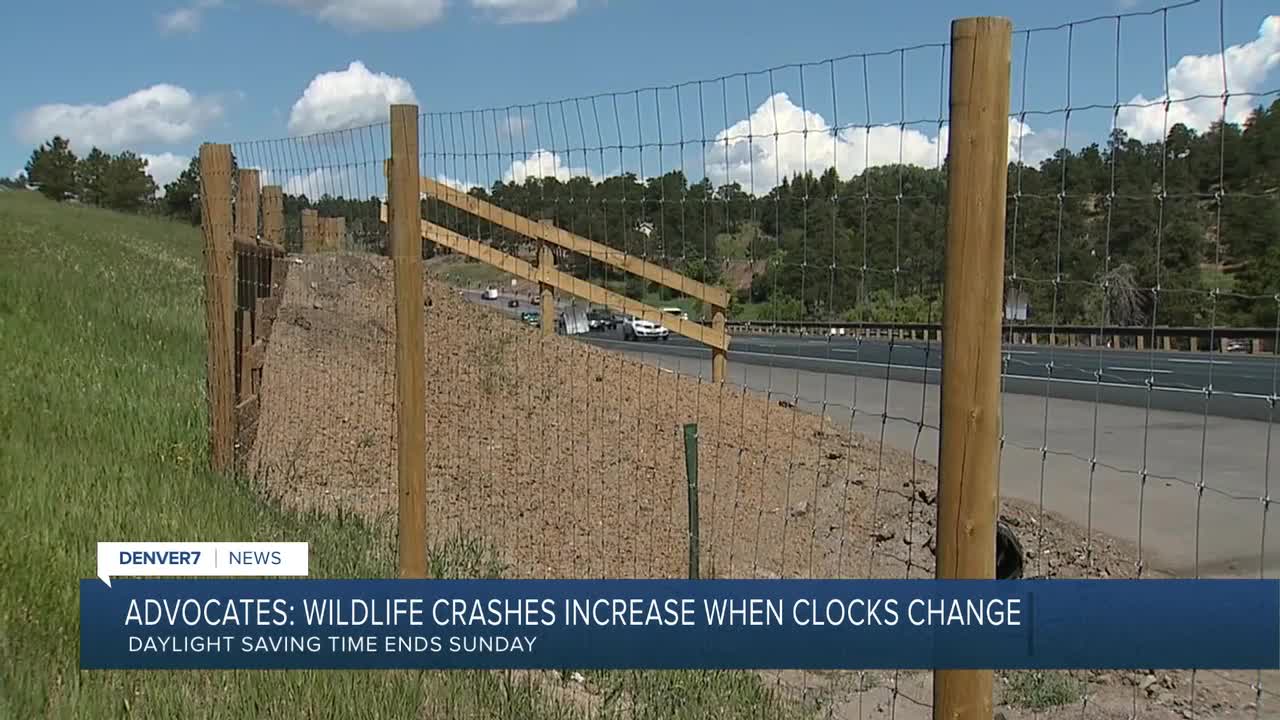


DENVER — This weekend’s change back to standard time means there will be more cars on the road when the sun’s down since the evening rush hour will now hit after the sun has already set in Colorado’s skies.
Conservation advocates say that usually leads to a higher risk of vehicle-wildlife crashes.
Denver7 reporter Alex Dowd has more on how those changes could impact wildlife in the video below:
“They don't have watches, so they don't realize that there's this thing called a time change,” said Danny Katz, the executive director of Colorado Public Interest Research Group (CoPIRG), a consumer advocate network with a nonprofit wing. “When suddenly a lot of our travel is happening within that kind of dusk to dark time, then a lot more vehicle wildlife collisions can happen, and that's what we see every year right after the time change, we see an increase of wildlife vehicle collisions because they don't know that we're suddenly shifting our driving by an hour.”
Colorado’s already in peak wildlife season, according to the Colorado State Patrol, and recorded collisions with wildlife have climbed since 2021. Deer and elk are hit the most frequently.
Katz says wildlife bridges could be a solution. Since one was built along I-70 in Genesee in 2024, wildlife crashes in that stretch dropped by 80%.
Watch Denver7's in-depth report on wildlife bridges in the video below:
“Our public lands and our mountains and the animals that we see when we go visit them, it's what makes Colorado, Colorado,” Katz said. “Unfortunately, so many of our roads are carving through these animals' habitats, and that means they're often needing to cross our roads to get to food or water or mates or shelter.”
AAA advises drivers to use their high beams when they’re driving long, dark roads with no other cars.
If an animal is in the roadway, don’t swerve. Instead, firmly press your brakes

