

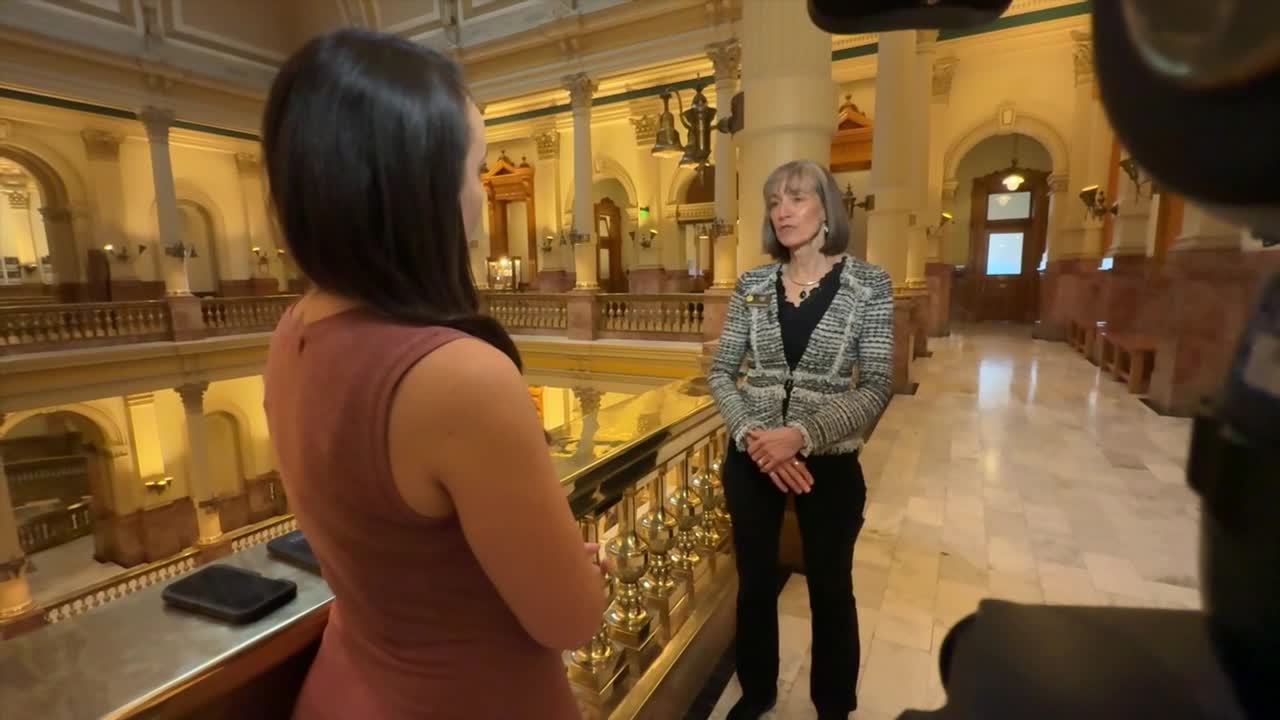


DENVER — Mothers who received frantic text messages from their children about gunfire at school, shop owners with stories of teenagers who never stopped running, and students whose sense of safety was shattered just over six months ago shared their harrowing experiences with Colorado lawmakers late into the evening on Wednesday.
A junior at Evergreen High School told legislators the most upsetting part of it all was that "the entire world had a warning, months in advance.”
They came to the Colorado Capitol to testify in support of House Bill 26-1255, which would mandate a "streamlined process" that allows law enforcement to contact social media platforms through a hotline that is staffed at all times. The hotline would help answer questions about search warrants, acknowledge a company has received those search warrants, and provide law enforcement with status updates on their requests.
The bill gives social media companies 24 hours to comply with search warrant requests, with an exception for extensions granted by a court. Colorado's Attorney General would enforce that, with penalties of up to $250,000 per violation.
State Rep. Tammy Story, D — District 25, said currently, social media platforms must respond to a Colorado search warrant in 35 days.
“There is no reason why social media companies — with the greatest technology available — that they can't turn around a search warrant in 24 hours when we're talking about these circumstances that are very dire," Rep. Story, the prime sponsor of the bill in the Colorado House of Representatives, said. "This bill was born out of the Evergreen High School shooting."
In addition, the legislation would mandate that social media platforms report to local law enforcement within one day of a post that violates their own policies and causes them to take adverse action against that user.
Jefferson County Sheriff Reggie Marinelli, who worked on the legislation, told Denver7 that "had this bill been in the law, it's my belief we would have been able to stop the Evergreen shooting before it happened.”
Ultimately, the House Judiciary Committee voted 7-4 along party lines to advance HB26-1255 just after 10 p.m. on Wednesday.

On Sept. 10, 2025, a 16-year-old student entered Evergreen High School and shot two of his peers before turning the gun on himself.
"It's my job — my job to make sure our community is safe. It's my job to make sure our kids go home," Marinelli said, becoming emotional. "I have two kids that were severely injured that day, so it is somewhat of a personal hit for me.”
Denver7 named the shooter when he was first identified but limits the use of their name in our subsequent reporting in order to focus our coverage on the community impacted by the crime.
The shooter fired multiple rounds inside the school before crossing the football field to continue the attack, which lasted more than nine minutes. Two students were critically injured that day — a 14-year-old boy whose name was never released and 18-year-old Matthew Silverstone.

Kris Koehler, Silverstone's uncle, testified before lawmakers on Wednesday evening and told them his nephew's story.
“In the middle of a shooting, he helped direct other students to safety, likely saving lives, and then he was shot — twice — once in the chest, once in the head. Matthew survived, but his life has been permanently changed," Koehler said. “Matthew did everything right that day. He protected others. But protecting students shouldn’t depend on the heroism of a teenager in a hallway. Now the question is whether we will do everything we can to protect the next student."
Six months later, Koehler said Silverstone and the rest of the family still face a long road to recovery. His nephew receives nutrition through a tube, will never hear out of his left ear again, and has at least three more surgeries that are expected.
"The first days after the shooting are still a blur for our family, but there is one moment I will never forget," said Koehler. "The FBI had received a credible lead about a potential mass shooting as early as July 5, more than two months before Matthew was shot. In that moment, our grief turned to anger, because we realized something might have been done to prevent this tragedy."
Federal authorities had been tracking the shooter's online presence for about two months before the attack after they were tipped off by the Anti-Defamation League (ADL) of his activities, which included visiting forums where users shared videos of killing and extreme violence, mixed in with content on white supremacism and antisemitism.
In July of 2025, the Federal Bureau of Investigation (FBI) “opened an assessment into a social media account user whose identity was unknown and who was discussing the planning of a mass shooting with threats non-specific in nature,” a spokesperson from the FBI’s national office said in a statement to Denver7.
TikTok accounts tied to the shooter contained white supremacist symbols, and the name of his most recent account included a reference to a popular white supremacist slogan.
A few days before the shooting at Evergreen High School, the 16-year-old gunman posted a TikTok video posing in a similar way to how the suspect in a school shooting in Wisconsin posed before killing two people in December of 2024.
Because the FBI was not able to identify the individual behind those accounts, “there was no probable cause for arrest or additional law enforcement action at the federal level,” an FBI spokesperson said in the days following the shooting.
The ADL's Center on Extremism published a report detailing the extensive online footprint of the shooter.

Evergreen
Evergreen High parents say they're unsatisfied by closure of investigation
According to Rep. Story and Jefferson County Sheriff Marinelli, the FBI requested three different search warrants related to the concerning posts that were eventually determined to be connected to the shooter.
Story said the results of those search warrants took roughly 75 days, and the FBI received information that connected the social media account to the Evergreen shooter two days after the attack.
"Had that information arrived in Jefferson County three days earlier, four days earlier, potentially law enforcement would have had an opportunity to interrupt or disrupt the plan by the user that was the Evergreen High School shooter," Story said. “In Colorado, with a 35-day response time for three separate search warrants, that's at least 105 days, which means if all of that had unfolded in Colorado, the information wouldn't have arrived with the Jefferson County Sheriff's Office until the middle of October.”
Marinelli told Denver7 she believes a change in the law like this should have been done a long time ago.
“Could we have done it sooner? Yeah, absolutely, it just was not on the table like it was September 10," Marinelli said. “My head immediately flipped to 'Yes, this is terrible. Yes, this is bad.' But my head, within a matter of two, three minutes, was like, 'We have an opportunity to either sit back and do nothing or run full speed ahead and make change.' My choice was to not dwell on that, but to spend my time and energy moving forward to get this bill passed.”
A software engineer and man with a career in internet technology were among a handful of people who testified against HB26-1255. One of them argued that a 24/7 hotline would be too burdensome on individually-run and volunteer-run sites, and another said that large companies would likely implement the reporting of concerning posts using artificial intelligence, which may not understand the nuances of social media interactions. The software engineer continued to say there is no evidence that shows compelling social media platforms to push out information to law enforcement prevents mass harm, and they could see the bill creating a tool set for domestic abusers, stalkers, and those who want to target vulnerable people online.
In addition, the American Civil Liberties Union (ACLU) of Colorado is registered as opposing the legislation. A spokesperson told Denver7 their concern is the bill allows social media platforms, instead of the courts, to determine what qualifies as protected speech. The ACLU believes the proposal, if enacted, would circumvent the Fourth Amendment protections of users.
Story told Denver7 that an amendment made on Wednesday night aims to address the ACLU's position by ensuring a social media company only has the duty to report a post to law enforcement if it violates their own policies, causing the platform to take adverse action against the user.
Echo Robbins was among the Evergreen High School students who testified during the committee hearing in support of HB26-1255. She came straight from chemistry class to the Colorado Capitol to do so.
"It's important to me to be able to say to my friends that I don't want them to feel like they're out of their depth or like nothing is being done. And I want to give them proof that anyone, no matter who you are, can go up to the legislature and demand action," Robbins said.

Evergreen
Bill unveiled reducing time for search warrant info post Evergreen shooting
Democratic Colorado Congresswoman Brittany Pettersen, who represents the 7th Congressional District, is running parallel legislation on this topic at the federal level as well.
"Should that one pass when they get ready to do that — to also move the needle, to shorten the response time — then that's going to be nationwide, and it's going to help all of us," Story said.
A bipartisan bill with a similar goal passed out of both chambers in the Colorado Capitol on Wednesday and is heading to Governor Jared Polis' desk for final approval. Senate Bill 26-011 would give social media platforms 72 hours to respond to search warrants with the option to request an extension. One of the legislation's sponsors, Minority Leader Jarvis Caldwell, R — District 20, told Denver7 it is intended to protect children in Colorado from things like drug deals on social media.
“When we're talking about protecting kids and responding to search warrants, that is a bipartisan issue," Caldwell told Denver7 previously. "When you tell them about this scenario where search warrants aren't being responded to, for sometimes months, the general public says that's unacceptable, and so that's why this is a bipartisan effort.”
Denver7 asked Story how SB26-011 and HB26-1255 are different.
"I prefer to not spend time talking about Senate Bill 11, because this bill needs to stand on its own merits," Story said. “There are some differences in terms of the response time. This bill is 24 hours. Senate Bill 11 is 72 hours. A huge difference is the duty to report, which we think is immensely critical to this bill and to ensuring that there are various opportunities for posts to be reported to local law enforcement, to give them an opportunity to interrupt or disrupt some potential violent act.”
Before voting, a handful of lawmakers on the House Judiciary Committee brought up SB26-011 as well.
State Rep. Matt Soper, R — District 54, said SB26-011 was drafted in such a way to avoid some of the "pitfalls" he sees in HB26-1255. Soper, along with State Rep. Cecelia Espenoza, D — District 4, also expressed concerns around Fourth Amendment rights with the proposal.
The chair of the committee, State Rep. Javier Mabrey, D — District 1, said he believes the bill sponsors will continue to work on any constitutional concerns related to the legislation. Mabrey also said he has never seen a community show up to support a bill in the way the Evergreen community did on Wednesday evening.
The fiscal note for HB26-1255 anticipates there is no cost to the state as a result of this legislation.
HB26-1255 heads to the Committee of the Whole for consideration next.


