



EVERGREEN, Colo. — February may have just begun, but unseasonably warm temperatures across Colorado are creating conditions that feel more like spring — bringing elevated wildfire risks along with them.
“We have a beautiful blue-sky day like this, which is great for the tourism bureau. But in the end, this is a high fire danger day — we in Colorado need to embrace that we are in a high fire danger state,” said Einar Jensen, public information officer for Evergreen Fire Rescue.
Colorado adopted a statewide wildfire resiliency code last summer, which sets rules for fire-resistant building materials and defensible space in Wildland-Urban Interface (WUI) areas, where development meets wildfire-prone terrain.
The new code must be adopted by jurisdictions across the state by April 1, with enforcement starting no later than July 1.
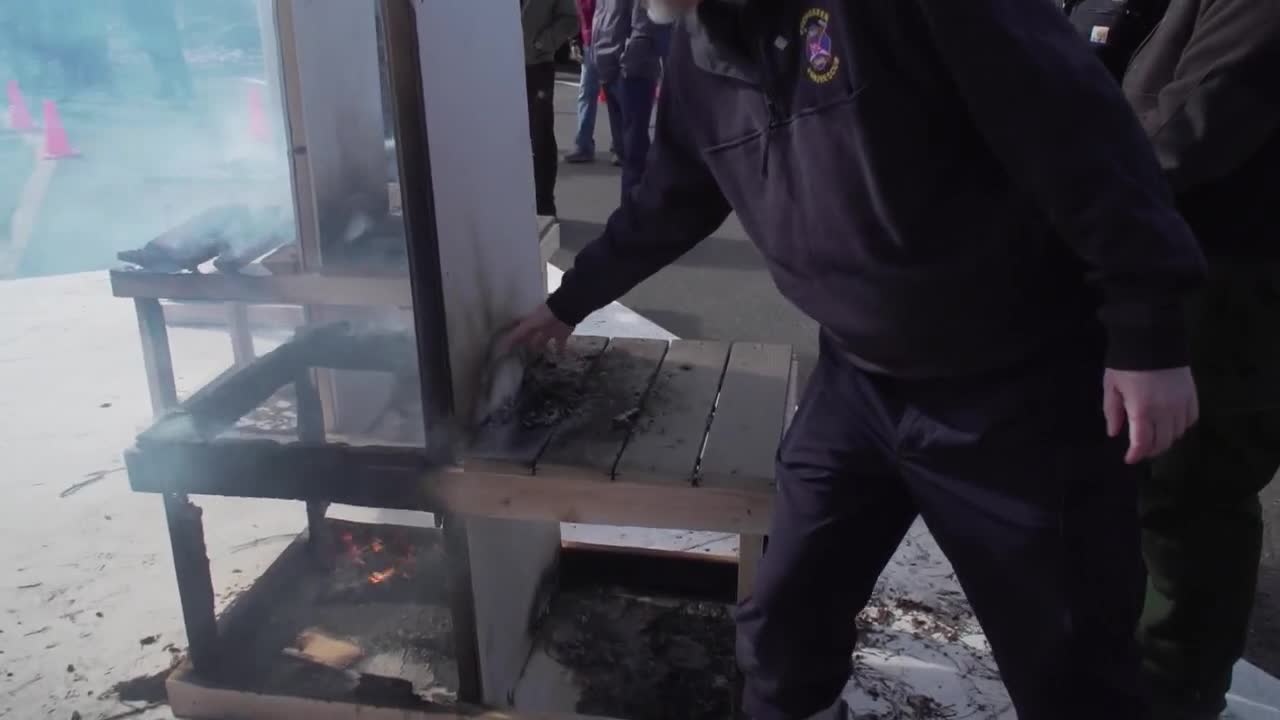
Evergreen Fire Rescue conducted a live burn demonstration Saturday to showcase how different building materials perform under wildfire conditions to illustrate the importance of the new wildfire resiliency code.
"You hear the local fire department talk about embers, but to actually see it here in front of you, where you're actually getting a little bit of smoke, you can feel the heat, it's suddenly a little bit more real," said Jensen.
Denver7 was there as six different decking models with varying class ratings were put to the test.

The Class C rated deck on the left was destroyed in the flames. The Class B rated model on the right, on the other hand, showed significantly less damage.
“The rating’s been tested on how easily it ignites, how it sustains fire, and when we're talking about family safety, the proof is here,” said Jensen.
Next, juniper tree clippings were set ablaze — within seconds, those branches were completely engulfed in flames exceeding 1,100 degrees Fahrenheit.
According to experts, certain oils in juniper trees cause them to burn hotter and faster than other species.

"Junipers are beautiful. They're green throughout the year, but we in the fire service know them as little green gas cans,” said Jensen, “If you have a juniper within 30 feet of your home, your apartment complex, even your fence, get it out — because that is a gas can waiting for an ignition source, and it's not going to go well.”
Coloradans are encouraged to incorporate low-flammability plants and shrubs within a safe distance of the building structure.
For Evergreen residents like Kyle Kociemba-Benson, seeing the demo firsthand made those wildfire risks more tangible.
"When we looked at the different types of composite decking, it was really a stark contrast," said Kociemba-Benson.
Many Evergreen residents, Benson noted, live in homes that were built years before the state pushed for increased wildfire mitigation efforts.
"To make sure that our homes are safe, collectively, and our neighbors are safe, our neighborhoods are safe; these are all things that we have to address in order to move forward as a community for fire protection," said Kociemba-Benson.
Jefferson County ranks as Colorado's second-highest at-risk county for wildfire, with areas like Evergreen particularly vulnerable during mild winters like we’re seeing this year.
December’s high wind event, which prompted Xcel Energy to implement power service power shutoffs throughout Evergreen, could have been catastrophic, according to Jensen.
“There's a solid chance Xcel Energy prevented at least 70 Marshall fires in our fire district alone, because that's how many times we had trees and branches slap into power lines. There were no wildfires that day up here because the heat source was missing,” he added.
The change in the state’s resiliency code is one part of the solution, but Jensen emphasized the importance of community members spreading awareness.
"Now they're the force multipliers," he said, “they can say, this is what I experienced [during the burn demo]. We should work together as a cul-de-sac, as a community, as a neighborhood, to make all of our homes safer, all of our landscaping safer, so all of us win.”


