

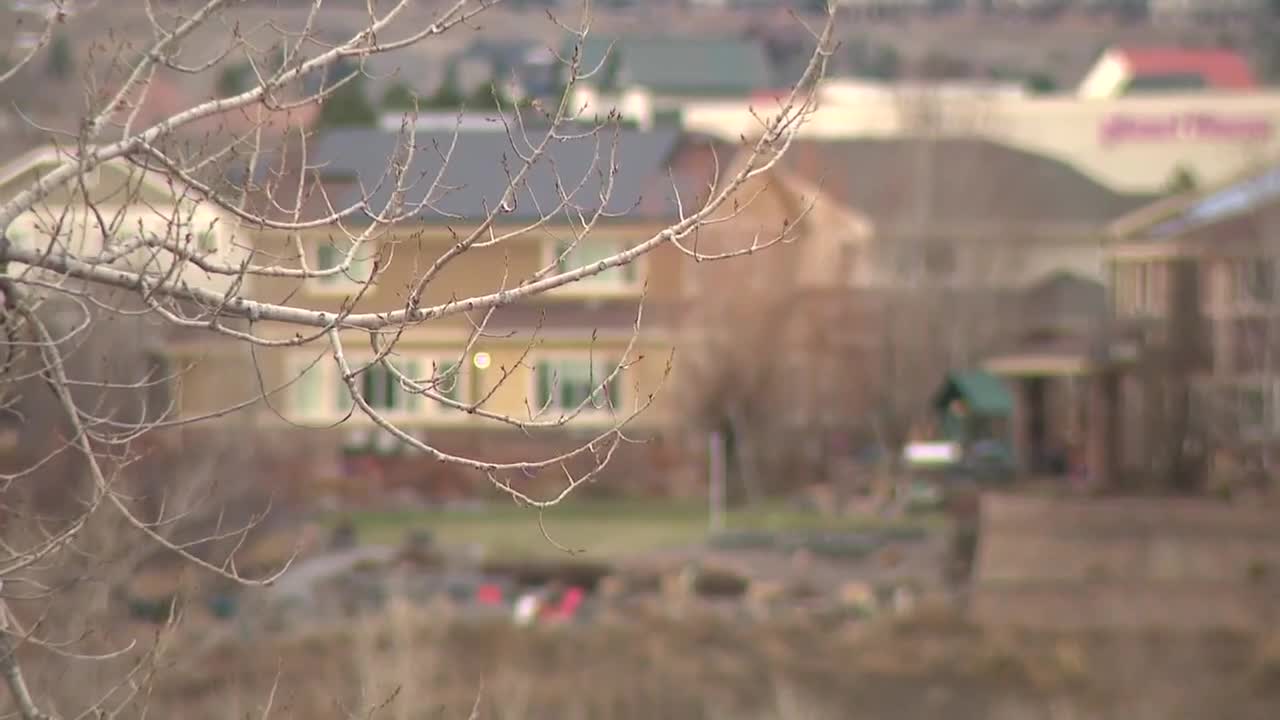


JEFFERSON COUNTY, Colo. — For years, homeowners living near Hyatt Lake have woken up to stunning waterfront views of the Rocky Mountains.
“I used to think how lucky we were,” said homeowner Judy Dain, who’s called the neighborhood home for 13 years.
But that’s changing fast.
“They've let the water out of the lake, and it gets really dry, and the grasses will grow long,” said Dain.
Hyatt Lake is now about a third of its original size.
As it shrinks, anxiety grows.

“We had a neighborhood meeting early November, and people brought it up because the Marshall Fire is still fresh on everyone's mind,” said Dain.
This month marks four years since a windstorm fueled the devastating Marshall Fire in Superior.
Since the Marshall Fire, Colorado has strengthened its wildfire prevention efforts.
Earlier this summer, it became one of a handful of states that have adopted a statewide wildfire building code.
The statewide standard sets rules for fire-resistant construction and defensible space in Wildland-Urban Interface (WUI) areas — areas where development meets wildfire-prone terrain.
Now, Jefferson County is updating its Wildfire Resiliency Code to meet state standards, including expanding its current WUI boundaries to extend past the mountains and into the plains.
This includes homes like Dain’s near Arvada and areas like Ken Caryl.
Right now, Jefferson County is among the top 2% of U.S. counties for wildfire danger, and the second-highest at-risk county in Colorado.
“It is definitely a collective effort. You know, the more properties that are mitigated in a community, the lower your wildfire risk is,” said Jefferson County planner Sara Kohles.
The county is also beefing up its defensible space and fire-resistant building standards for new construction in unincorporated areas — possibly even going beyond what the state requires.
“We are taking some recommendations from [our] community wildfire protection plan and also trying to implement those as well,” said Kohles.
The proposal would ban plants within five feet of structures, prohibit flammable plants within 30 feet, and require non-flammable fencing materials within 8 feet for any new builds.
These requirements would not be retroactive.
“This is not just blanket regulation [where] everyone needs to go out and do this right now. It's really, if you're coming in for a permit to our building division for any of that kind of major work that someone would be doing,” added Kohles.

The county is currently seeking community feedback on the proposed structure hardening standards.
Jefferson County wants to hear from you — a community meeting is scheduled on Tuesday, Dec. 16 from 6 to 8 p.m. to review the proposed draft and address community concerns.
Residents can join virtually or attend in-person at Hearing Room One, 100 Jefferson County Parkway, in Golden.
The proposed solutions are ones that county leaders hope will make Jefferson County more wildfire-resilient in the long run.
However, homeowners like Dain say they are worried about the present moment.
“We have an abandoned property here with a lot of open space,” she said. “There could be vandalism over there during the winter. If someone wants to seek shelter, they've cut down all the trees over there and left them as slash. And it's definitely a concern.”
Every windy day is a reminder of the potential danger.
“Just because you're on the border of an unincorporated versus incorporated area, the fire doesn't care. So I don't know that we will feel any more secure,” added Dain.

