

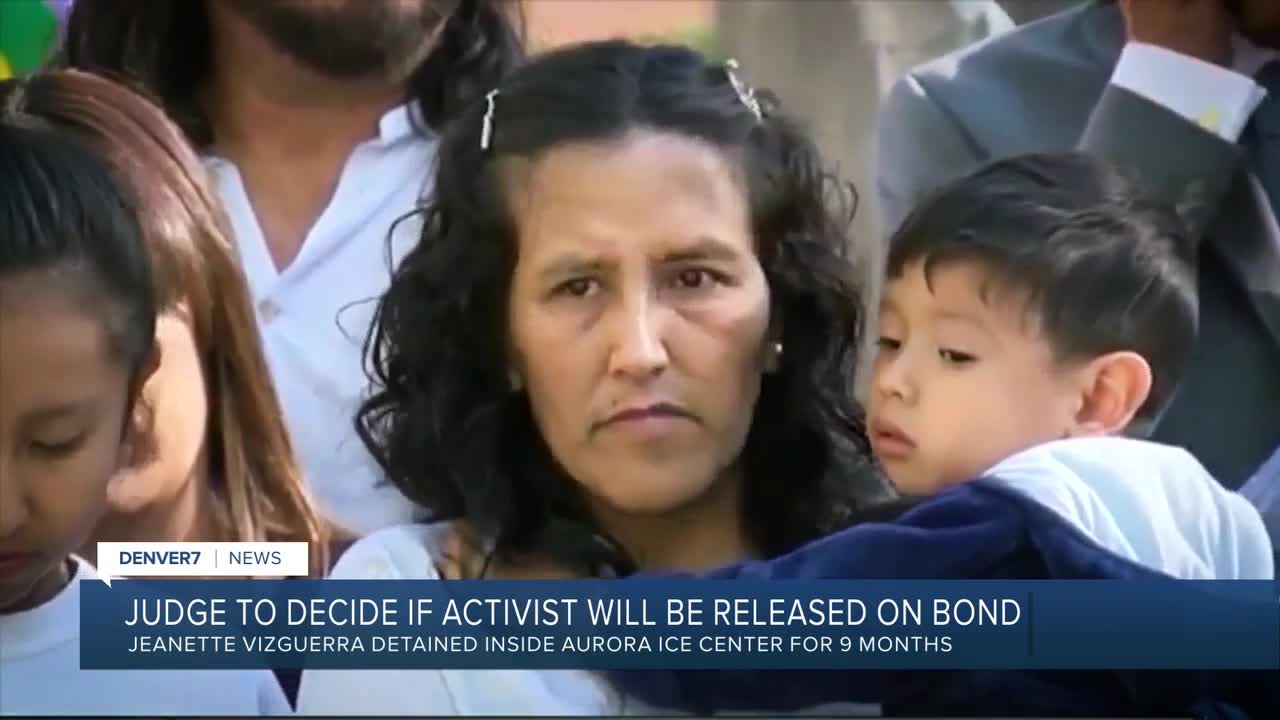


AURORA, Colo. — An immigration judge will decide whether or not a well known activist, who has been detained for nine months inside of a U.S. Immigration and Customs Enforcement (ICE) facility in Aurora, will be released on bond.
Inside of a crowded courtroom where more than a dozen detainees waited for their hearing on Friday, family and supporters of Jeanette Vizguerra filed into the back row along with members of the press. Her family was disappointed when the judge did not rule on Vizguerra's bond on Friday, calling it an "extremely complicated" case and deciding to issue a written statement.
53-year-old Vizguerra was detained by ICE on March 17. Her legal team believes Vizguerra was targeted for her criticism of U.S. immigration enforcement policies and practices over the years.
A federal judge ruled Vizguerra must be given a bond hearing, with the burden of proof placed onto the federal government. That means the government's attorneys were tasked with using clear and convicting evidence to argue that Vizguerra is a flight risk or a danger to the community, otherwise she may be released on bond.
The government's attorney pointed to February of 2009, when Vizguerra was convicted of criminal possession of a forged instrument for having a fake Social Security card. At the time, Vizguerra said her Social Security card was made up of digits from her birth date, and did not belong to another person. She ended up serving a 23-day sentence after her conviction.

Aurora
6 months into Jeanette Vizguerra's ICE detainment, case remains in 'legal limbo'
The government's attorneys claimed Vizguerra's criminal history shows she does not follow the law, and asked the judge why she would follow this court's order.
Her attorneys argued otherwise.
“What was really curious about today's hearing was they really didn't say much at all about flight risk or dangerousness," said Laura Lichter, an attorney who is part of Vizguerra's legal team.
"What they did over and over and over again was say how much they didn't like Jeanette. She's a bad person. She came into the country illegally. Oh, my goodness, she worked without authorization. These are requirements under the law. Yes, these are violations, but they don't make someone a flight risk. They don't make somebody a danger to the community.”
Lichter said the government threw "playground-level insults" at Vizguerra while in the courtroom, adding they expect to see a "positive decision, hopefully in the next few days."
In 2009, Vizguerra was placed in removal proceedings. She applied for a form of relief that would have authorized a judge to cancel the deportation and grant permanent residency if certain requirements were met. That application was denied in 2011, but an alternate request for voluntary departure was granted, giving Vizguerra 60 days to leave the country.
Vizguerra's attorneys claim she appealed that decision. In 2012, learned her mother was struggling and flew back to Mexico to see her mom one last time. That departure "triggered a subsequent, automatic withdrawal of her appeal," according to Vizguerra's legal team.
Vizguerra returned to the U.S. in 2013, when the amended court filing states she was "apprehended shortly after her entry and charged criminally for illegal entry." She was convicted in that case and sentenced to probation.
When Vizguerra was released from criminal custody, she was turned over to ICE in El Paso, Texas. She was able to return to Colorado, and required to report to the Denver ICE Field Office in Centennial, court documents state.

Aurora
The Waiting State: An unflinching look at immigration in Colorado
Vizguerra was forced to seek sanctuary at a Denver church in 2017 under the first Trump administration after a hold on her deportation was not renewed. Denver7 spoke with her more than two months into her stay at First Unitarian Church in 2017 — the same year she was named to TIME Magazine’s list of the 100 most influential people in the world alongside President Trump.
She was given a two-year reprieve, which allowed her to stay in the country until March of 2019 after Sen. Michael Bennet and then-Rep. Jared Polis — now Colorado’s governor — introduced so-called private bills to give her a path to become a permanent resident. But her two-year stay was not renewed and Vizguerra was further denied a U Visa — which allows undocumented victims of certain crimes to live legally in the U.S.
A timeline provided by ICE showed Vizguerra was twice granted a stay of deportation in both 2021 and 2023, lasting for a year each.
In the past, a senior official with the U.S. Department of Homeland Security (DHS) told Denver7 that Vizguerra has a final order of deportation issued by a federal immigration judge. Vizguerra's legal team disputes that.
An ICE spokesperson has also previously told Denver7 that Vizguerra has received legal due process in immigration court throughout the process.


