

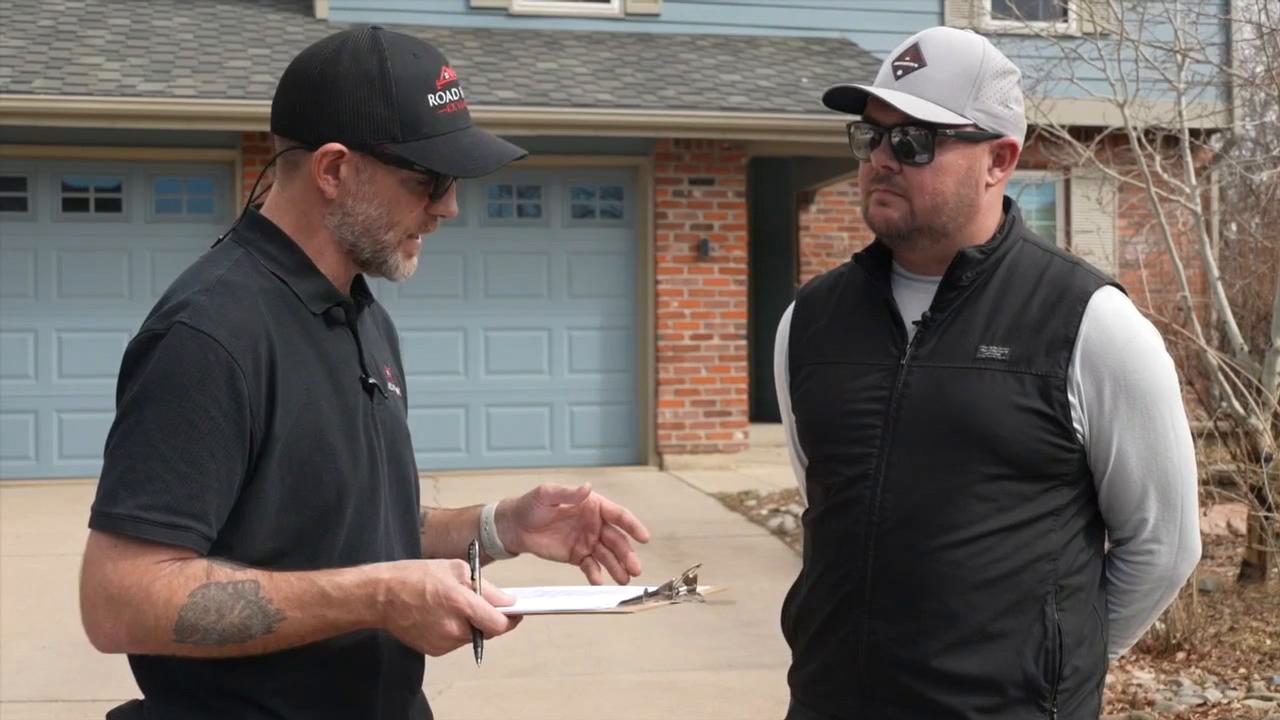


JEFFERSON COUNTY, Colo. — Jake Arnold has lived in Colorado all his life, yet his recent move to the Ken Caryl foothills has brought in new terrain and new fears.
“Being that we are not in a fire zone, but very close to one, it's just something we want to take care of,” Arnold said. “I've got a family in there, and we've got a lot of things to worry about.”
One internet search later, Arnold found Road Home Exteriors. The roofing and siding company recently launched the Harden Your Home Program.
It’s a free 28-point assessment designed to walk homeowners through making their properties more fire-resistant by looking at things like siding, vents and vegetation.
Gaps in a home’s roofing, siding or vents can create entry points for embers during a wildfire, according to Road Home Exteriors co-founder Leo Dunn.
“Last year was a pretty big year for Colorado regarding fire mitigation,” Dunn said. “We have the Colorado Wildfire Resiliency Code, along with House Bill 1182, both dealing with fire mitigation for homeowners.”
Dunn said the changes have sparked a flood of questions from homeowners trying to make sense of these changes and what it means to keep their homes safe from wildfire.
“We felt like there were a lot of information gaps for homeowners that were looking to harden their homes,” Dunn said. “We see it as our duty to provide that information.”
The CWRC sets rules for fire-resistant building materials and landscaping for new construction or renovations in Wildland-Urban Interface (WUI) areas — places where development meets wildfire-prone terrain.
Counties across Colorado, including Jefferson County, are updating their own versions of their local wildfire resiliency code to meet state standards. Jefferson County, for instance, is considering expanding its current WUI boundaries past the mountains and into places like Ken Caryl, which is currently not considered a fire zone.
For that reason, Dunn told Denver7, each assessment is highly personalized — factoring in a homeowner's proximity to the WUI and the specific fire-resistance rules that apply where they live.
HB 1182, which goes into effect this July, will require insurers to incorporate mitigation efforts into a homeowner’s rates. Dunn said homeowners who complete the program will have documentation to bring to their insurance companies — but worries the law won’t always guarantee lower rates for homeowners despite their efforts.
“Hopefully these changes will provide some sort of discount to insurance," he said. "But that is something that needs to be communicated, and we cannot guarantee that as part of this program.”
Denver7 got a firsthand look at the assessment process as Arnold's home was put to the test. The verdict: his home's roofing and deck materials all meet Class A fire ratings, but the wood composite siding is susceptible to fire.
“It was an eye-opening experience,” said Arnold. “I'll probably be looking at [replacing] the siding, have them look at my gutters as well.”
The importance of fire mitigation was even more apparent as we stood outside on this 70 degree February day.
“We're all in this neighborhood together,” said Arnold. “What [my neighbors] do [to strengthen their homes] helps me, and vice versa.”

