



DENVER — As Denver Public Schools started a new school year Monday, Colorado’s largest district also launched its new bell-to-bell cell phone ban.
A state law passed last year, requiring all Colorado school districts to establish a policy regarding students’ communication devices, spurred the new DPS ban.
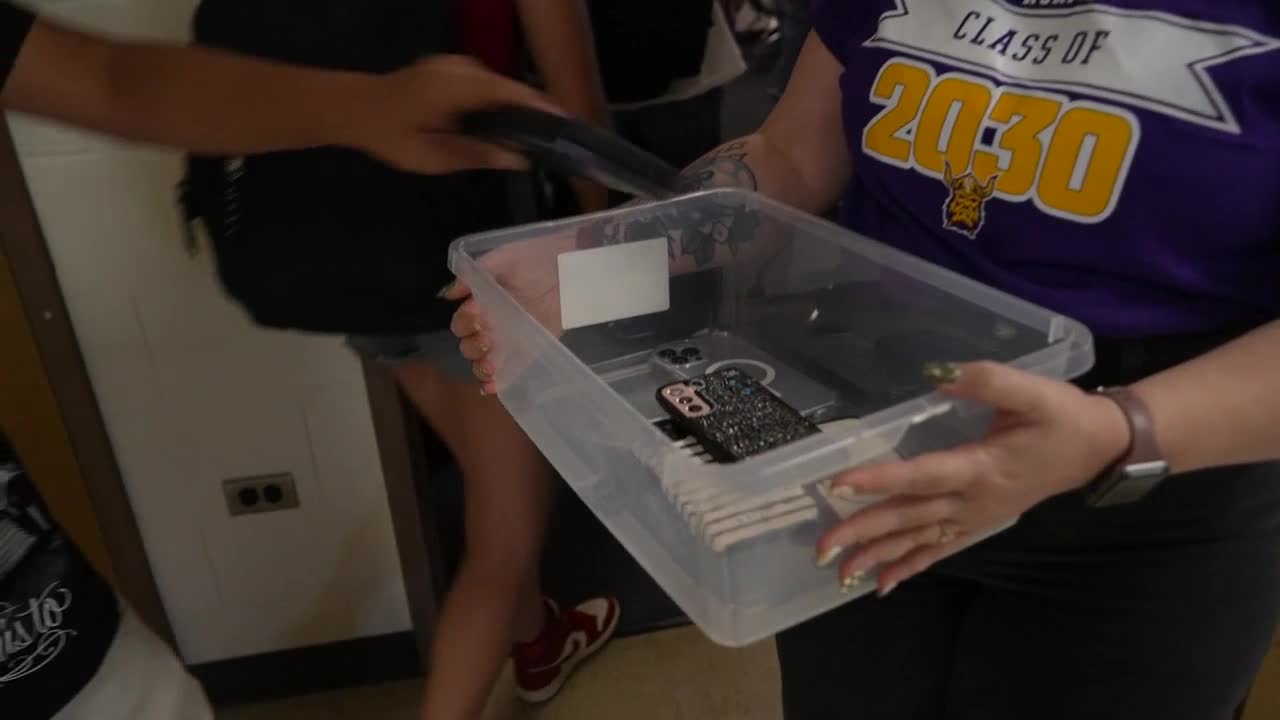
North High School in Denver has already had a stricter phone policy in place for the past couple of years: teachers holding bins to collect students' phones as they walk into class.
“Already we've been collecting cell phones from ninth and 10th grade students at the start of every class,” principal German Echevarría explained. “[Now] we will be collecting cell phones in every classroom, ninth grade to 12th grade. Some students will choose to leave them in their lockers. Some students have backpacks. They will leave them on silent in their backpack. As long as we don't see them, as long as they're not in the learning environment visible, then we can move forward with the learning.”
PREVIOUS COVERAGE:
- Dialed in: Colorado school districts face first year of required phone policies
- Denver Public Schools adopts all-day cell phone ban for students
- 'It's hurting their mental health': Colorado school district bans use of cellphones
Echevarría says the policy change came in response to observing students being distracted in class and leaving class to meet with friends, and that it has led to better student engagement.
Learn more about the new policy and its outcomes in the video player below:
“You know, the phone becomes part of you,” he added. “It's part of your day-to-day, and what we don't realize is the bombardment of alerts and of messages and of media input that students and adults get, nonstop.”
“Our biggest goal is just to limit distractions,” said Mack Gadis, Dean of Culture at North High School. “[Our bin policy has] been a really good structure, and I'm hoping that this should be no different from last year.”
Echevarría says with more than 1,600 students, their current policy is the most “realistic” and “consistent” way to implement the new DPS policy.
He also clarified the school wants the policy to support a “growth mindset” and healthy phone use, and not simply be “punitive.” He says discipline for breaking the rules centers on conversations, and that “it would probably have to take quite a bit” to consider serious punishments, such as a suspension.
“I think the conversations that we're able to have with students and families, and how we mediate conflict, really allows us to not get to those steps,” Echevarría said. “I would say that being able to not look at your phone for an extended amount of time is a healthy practice, and not just for adolescents, but I think for adults.”
Junior Kiyana Fernandez is used to turning in her phone for class, but has mixed feelings now that she will have to continue as an upperclassman because of the new district-wide policy.
“I get very distracted by my phone, like if I'm at home or in public or something. So I feel like it honestly helps me a lot,” she said. “I feel like it's a good thing, but also I know like a lot of students, maybe including myself, as it feels like in a way unfair, because we were coming into high school with like the expectation that we were gonna get like more leniency and stuff like that, like the older we get.”
Fernandez believes adherence would be even better if phone enforcement were more flexible.
The district’s ban is not a one-size-fits-all.
Other schools like Marie L. Greenwood Early-8 on the East Side are taking things a step further; teachers there have already been using Yondr pouches to lock students’ phones during the school day. The principal told Denver7 that they can be unlocked quickly in case of an emergency.
Denver7 has heard from some parents concerned about being unable to reach their kids directly during an emergency, who now have to go through a school’s office.
“We do a really good job here of being transparent with families, having timely communication, and really making sure that safety is the priority because we know that if we're not safe, we can't learn,” Echevarría said.
The district’s ban also applies to wireless earbuds, tablets and smart watches.
Studies from the National Bureau of Economic Research examined schools using both the “out of sight” and Yondr pouch strategies, finding that both involve an adjustment period and greater discipline during the first year, before student well-being improves.
The study analyzing Yondr pouches found minimal or modest positive effects on test scores, with “little evidence of effects on school attendance, self-reported classroom attention, or perceived online bullying.”
