

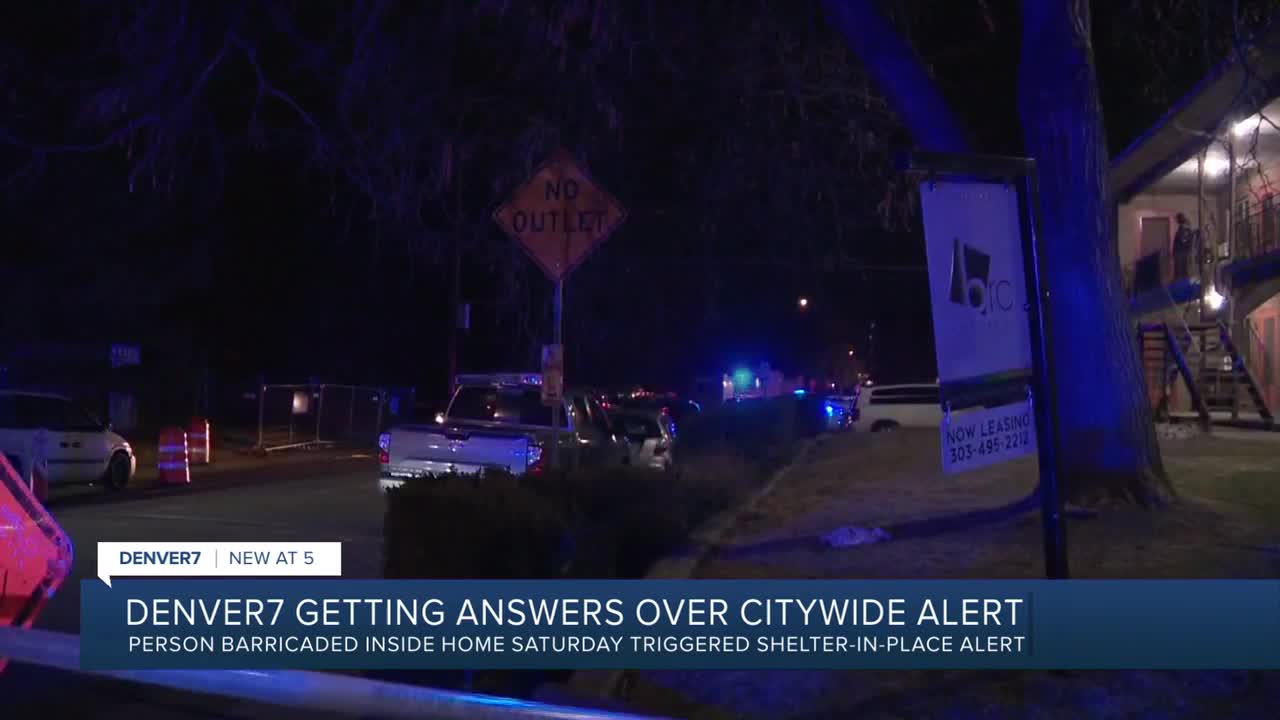


DENVER — A barricaded person near the University of Denver prompted a city-wide shelter-in-place alert late Saturday night, leaving thousands confused about why they received the alert in the first place.
Denver7 knows you want answers about what went wrong and so we took those concerns to Andrew Dameron, the director of Denver’s 911 Communications Center.
Speaking to Denver7 Tuesday, Dameron said the shelter-in-place alert was intended for a two-block radius around the home and that supervisors working that night “followed all of the appropriate policy and procedure” to make sure the alert would only go to those homes.
Unfortunately, a tech issue got in the way of that.
“Due to a configuration issue on the back-end of the vendor software that we utilize to access this system, effectively, what happened was the map that they drew around where that specific incident was happening was not taken into consideration by the software when it fired off that alert, so it defaulted to the entire city and county,” said Dameron.

Denver
Barricaded person incident near DU prompts accidental city-wide alert in Denver
He said that in the past, people would have to opt-in for these type of alerts, but that ended up creating potential public safety issues since people would have to know which website to go to and how to sign up.
More recently though, Dameron said the city began leveraging FEMA’s Integrated Public Alert and Warning System (IPAWS) network — a network managed by the federal government that allows local jurisdictions like Denver to send loud push notifications like the one heard by thousands of people Saturday night, “to any mobile device in a specified area, regardless of whether or not they have opted in,” Dameron said.
The director of Denver’s 911 Communications Center told Denver7 they have reached out to the vendor, Everbridge, to figure out how that faulty configuration occurred in the first place to make sure something like what happened Saturday night doesn’t happen again.
Why was there no follow-up about the error?
Dameron told Denver7 they realized something was wrong the moment their own phones started making that horrible noise you and I heard, since the 911 Communications Center is nowhere near DU. At that time, they decided to cancel the alert “before it had a chance to go to everyone in the city and county of Denver to try and mitigate any confusion.”
As it turns out though, when the 911 Communications Center cancels an alert like that, they can no longer send an update just to the folks that received it in the first place.
“So, in order to send an update, we would have to send a brand-new message to the entire City and County of Denver and not knowing how many people received the original one, the concern was that it was going to create more confusion,” Dameron said.
He acknowledged the “incredible responsibility that we have managing these tools” and the erosion of trust that can eventually occur by introducing what he called “alarm fatigue,” which is why he said a team has been working for the past several days to see if they can figure out what exactly happened.
“Sending an alert like this is a nerve-wracking thing for a dispatch supervisor, because they know the incredible kind of power at their fingertips,” Dameron said. “That's why we put a lot of thought and time and energy into our training and our policy and procedure.”
Dameron said, ultimately, he’s confident “our vendor partner is going to help us out. … This is not a regular occurrence.”

Denver7 is committed to making a difference in our community by standing up for what's right, listening, lending a helping hand and following through on promises. See that work in action, in the videos above.
