




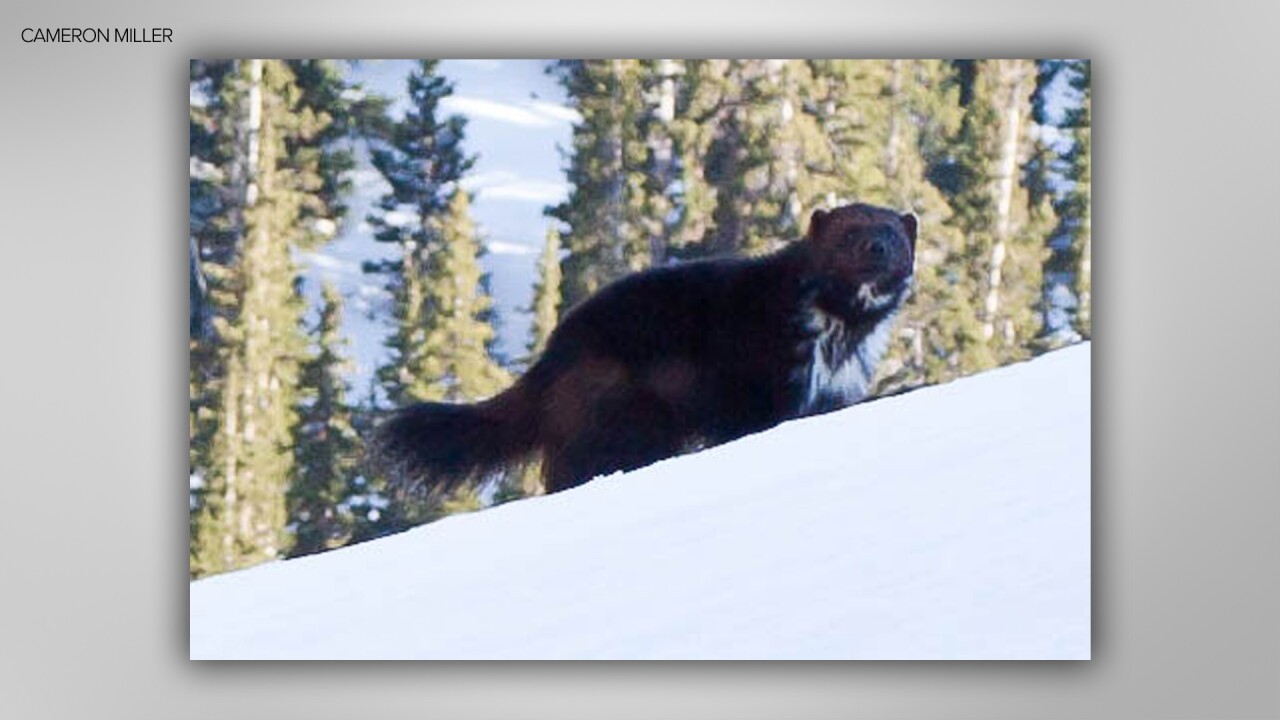
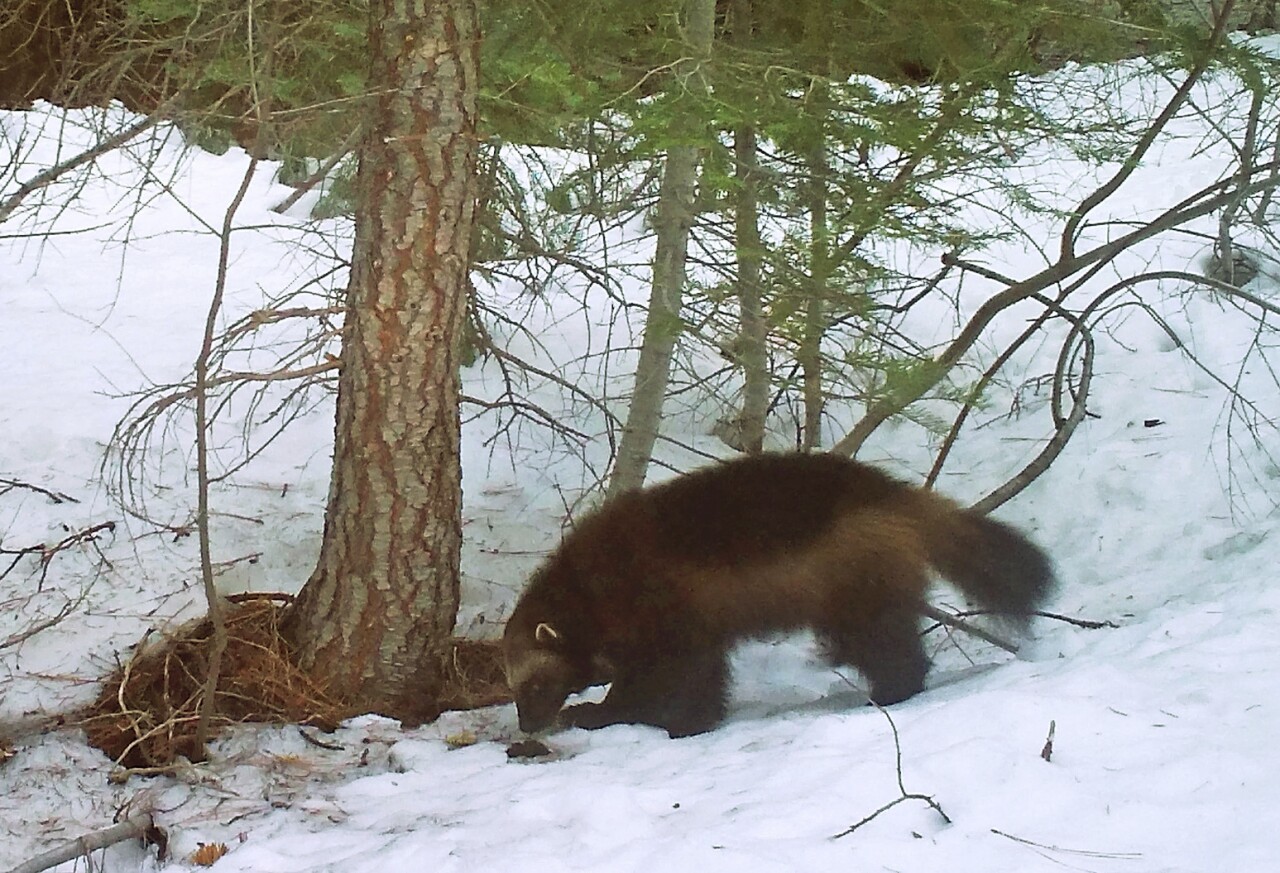
DENVER — On a snowy and steep slope on Mount Bierstadt in 2012, one of the rarest animals in Colorado looked up at a photographer, revealing a shock of white fur across the chest of the otherwise brown animal. He steadied his camera. Click.
What Cameron Miller captured is one of the extremely few confirmed photos of a North American wolverine in Colorado within the past century. But his extraordinary luck that day in April 2012 could become slightly — albeit very, very slightly — more common as the state of Colorado prepares to reveal a first-of-its-kind Wolverine Restoration Plan on Thursday.

Currently, Colorado Parks and Wildlife (CPW) believes there are no wolverines within the state.
However, it has abundant habitat for them — about 11,600 square miles of prime wolverine terrain, adding up to roughly 20% of the species' estimated habitat in the entire lower 48 states, according to an advanced copy of the plan CPW provided to Denver7. Roughly two-thirds of that land is in prime wilderness away from human activity and roads.
Given their large territories, that means the state can hold as many as 100 to 180 wolverines, if this restoration plan is successful.
The ultimate goal: To restore a breeding population of wolverines in the southern Rocky Mountains and providing a much-needed boost for the conservation efforts to save the species, which is considered federally Threatened and a State Endangered Species, the restoration plan reads.

But the path to that point is full of unknowns, as this is the first formal wolverine reintroduction ever. CPW acknowledges that success will hinge on their ability to adapt as the plan unfolds.
"I'd love to see them again," said Miller, who now lives in Ridgway. "I know even with a reintroduction, it'd be rare to see them, but just to know that they're out there and have a chance to see them again would be awesome."
He recalled that day in 2012: "I was just up by the beaver ponds and setting up my camera to take a picture of Mount Bierstadt. And I heard a bunch of noise at one of the lower beaver ponds that I couldn't see, so I thought it was a bear or something. I wanted to make some noise, so I cleared my throat, and then M56 ran up a hill, and I grabbed a picture."

The animal he photographed, called M56, had traveled from the Tetons in Wyoming south to Rocky Mountain National Park to Mount Bierstadt, which is an exceptionally abnormal move as there is no bridge of suitable wolverine habitat to connect Wyoming's and Colorado's mountains. That is one obstacle preventing the species from naturally repopulating to Colorado.
Miller's experience was the first confirmed evidence of a wolverine in Colorado in nearly 100 years.
Bob Inman, who was working at Montana Fish, Wildlife and Parks at the time, was on the team that initially captured and collared M56, and then later tracked him as he left the Tetons.
"We got up in the airplane and flew every day and located him and watched in amazement as it looked like, wow, he might go to Colorado," he remembered. "This would be something that hasn't happened in 90 years."
M56 trotted across Interstate 80 on Memorial Day weekend amid busy traffic and down to Colorado.
"It was reported in the newspapers and stuff," Inman said, and then laughed. "And I remember a headline from the newspaper that said, 'Marmot for dinner, but will he have a date?' talking about what they eat and the fact that there's no female wolverines here (in Colorado)."
Inman, now a CPW species coordinator in charge of wolverines, Canada lynx and river otters, is already imagining how residents and visitors alike may react to spotting one of these uncommon creatures.
"Sightings of a wolverine are extremely rare, so even people who have spent a lot of time outdoors have very rarely seen a wolverine, and it's something they remember for the rest of their life," Inman said. "So, we're looking forward to providing that opportunity for people here in Colorado."

First, meet the North American wolverine
Before we dive into the plan, let's take a look at the wolverine as a species.
Their current range covers portions of Scandinavia, Asia and North America, particularly Canadian provinces west of Quebec, as well as Alaska, Washington, Idaho, Montana and Wyoming.

They have large territories and patrol them regularly. Average density is about one wolverine per 96 square miles, CPW's plan reads. Inman explained that, as an example, Rocky Mountain National Park could only support four or five of the animals.
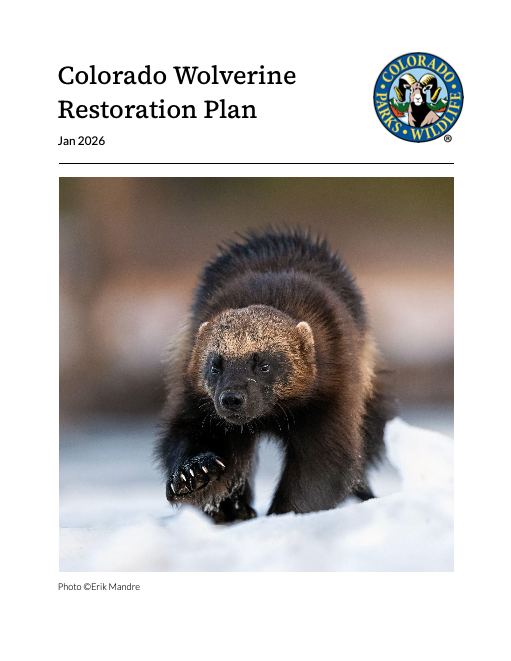
Wrapped within their short and stocky bodies is a solid survival instinct, impressive power and endurance for its size, and one of the most powerful sets of jaws of any carnivore, when it comes to chewing strength.
They can hunt small mammals, like marmots, but are mostly scavengers with a knack for finding ungulate carcasses and storing pieces of the meat in a cache to help get them through the winter.
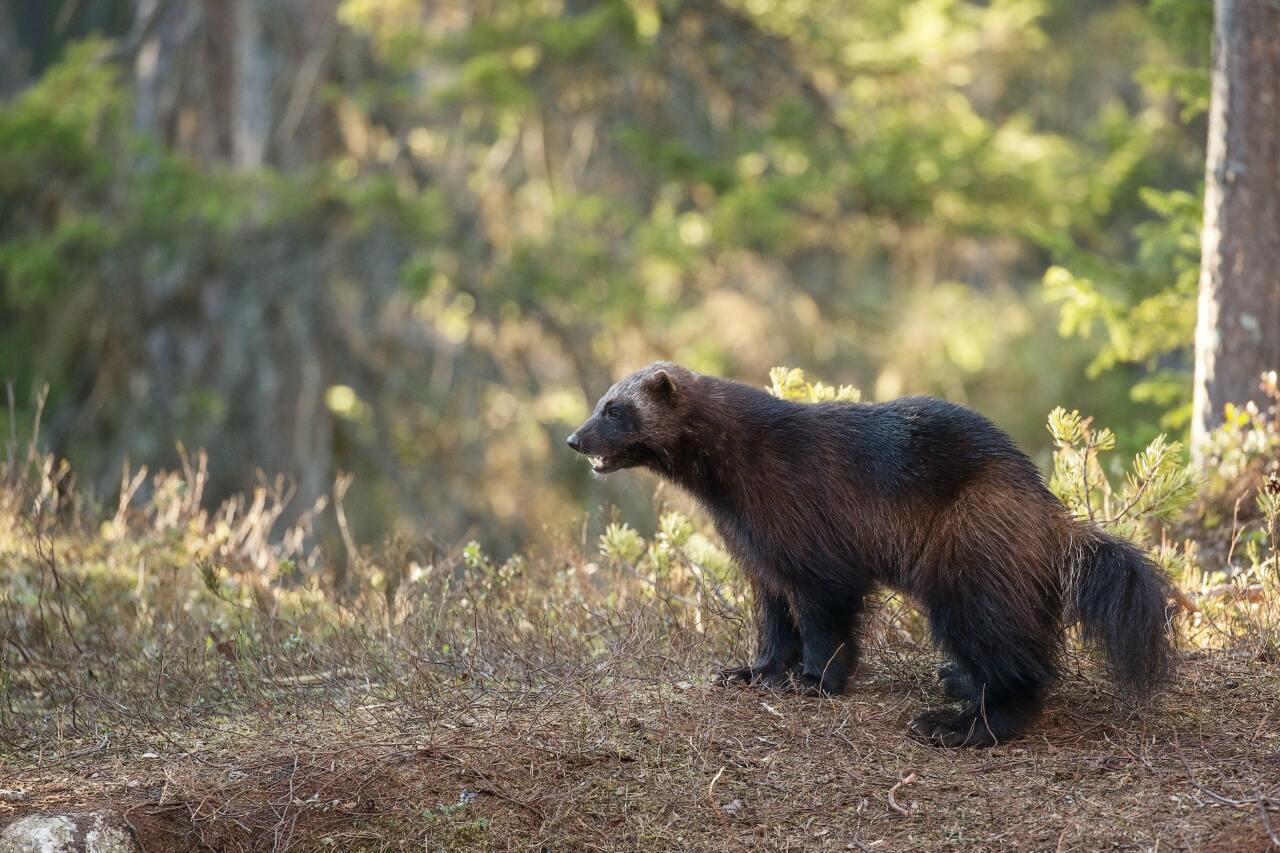
Because they weigh between 20 and 40 pounds, wolverines are not a threat to cattle or their calves by the time the livestock are moved to alpine areas, according to the plan.
CPW noted only two instances of sheep depredations by wolverines in North America: one in Wyoming in the late 1990s and one in Utah in 2022. CPW will set up a compensation program for any livestock lost due to wolverines.
Inman said they are not expecting any major conflicts between wolverines and producers, but acknowledged it could occur at some point.
"Producers in Montana, Idaho and Wyoming, where wolverines have been around for 75 years, really don't have depredations (and) are not concerned about wolverines and depredation," Inman said.
Female wolverines have a 90% pregnancy rate but only about half will wean a litter, Inman said, as litter loss in wolverines is common.
A wolverine will have one to two babies every other winter inside a den, which is usually protected by some sort of snow and foliage cover, like avalanche debris.

The biggest dangers to the animals are trapping, starvation and other carnivores like black bears, mountain lions and wolves that may prey on them, the plan reads. Like most alpine wildlife, climate change will cause increasing pressures on them as well, however experts say Colorado may endure climate change better than many other areas of wolverine distribution.
“Some people think that Colorado could be a climate refugia for the species," Inman said.
They can live about 15 years.
- Gray wolf reintroduction was introduced by wildlife activists and later mandated by voters. A wolverine reintroduction was introduced by CPW and the legislature.
- Wolves are pack animals. Wolverines are solitary and only exist in small densities.
- Wolves prey on elk, deer and other ungulates. Wolverines are mostly scavengers, meaning they eat already-deceased animals. They also will prey on small rodents, birds and fish.
- Wolverines have attacked livestock, mostly sheep, only in extremely rare instances.
- Both programs will have a compensation program for livestock losses. The wolf one has been in place for years.
Colorado is no stranger to reintroducing animals that have historically called the state home, but suffered from either declining populations or were nearing extinction: Elk were reintroduced in the early 1900s, bighorn sheep were brought back in the 1940s, moose were reintroduced in the late 1970s, Canada lynx were reintroduced in the late 1990s and early 2000s, and the gray wolf reintroduction program began in late 2023.
While the wolverine plan comes mostly recently on the heels of the wolf program — and they share a similar name — the animals are not related and are completely different species, with the wolverine belonging to the weasel family and wolves in the Canidae family.
"Wolverines and wolves are just very different species. Wolves are tough, socially. It can be a very divisive issue, and wolverines are not nearly as difficult in that way," Inman explained. "So, we do think that the wolverine reintroduction is going to be much more like lynx or river otter that were reintroduced 50 years ago this year in the state of Colorado. The hard part about a wolverine reintroduction will be getting enough animals to start a population, and we don't think the social aspect of this reintroduction will be nearly as tough."
Like the gray wolf, wolverines sometimes have a certain notoriety attached to the name.
As an animal historically portrayed as vicious and brutal, the wolverine has had a slew of nicknames over the decades, including devil beast, skunk bear, nasty cat, woods devil and carcajou. A 1974 newspaper article in the Fort Collins Coloradoan dubbed the wolverine as "the head criminal of nature’s underworld; a true gangster."
But as a biologist who has come face to face with them many times, Inman said that reputation is more dramatic than reality.
He has witnessed them attack bears over carcasses, but he has also crawled into holes with wolverines in the pursuit of research.
And he still has all of his fingers today, he said, smiling.
Wolverines' fall in Colorado and the creation of a plan to get them back
North American wolverines are native to Colorado's alpine and subalpine ecosystems but were extirpated from the state in the early 1900s largely due to unregulated trapping and predator poisoning campaigns. By 1973, they were listed as a State Endangered Species, which they have remained ever since. CPW completed 12 searches for any signs of wolverines — as well as Canada lynx — between 1979 and 1996 and found no evidence of either animal left in the state.
In the late 1990s, CPW issued a publication titled "Draft Strategy for the Conservation and Reestablishment of Lynx and Wolverine in the Southern Rocky Mountains" and elected to focus on just one species at a time. The lynx was up and that program was later deemed a success in 2010.

And so CPW brought the wolverine plan up from the backburner and a drafted plan was completed in 2010. At that point in time, most stakeholders didn't have many concerns about the wolverines themselves, but were worried about if they were federally listed, which would involve "an enhanced regulatory burden for their industries," a CPW spokesperson told Denver7.
"For several years, it was unclear whether the species would remain unlisted or would be listed, and CPW decided to wait out the legal uncertainty before moving forward with restoration efforts," the spokesperson said.
Wolverines were officially listed as a Threatened species by the U.S. Fish and Wildlife Service in the fall of 2023.
And with that, CPW jumped back into the nearly 13-year-old plan, updating it as needed.
The final push came when Colorado Gov. Jared Polis signed Senate Bill 24-171 "Restoration of Wolverines," which was introduced in March 2024, into law.
The law noted how the lower 48 states are home to only 300 to 400 wolverines, and how the prime habitat available in Colorado can strengthen those numbers.
"And so that's why reintroducing them here — it's not only good for Colorado, it's a big part of wolverine conservation in the western United States," Inman said.
"It is the largest block of unoccupied wolverine habitat that we have, and it's really not close," added Jake Ivan, CPW wildlife research scientist. "So, it makes a lot of sense from that bigger picture... If we could re-establish a population here, that would go a long ways toward conserving the species in the entire lower 48."

To this day, the only confirmed sighting of a wolverine in Colorado in the past 90 years was M56 — first in Rocky Mountain National Park in 2009 and then when Miller saw it on the snowy slope of Mount Bierstadt in 2012.
M56 ultimately left the Centennial State and its GPS collar tracked it up to North Dakota, where it was shot and killed.

The Wolverine Restoration Plan to be unveiled publicly on Thursday is the next step toward bolstering their population in the contiguous United States. CPW is also currently working to create a communication plan and submit a formal request for a 10(j) rulemaking. The 10(j) section of the Endangered Species Act promotes the conservation of an endangered species by relaxing regulations for an experimental population and allowing for state-customized management.
A depredation compensation plan was approved by the CPW Commission on Thursday.
For Inman, who has worked in wolverine research and conservation for 25 years, this restoration plan is the "most exciting thing that I've seen during that time."
"It's a real step forward, a real on-the-ground conservation effort, that improves things for the species and will give Coloradans an opportunity to see something that's really cool. Most people are just fascinated by wolverines when they learn about their biology and all the incredible things they can do, like climbing a 5,000-foot mountain in 90 minutes, or giving birth in a den at the base of an avalanche chute," he said. "It's just a fascinating and incredible species that I think people are really going to enjoy learning about and hopefully seeing in Colorado soon."
A look at the restoration plan ahead of Thursday's public release
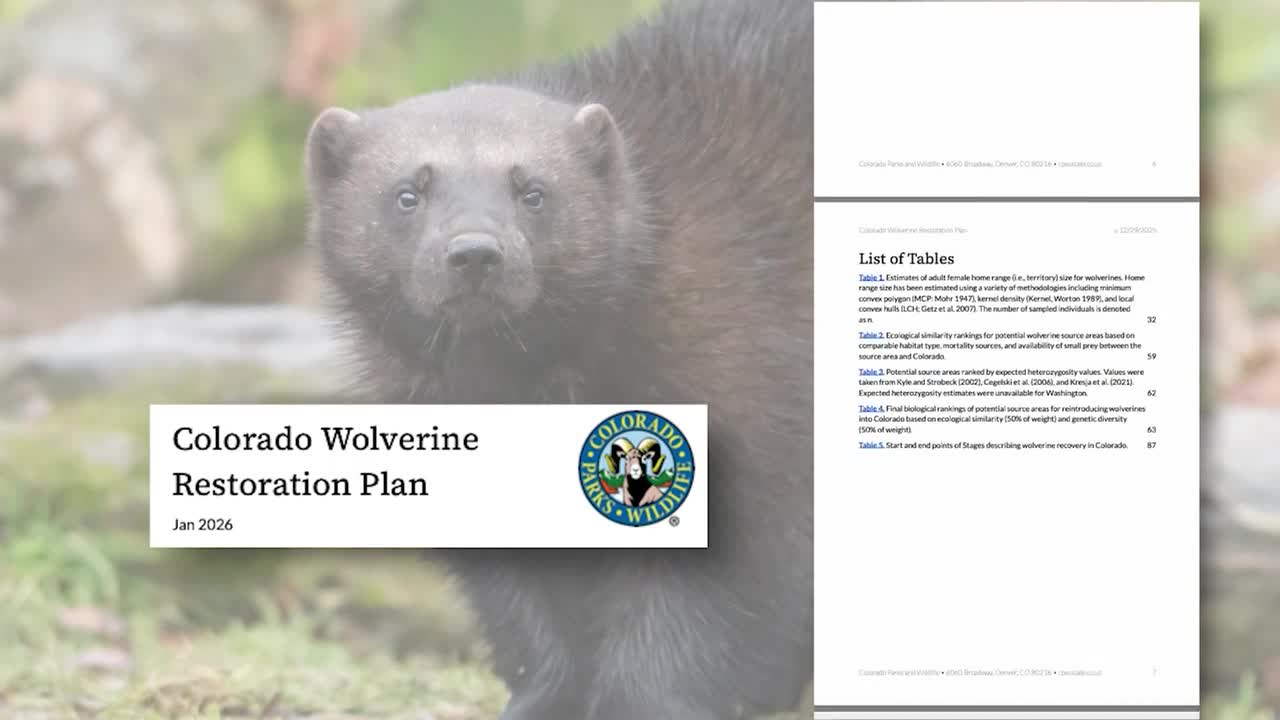
Denver7 scoured through all 106 pages of the Wolverine Restoration Plan to uncover the key points of what this program will look like.
Here's a brief overview:
- CPW is proposing to translocate up to 45 wolverines over three years (targeting 15 per year), with captures from various sites for genetic diversity. Most adult females captured will likely be pregnant
- Top locations for sourcing are southern and central British Columbia and Alberta
- CPW hopes to work with experienced local trappers at the source locations, as well as wildlife agencies
- All captures will happen in the winter
- The wolverines will be brought to CPW's Frisco Creek Wildlife Rehabilitation Center for examination, to be fit with a collar and to recover. Human contact — by sight, sound and smell — will be limited
- Releases will happen north of I-70, in the central mountains (only this one for the first year) and in the San Juan mountains. See the map below this list
- Half of the translocated females that are pregnant will be released at individual sites in early February. A carcass will be provided, with additional food brought in as needed until marmots emerge in the spring
- The other half of the pregnant females will give birth at the Frisco center and will be released in early June at individual sites with their young
- Females with pregnancies that fail will be released after a month at the Frisco center
- Male wolverine translocations in the first year will be limited to ensure some male presence but reduce the chances of infanticide. They will also be released about a month after they arrive at the Frisco center
- The capture and release methods will be assessed after the first year

Ivan explained that CPW spent a lot of time brainstorming where the wolverines could come from. They came up with two main areas of focus, ecological similarity and genetics, and created a scorecard for each possible source location.
"We scored some of the source populations based on how similar they are to conditions here in Colorado," Ivan said. "And then we also went through the literature and scored them based on genetic diversity of these other source populations too — the more diverse, you know, (the) higher (the) score. Kind of combined those scores and said, 'OK, in a perfect world, considering biology only, where would you like to go?'"
That led them to western Canada as the top choice.
The initial phase of capturing and release wolverines will continue for 1-3 years or longer. Success means the animals have an "adequate" survival rate, stay in Colorado and establish home ranges, the plan reads.
In the first year, Inman said CPW plans to release the animals in den sites in February around 11,000 feet in elevation in snow-covered avalanche country — something that will not be easy, but it has the greatest chance of success.
Within the second phase, CPW hopes they will reproduce and create a population of animals born, raised and breeding in Colorado.
The final benchmark for success in the program is evidence of a stable or increasing population of wolverines within the state.

Each milestone along the way is another step into uncharted territory.
"This will be the first attempt to reintroduce wolverines anywhere in the world," Inman said. "So, it's never been done before. There's not a recipe for it or a blueprint. There are a lot of unknowns, and so our approach, which is outlined in the restoration plan, is one of learning and adapting as we go."
Ivan said scientists are also seeing this as a blank slate.
"It's kind of exciting too, right? To try to do something no one else has tried before," he said.
Both Ivan and Inman hope that Coloradans find it intriguing too.
"Part of why we're here is we love the outdoors, right? We love the Colorado landscape. We love the mountains," Inman said. "This is an iconic species that's native here, that should be up in our mountains. And I just think it'd be so cool if we could put that species back. How neat would it be to be able to be on Trail Ridge Road at Rocky Mountain National Park and see one with your kids or your grandkids, right? That's probably not a very high probability event, but that would be a pretty cool bucket list kind of thing."
