



DENVER — Artificial intelligence could make it possible for communities to get weeks or even months to prepare for drought.
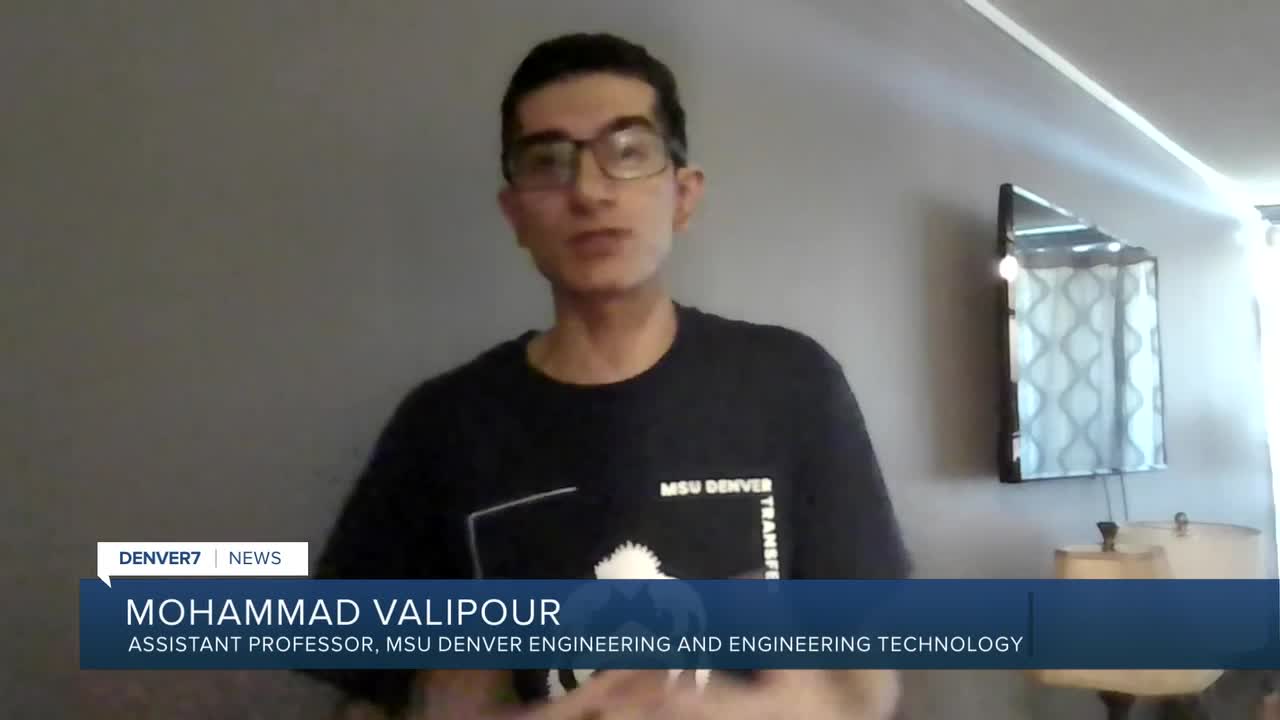
A grant from the Colorado Water Conservation Board is powering that project at Metropolitan State University of Denver. Assistant professor Mohammad Valipour is leading the charge to forecast streamflow in seven major rivers in Colorado, including the Colorado River.
“I remember when I was in Kentucky, the main problem was also floods, actually, and not droughts,” Valipour said. “But the good thing about this AI model is that we can forecast both.”
- Watch the full story in the video player below.
The process involves taking data like air temperature, precipitation and river discharge from previous years, plugging them into short-term and a long-term AI models, as well as an ensemble model combining the two. Those model predictions are then compared to actual streamflow measurements from previous years, provided by the U.S. Geological Survey, to see which process is most accurate.
The goal is to refine an AI model to predict future streamflows in order to flag signs of incoming floods or drought.
Valipour told Denver7 climate data has seasonal cycles and anomalies that can hurt the quality of the data.
“If we just feed our models with raw data, we could expect to see some results, but those results are not really reliable, because the models cannot be trained in a good way that we can rely on the results,” Valipour explained. “So that's why the first step is just to ‘de-noise’ the data.”
Looking at the bigger picture, however, Valipour said the eventual model also needs leaders and industries like agriculture to make changes and take action in order for it to have an impact.
“We know the result, but if you don't want to be prepared for that, eventually it's just useless,” Valipour said. “We cannot use that.”
Valipour also acknowledged there is an environmental cost, with these advanced AI models requiring extra energy and water.
“We want to forecast drought for future, but if we need more water to do that, it's a kind of controversial,” Valipour said.
That being said, Valipour is still working to make this a potential solution one day. He is now looking for more funding and more time for other researchers to test his model.
Valipour said he’s been surprised with how helpful satellite data has been in accurately measuring precipitation, compared to weather stations on the ground. The project also uses snowpack data from Airborne Snow Observatory, though Valipour said the data is still relatively new and more is needed to feed the AI models.

