

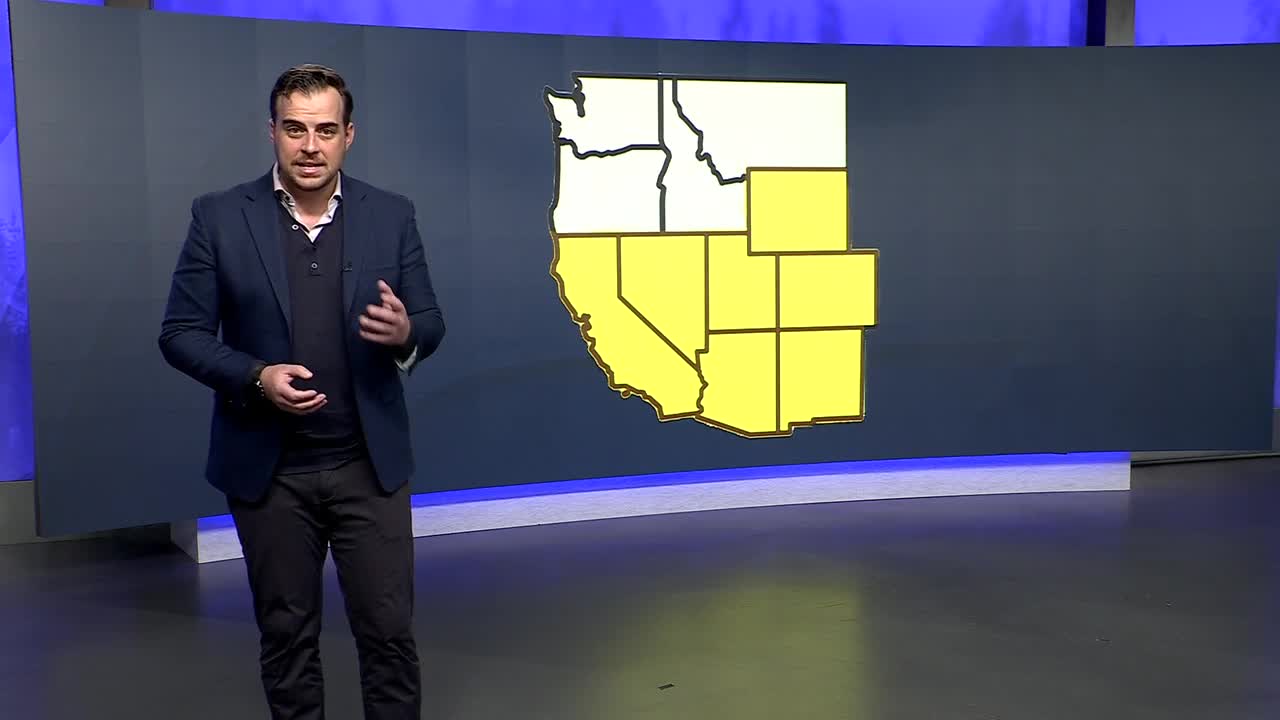


Prominent Colorado water attorney James Eklund tells Denver7 it’s unlikely the seven states in the Colorado River Basin will reach an agreement before its Feb. 14 deadline, shifting control of the Colorado River to the federal government.
The river’s operating guidelines that determine water allocations and replenishment responsibilities expire at the end of the year, and the Department of the Interior said if the states cannot come to an agreement themselves, it will take over.
The Colorado River is often referred to as “the most regulated river in the world” as it supplies Colorado with 40% of its water supply and, more broadly, 40 million people with drinking water across the western United States.
The river has come under intense debate as climate change has sapped its reserves in Lake Mead and Lake Powell.
“It really will produce a crisis [if reservoir levels drop below their minimum levels],” said James Eklund, a fifth-generation Coloradan, and current water attorney based in Denver. “Even if we came together and somehow agreed, it’s still a very long road ahead to make sure the ripple effect of injury and damage is sufficiently mitigated to not cripple economies, ways of life, water for people, water for the environment.”
In 1922, the Colorado River Compact was formed, splitting the seven states into two factions: the Upper Basin states, which rely on Lake Powell (Colorado, Wyoming, New Mexico, and Utah) and the Lower Basin states which rely on Lake Mead (California, Arizona, and Nevada).
After the historic drought of 2002, the states started thinking about contingencies for such conditions, so it created interim guidelines in 2007 that reduced the amount of water Lower Basin states could use during periods of drought.
In 2019, those plans were updated with Eklund’s help as then-Gov. John Hickenlooper’s appointee for Colorado’s River Compact representative (2013-2019), and all seven states agreed.
Then, more persistent drought occurred. In 2023, Lake Mead reached its lowest level ever, and Eklund said it caused the two basins to start operating under their own best interests rather than in the spirit of collaboration, which leads us to where we are only a day out from the current deadline.
“It boils down to the law and legal entitlements [by the states] are running headstrong into the practical reality of the system and how little water there is in Lake Powell and Lake Mead,” Eklund said.
In 2024, the Upper Basin states released this proposal, claiming they bear the brunt of climate change because it changes the snowpack where the river begins and any new rules should reflect that.
The Lower Basin states rejected it, arguing the suggestions were impractical. It countered with a proposal of its own, suggesting a new framework for measuring reservoir levels that it claimed was more “holistic.” It also proposed Upper Basin states face water restrictions once reservoir levels dip below a certain threshold.
That deadlock remains, and Eklund worries what might happen should the Department of the Interior take over.
“The 2007 guidelines expire under their own terms at the end of this year,” Eklund said. “So, whether anybody likes the administration or not, the decision [regarding the Colorado River] needs to be made. It will be made, and inaction is a decision. So, we really don't have a choice of delaying the decision.”
A month and a half ago, President Donald Trump vetoed the bipartisan Finish the Arkansas Valley Conduit Act that would’ve supplied clean drinking water to 50,000 people in southeastern Colorado.
Some suspect it was due to the president’s gripes with Colorado’s politics, and how it handled the case surrounding Tina Peters, the former Mesa County Clerk serving a nine-year prison sentence for trying to overturn the results of the 2020 election.
If the Department of the Interior assumes control of the Colorado River, Eklund worries it may reshape the compact, divvying water based on political motivations rather than need.
“I think we would be foolish to think that we would get a different outcome if we cede this decision making to the administration,” Eklund said. “I don't think they're going to change their attitude toward Colorado anytime soon.”
