

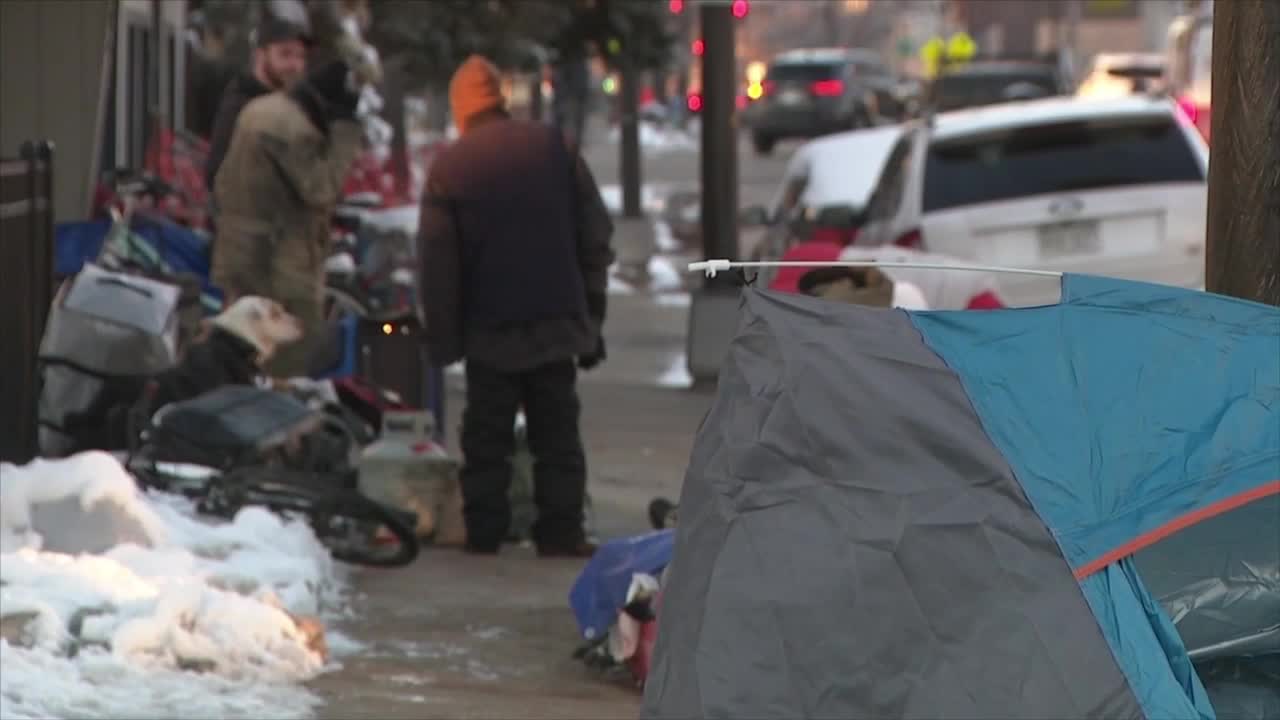


LOVELAND, Colo. — Loveland City Council voted Tuesday night to expand the city's authority to enforce bans on public encampments.
In a 5 to 4 vote, council members passed an ordinance that no longer requires the city to make sure there is a shelter vacancy before giving a public camping ticket.
The city said the passed ordinance puts the city code in line with a 2024 U.S. Supreme Court decision that ruled cities can enforce public camping bans even if there is no shelter space available. The decision reversed lower court rulings that said jurisdictions cannot punish people for sleeping on public property if they don't have access to shelter.
The city council decision comes one week after the city scrapped plans to create a permanent 24-hour shelter and just over a month before Loveland's only overnight shelter, the Loveland Resource Center (LRC), closes permanently. Loveland Mayor Pat McFall said the city decided not to move forward with plans for a long-term shelter after Bridge House, a Boulder-based nonprofit, pulled its application to run the space.
Eric Ford, who said he has been experiencing homelessness since the COVID-19 pandemic, said the new encampment enforcement rules come at a bad time for people living on the streets.

"It just compounds the problem if they don't give them another option," Ford said.
Cody Nelson, who's experiencing homelessness and uses the LRC for services, said people living on the streets will run out of options after the LRC closes.

"No one's got any plans or options to go to," he said. "I'm just trying to do the best I can."
Julie, who has stayed at the LRC overnight shelter, said she feels disrespected by community members and by city leaders.

"It's like they think we're like a piece of dirt on the ground," she said. "That we don't deserve to have some place that we can actually call home.
Council members in favor of the ordinance said it puts them in line with the 2024 U.S. Supreme Court ruling and gives law enforcement the tools they need to enforce city code. Several council members questioned why the city would have an ordinance requiring available shelter space before handing out citations, if there will soon be zero shelter space.
"I don't see this as an end all be all. I don't see this as a stopping point," Councilmember Andrea Samson, who represents Ward 2, said. "There is a place for enforcing our laws. There's a place for having laws. There's a place for safety, and that is extended to all residents. Everyone needs to feel safe. And if you're in Loveland, you should feel like you have a place in Loveland, I don't think a tent is a place that you belong. I think we can do better."
Several council members who voted against the ordinance said it would criminalize homelessness.
"If you say you can't sleep outside, but someone doesn't have a choice other than to sleep outside, you're not criminalizing their choices, you're criminalizing the life situation that they're in," Councilmember Sarah Rothberg, who represents Ward 2, said.
During the meeting, Loveland Police Chief Tim Doran said well over half of police encounters at encampments do not end in citations. When asked by councilmembers if the ordinance would put his officers in a hard spot while enforcing camping bans, he said officers have a duty to respond to calls from citizens.
"I think our officers are used to being in hard spots. That's what we train them to do. Dealing with camping violation is certainly not what our officers join the police force to do. We also need to look at the other side of the coin, is that we receive calls from complainants or reporting parties, and we owe something to them. We owe our diligence to address the complaint that is called in," Chief Doran said.
He said officers do not have time to do full sweeps of encampments and said officers are generally busy going from call to call.
The ordinance drew mixed reactions from community members during the meeting's public comment portion. Some questioned where unhoused individuals would go, while others said the city needed to enforce laws surrounding public encampments.
-
Click here for more stories Denver7 revisited

-

The Follow Up
Denver nightclub tied to sexual assault accusation to reopen under new name
-

The Follow Up
Denver accelerates Aztlan Pool rebuild after leak forced summer closure
-

The Follow Up
Father of cyclist killed in hit-and-run crash fighting for safer Aurora roads


