



FLOYD HILL, Colo. — Three years into one of Colorado's largest mountain highway projects, the Colorado Department of Transportation (CDOT) says the blasting, closures and backups at Floyd Hill are moving to the next phase.
"This is an exciting milestone, being halfway done with the Floyd Hill project," said CDOT Executive Director Shoshana Lew.
She told Denver7 that CDOT has considered the past few months the general "halfway" mark of the project. Denver7 asked about this after noting that CDOT had announced back in May that they were — also — halfway done.
This project officially started in 2023, when CDOT and Kraemer North America partnered to transform eight miles of the Interstate 70 Mountain Corridor between Evergreen and eastern Idaho Springs.
Lew said the stretch had long been a problem area for drivers.
"There was essentially an hourglass problem on the configuration of the highway… just creating one of a few remaining and very challenging sections along the stretch going from Denver into the mountains," Lew said.
As of July 2026, rock blasting operations are now substantially complete. Crews completed 211 controlled blasts and removed more than 765,511 tons of material — equal to the weight of 30 Statues of Liberty.
"We are grateful to the public for their patience. It is hard to deal with things like 15-minute rock blasts on a road as busy and as essential as this one," Lew said.
With excavation largely finished, the project is now shifting its focus to bridge construction. Floyd Hill Project Director Kurt Kionka said the first half was mostly about excavation, and the second half will be about connecting 10 bridges together to create the new road.
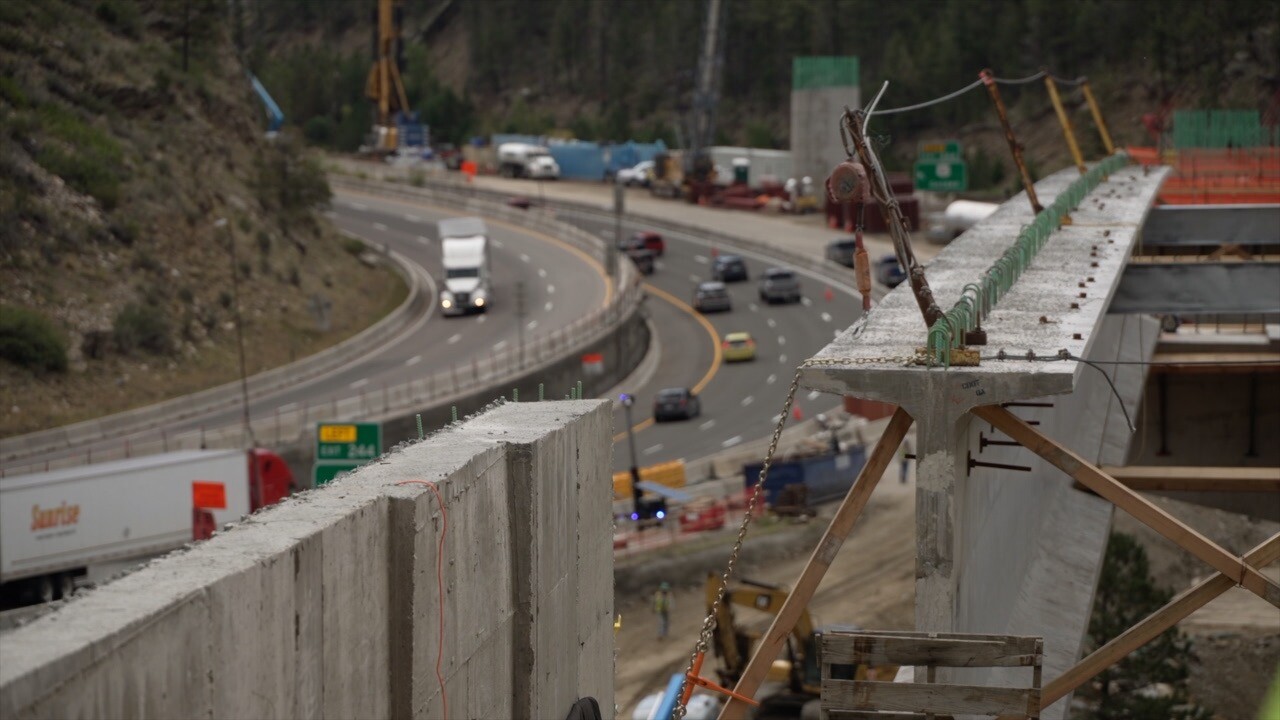
"What you'll see in the future driving through here over the next couple years is a lot of bridge columns come up out of the ground, bridge beams being set, and just substantial bridge construction," Kionka said.
At the bottom of Floyd Hill, crews are using a construction method called balanced cantilever segmental construction — an approach Kionka said is not commonly used in the Denver area.
"What's so unique about this method of bridge construction is it allows us to do very long spans. These spans... Some of them are over 300 feet," Kionka said.
The method involves building a pier column up from the ground, then extending the bridge outward in 15-foot sections cantilevered from the column before connecting them in the middle. Kionka said the approach was chosen in part because of the complex conditions at the bottom of the hill, where crews must keep both eastbound and westbound I-70 open, cross over Clear Creek and navigate around an active landslide, all while going around a curve.
"We're doing it over live traffic up in the air, and so that makes it so that we don't have to close traffic during construction," Kionka said.
► Watch Ethan Carlson's report in the video below:
Since late 2025, crews have constructed 15 bridge columns and erected 31 bridge beams. The project includes more than two miles of deep caissons drilled into bedrock across all structures.
The good news for drivers is that the most disruptive phase is now largely behind them. CDOT said the 20-minute traffic holds that were common throughout the week during the first half of construction are now largely complete.
"Expect all lanes to be open during those busy times of travel through here. If you come here overnight, you might see lane closures," Kionka said.
From early to mid-August, CDOT said drivers can expect a series of overnight, single-direction eastbound and westbound I-70 closures at the bottom of Floyd Hill near the US 6 interchange for segmental bridge construction.
The project is also adding a new connection from the bottom of the hill at US 6 into Central City Parkway, which will provide an alternate route when I-70 is shut down and reduce lengthy detours.
CDOT said the project remains on schedule and on budget. The new I-70 alignment is expected to open in 2028, with the full project finished in 2029. When complete, the corridor will be brought up to a 55 mph design speed.
"It's going to feel much better, much safer as you go through here," Kionka said.

