




DENVER — President Donald Trump on Thursday said he was granting a “full pardon” to disgraced former Mesa County Clerk Tina Peters, who was convicted last year on state charges for tampering with Colorado's election systems in the 2020 presidential election.
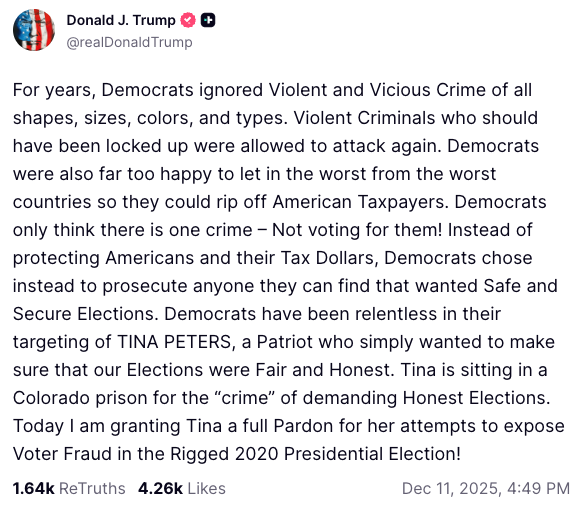
In a post on his Truth Social platform, President Trump continued to air grievances about Democrats, accusing them of relentlessly targeting Peters, who was convicted and sentenced to nine years behind bars for granting unauthorized access to Mesa County voting systems that she oversaw while continuing to press discredited claims about voter machine fraud.
Describing her as a “Patriot who simply wanted to make sure that our Elections were Fair and Honest,” Trump said he was granting the former county clerk “a full Pardon for her attempts to expose Voter Fraud in the Rigged 2020 Presidential Election!”
Legal experts who spoke with Denver7 late Thursday afternoon, however, said the president of the United States doesn’t have that kind of power.
“It’s purely performative, like 99% of the stuff he does. It has no impact on anything. She is not charged with any federal crimes. She is not convicted on any federal crimes. And President Trump has no ability to stick his nose into the Colorado justice system,” David Lane, a Denver-based civil rights lawyer told Denver7.
The American Bar Association agrees.
“A U.S. president has broad but not unlimited powers to pardon. For example, a president cannot pardon someone for a state crime,” the ABA states on its website.
Citing Article II, Section 2 Clause I of the U.S. Constitution, the ABA notes that the president has the power to grant reprieves and pardons “for Offenses against the United States.”
“In other words, state law enforcement authorities could review any criminal allegations, without presidential intervention, to determine if they rise to the level of a state offense,” the ABA website reads.
Colorado government officials weigh in on Trump's attempt to pardon Peters
Secretary of State Jena Griswold was the first to denounce the president's pardon of Peters, telling Denver7 the president's announcement is an "assault not just on our democracy, but on states' rights and the American Constitution."
"Tina Peters was convicted by a jury of her peers for state crimes in a state Court. Trump has no constitutional authority to pardon her," Griswold said.
Dan Rubinstein, the Mesa County District Attorney, said Trump "does not have authority to pardon her. No court will uphold that order."
The Colorado Democratic Party was quick to point out that legal experts from across the spectrum agree that presidential pardons do not extend to state charges.
In a statement obtained by Denver7, Colorado Democratic Party Chair Shad Murib said they were not surprised by the president's "meaningless pardon for his friend and fellow election denier Tina Peters."
"For a president who obviously doesn't respect the rule of law, this is not surprising," Murib said. "Nobody is above the law, not even the president's friends."
Colorado Attorney General Phil Weiser, who is running for governor of Colorado in 2026, issued the following statement:
“One of the most basic principles of our constitution is that states have independent sovereignty and manage our own criminal justice systems without interference from the federal government. The idea that a president could pardon someone tried and convicted in state court has no precedent in American law, would be an outrageous departure from what our constitution requires, and will not hold up."
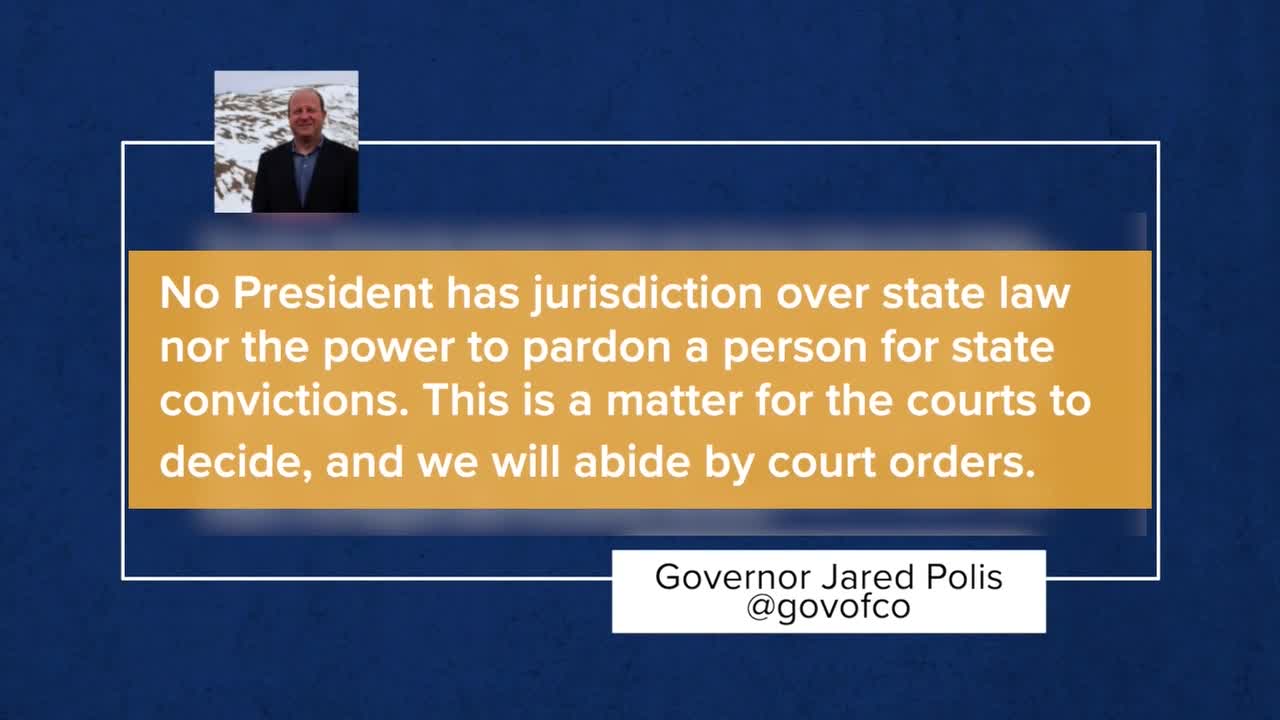
Gov. Jared Polis said in a statement early Thursday evening that Peters' conviction was "a matter for the courts to decide, and we will abide by court orders."
"Tina Peters was convicted by a jury of her peers, prosecuted by a Republican District Attorney, and found guilty of violating Colorado state laws, including criminal impersonation. No President has jurisdiction over state law nor the power to pardon a person for state convictions. This is a matter for the courts to decide, and we will abide by court orders," Polis wrote on X, formerly Twitter.
Trump’s latest attempt at trying to influence state law comes just a few days after a federal judge rejected Peters’ latest bid to be released from prison while she appeals her state conviction.
Peters filed a federal lawsuit asking that she be released on bond while her appeal is considered. Attorneys for the state had argued the case should be thrown out partly because of a legal doctrine that prevents federal courts from getting involved in pending state criminal cases.
But federal magistrate judge Scott Varholak ruled Monday that Peters didn’t make a case that he should get involved in overturning her state sentence.
Peters argued that the magistrate judge should free her because she said the state judge who sentenced her to nine years behind bars violated her First Amendment rights. Peters claimed he punished her for making allegations about election fraud, but prosecutors argued that the U.S. Supreme Court has allowed judges to consider people’s speech during sentencings if they deem it relevant.
During Peters’ October 2024 sentencing, Judge Matthew Barrett called the defendant a “charlatan” and said she posed a danger to the community for spreading lies about voting and undermining the democratic process.
- "You are a charlatan": Watch the moment a judge sentenced Tina Peters to nine years in prison:
Peters was unapologetic and insisted that everything she did was geared toward trying to unroot what she believed was fraud. She claimed her actions were done for the greater good.
Her lawyers argued that Barrett was wrong to call Peters statements “lies” and said there was no evidence her speech posed a danger.
President Donald Trump and other supporters, including retired Lt. Gen. Michael Flynn, the national security adviser during Trump’s first term, have repeatedly called for Peters to be released. In August, Trump warned he would “take harsh measures” if Peters wasn’t freed, saying she was old and very sick.
The administration sent a letter to the Colorado Department of Corrections (CDOC) in mid-November asking that Peters be transferred to federal custody. One her lawyers said he believed the request was made so Peters could more easily be involved into an investigation into the 2020 election.
That request was denied a few days later, with a CDOC spokesperson telling Denver7 requests to transfer inmates housed in state prisons “emanate from the state, and not from other entities.”

Politics
State officials appear to reject Tina Peters transfer request
A day after Peters’ bid to be freed from state prison was rejected, the U.S. Department of Justice announced it was launching a sweeping investigation into alleged violations against inmates across dozens of Colorado correctional facilities.
Specifically, the investigation will focus on whether there is a pattern of constitutional rights violations, such as inadequate medical care, unsafe and unsanitary conditions, and excessive force against juveniles.
Lane, who spoke with Denver7 about the DOJ investigation earlier this week, said he was skeptical of the timing and intent behind the federal investigation since it coincided with the federal push to transfer Peters into federal custody.
"Payback to Jared Polis because he won't turn Tina Peters over to federal custody so Trump can let her out of jail, that's what's probably motivating this," said Lane. "But the fact is, it doesn't matter what's motivating it if DOJ actually is going to do the job that they're paid to do, which I'm very skeptical of."
The DOJ got involved in Peters’ federal case in March, saying “reasonable concerns” had been raised about her prosecution. It also said the DOJ was reviewing whether the prosecution was “oriented more toward inflicting political pain than toward pursuing actual justice or legitimate governmental objectives,” a line from an executive order entitled “Ending the Weaponization of The Federal Government” that Trump signed shortly after his inauguration.
The state objected to the federal government inserting itself, saying the statement the department filed in the case appeared to be a “naked, political attempt” to intimidate the court or Peters’ prosecutors. It unsuccessfully asked for the court to reject it.
There is no evidence of any widespread cheating in Colorado elections, which have been staunchly defended by county clerks throughout the state, most of whom are Republican. Peters was prosecuted by an elected Republican district attorney, and the three supervisors in her conservative-leaning county also supported the case and defended the integrity of the state’s elections.
The Associated Press contributed to this report.


Denver7 is committed to making a difference in our community by standing up for what's right, listening, lending a helping hand and following through on promises. See that work in action, in the videos above.