



DENVER — A debate that has dominated headlines across the country has made its way to Colorado's November ballot, where voters will have to decide what role gender identity plays in youth sports.
Initiative #109 submitted almost 169,000 petition signatures, which landed the Protect Women and Girls Sports Act on the general election ballot.
The final text of the measure asserts that separating athletic teams by sex due to "physical differences between males and females" reduces the chance for injury, promotes equality, and "allows female athletes to compete on a fair playing field for athletic accomplishments, including educational scholarships."
Protect Kids Colorado, an organization that seeks to "mobilize the people of Colorado and the Church to engage with biblical and biological truth," is behind Initiative #109.
The proposal encompasses students ranging from elementary school to college, who would have to classify their sports teams as male, female, or coeducational. Teams designated as female would not be open to male students, but male teams would be open to female students if no female team is offered for the specific sport.
"Our intent is to protect females' opportunity, not restrict it," said the Executive Director of Protect Kids Colorado, Erin Lee. "For example, there are female kickers on the football team, where there are appropriate positions for females, and they don't have an opportunity of their own."
The concept is controversial and would restrict the ability of transgender youth to participate in school sports that are consistent with their gender identity.
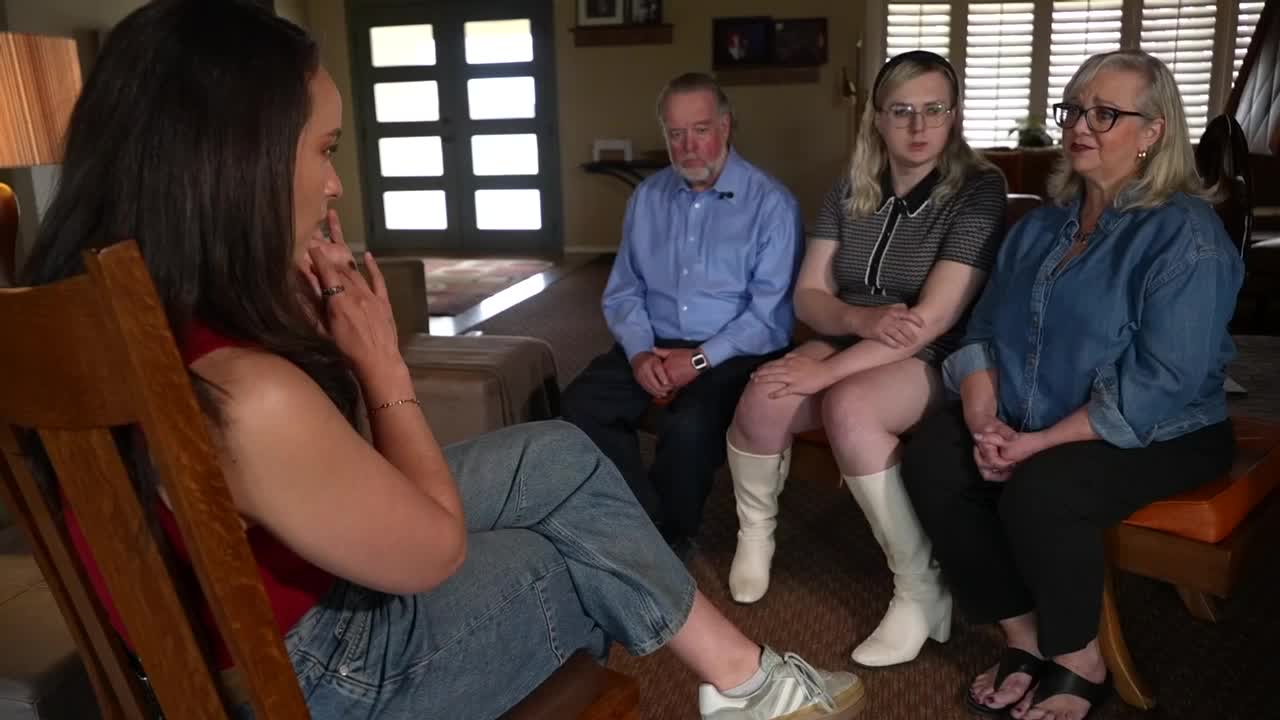
Denver7 spoke with individuals on both sides of the ballot measure, including a teen athlete who advocates for the proposal, and a family who believes the issue only hurts the transgender community.

On a brisk and bright morning in Severance, Maddie Wilcken was warming up for her match as part of a larger tennis tournament.
"I'm a very competitive person," said 16-year-old Wilcken. "I can't imagine my life without sports.”
Wilcken said she is an advocate for XX-XY Athletics, which is how she connected with Protect Kids Colorado.
"I have no hate toward anyone at all. I will never speak down about anybody," said Wilcken. “It's really just about equality and having the same chance and fairness.”
The teenage athlete told Denver7 she has played a number of sports over the years, including wrestling.
"I wrestled a biological male, and it was so fast," said Wilcken. "In the blink of an eye, and it was over. I tried, but really, the strength was unmatched.”
She supports Initiative #109, and believes it is not an idea motivated by hate or discrimination.
"I just believe that women's sports should be for women, and that’s it," said Wilcken.

Education
Trump admin: Jeffco Schools violate Title IX with transgender student policies
However, at a cozy home in Denver, the Lindsey family strongly disagreed with that assessment of the ballot measure.
“It's a damn shame that we're here," said David Lindsey, sitting on one side of his daughter, Rose Lindsey. "This is a solution looking for a problem.”
“This is codifying bullying in the statute," said Catherine Lindsey, from the other side of her daughter.
► Watch Colette Bordelon's report in the video player below:
The Lindsey family told Denver7 they have never been too vocal about the issue, but felt they could not stay silent any longer. They first went public with their perspective as part of a campaign launched in opposition to Initiative #109, called Families, Not Politics, which urged Coloradans to vote against the proposal.
"I feel like gender in general is being thrown under the bus for the sake of trying to create a boogeyman out of trans people," said Rose Lindsey, a transgender woman in her mid-20s.
Rose Lindsey said she has always felt supported by her parents, and did not realize how rare that was until meeting other transgender women, whose familial relationships were fractured when their true gender identity was revealed.
“A ballot measure like this is an intimidation tactic. It's communicating to children that either you allow yourself to identify as trans, or you get to play sports," said Rose Lindsey. “It is making a statement that if you want to live your life this way, it means that you don't get to be with the rest of us.”
According to One Colorado, an organization that advocates for the LGBTQ+ community, estimates show that less than 2% of Colorado children are transgender.
"If it ain't broke, it doesn't need fixed. There's not a problem right now, other than one that's made up by politicians," said David Lindsey. "There's no need for this law. Parents will make the right decision. Parents aren't going to put other children at risk to have their kid play sports. I just don't believe that that's something that would happen.”
The Lindsey family believes the ballot measure is about safety, but not in the way proponents say.
"This is about the safety of every child and their ability to be fully who they are," said Catherine Lindsey. "Letting a family take this journey with a sense of privacy and a sense of safety means that their kid gets to be fully who they are. They don't have to pretend to be somebody that they're not.”
Rose Lindsey said her goal in speaking out is to ensure the place where she grew up is a safe space for other children who may find themselves in her shoes.
“This is an extremely pivotal moment," said Rose Lindsey. "These are the first days where we're deciding what is okay? What lines are we willing to cross? What freedoms are we willing to capitulate?"
The general election is on Nov. 3. If Initiative #109 is approved by Colorado voters, it would go into effect at the start of 2027.


