



DENVER — The Colorado Supreme Court on Friday rejected an appeal that sought to stop a proposal that would raise taxes on the state’s wealthiest residents from appearing before voters this November.
The appeal, filed by Michael Andre Hancock, an Arapahoe County resident, came just a day after a Denver judge rejected a last-minute effort by Hancock to nullify the votes already cast on the ballot question last week.
Hancock brought forth the lawsuit against Secretary of State Jena Griswold and Amendment 87 proponents Chris deGruy Kennedy of the Bell Policy Center and Kiyana Newell of New Era Colorado in September, alleging there were violations with the signature gathering process for the measure. The lawsuit also challenged the Secretary of State's review of the signatures.
What do Colorado Democrats think of Amendment 87? Watch what they had to say in the video below:
On Friday, the Supreme Court affirmed the Denver District Court’s decision, saying in a one-page ruling that the court would issue a full opinion "in due course."
"Twice now, Colorado courts have said that more than 130,000 voters who signed this petition deserve to have their signatures count, and that Coloradans deserve to decide this question for themselves," said Chris deGruy Kennedy, co-chair of Protect Colorado's Future and President of the Bell Policy Center, in a prepared statement.
Last week, deGruy Kennedy admitted there were "administrative oversights" during the initial registration of a small number of paid circulators, but said the campaign fully disclosed every paid circulator after petitions were turned in. He said Protect Colorado's Future was "substantially complying with the letter and spirit of the law."
"The attempt by these dark-money-funded lawyers to say otherwise was a perversion of the law with one goal: deprive Colorado voters of the opportunity to vote on Amendment 87," deGruy Kennedy said in a statement Friday.
Jason Dunn, an attorney for the plaintiff, said Friday’s ruling by the state Supreme Court, “is disappointing as it leaves a system in which there will be little accountability for those who collect signatures and fail to follow the rules.”
From her part, Griswold said she appreciated the court’s “quick affirmation… [that] Amendment 87 was rightly certified to the ballot, and every voter in this contest will have their voice heard.”
What does Amendment 87 do, exactly?
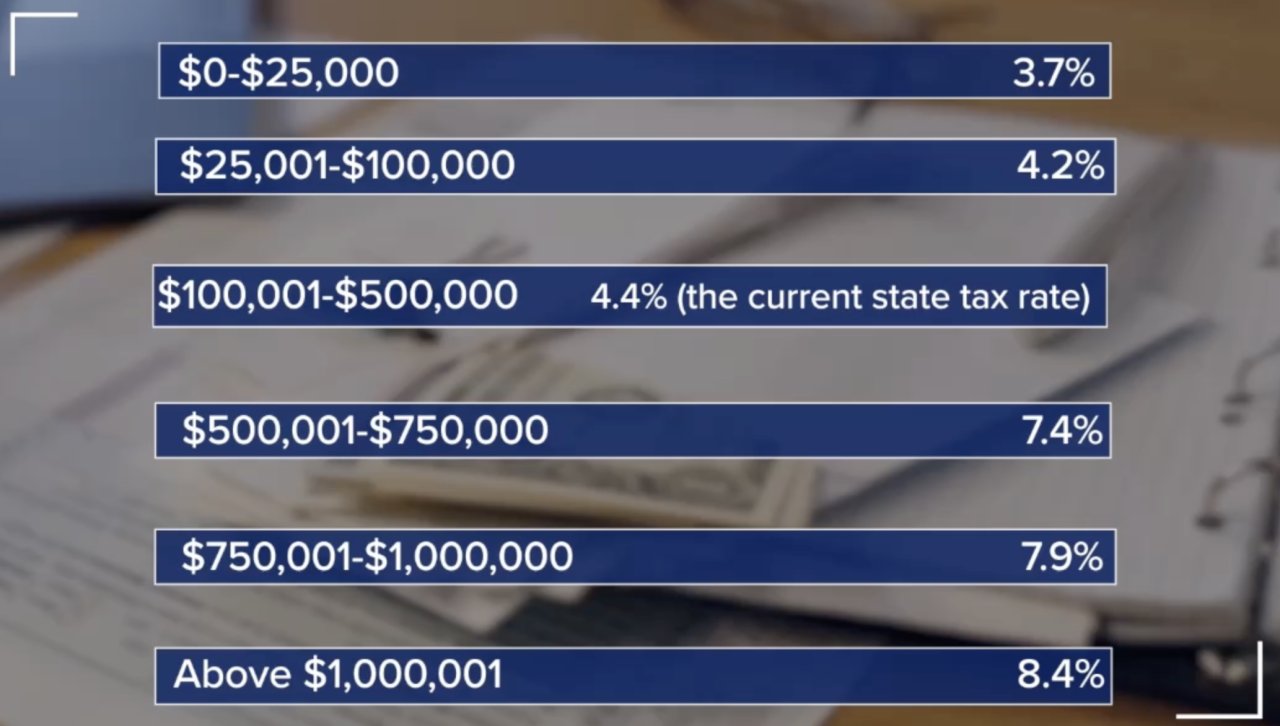
Under Amendment 87, the state would do away with its current 4.4% flat income tax rate, and would instead create a graduated income tax bracket.
Individuals and small businesses making less than $500,000 per year would see a drop in their state income taxes. Taxes would rise for individuals and businesses who make above $500,000 thanks to a graduated tax rate.
Here's how that income bracket breakdown would work if Amendment 87 passes:
Any revenue made from this change would go to the Colorado Futures Account, a proposed fund that would give money to public education, healthcare and early child care programs.
Amendment 87 is separate from Proposition 136, which is another ballot measure that could cap individual and corporate taxes at 4.4%. If voters approve both, the proposed tax rates within Amendment 87 would be higher than the limit set by Proposition 136.
According to the 2026 Blue Book, the state legislature or a court will have to resolve any conflicts that arise if both measures pass since the "exact outcome is unclear."
In Colorado, a ballot measure needs signatures from 5% of the total number of votes cast in the Secretary of State race in the prior general election.


