



DENVER — A last-minute effort to stop Amendment 87 from appearing before Colorado voters on the November ballot this year was rejected by a Denver judge Wednesday.
Michael Andre Hancock, an Arapahoe County man, filed suit against Secretary of State Jena Griswold and Amendment 87 proponents Chris deGruy Kennedy of the Bell Policy Center and Kiyana Newell of New Era Colorado, alleging the signature gathering process for the graduated income tax ballot question was done incorrectly. The lawsuit also challenged the Secretary of State's review of the signatures.
Watch Denver7's previous reporting on this lawsuit in the video below:
During a hearing Monday, the defendants admitted that mistakes were made in the signature gathering process but said they proved in court it was not to the extent alleged by Hancock.
“There were a couple issues where not all the circulators were registered, but I think what we showed is that was not the case in enough cases to disqualify the measure from the ballot," said deGruy Kennedy. “What we showed in the evidence today is that at most we're talking about 33 circulators having their signatures disqualified, and that is not enough to knock 87 off the ballot."
On Wednesday, Denver District Court Judge Heidi L. Kutcher ruled that Hancock “did not meet his burden to establish” his case against Griswold and Amendment 87 proponents.
“Therefore, the Court DISMISSES this matter,” Kutcher wrote in her ruling Wednesday.
In a statement following the ruling, Griswold said she appreciated the Court’s “careful consideration of this matter, and look forward to voters making their voices heard on this question.”
Griswold said voters should continue to vote on the ballot they were sent.
Amendment 87 tackles Colorado’s flat income tax rate by instead offering a graduated tax rate. Colorado currently has a 4.4% flat income tax. A ‘no’ vote on 87 would keep the rate the same. A ‘yes’ vote on Amendment 87 would tax income by bracket and remove the flat tax rate from the Taxpayer’s Bill of Rights, more commonly known as TABOR.
Here's how that breakdown would work if Amendment 87 passes:
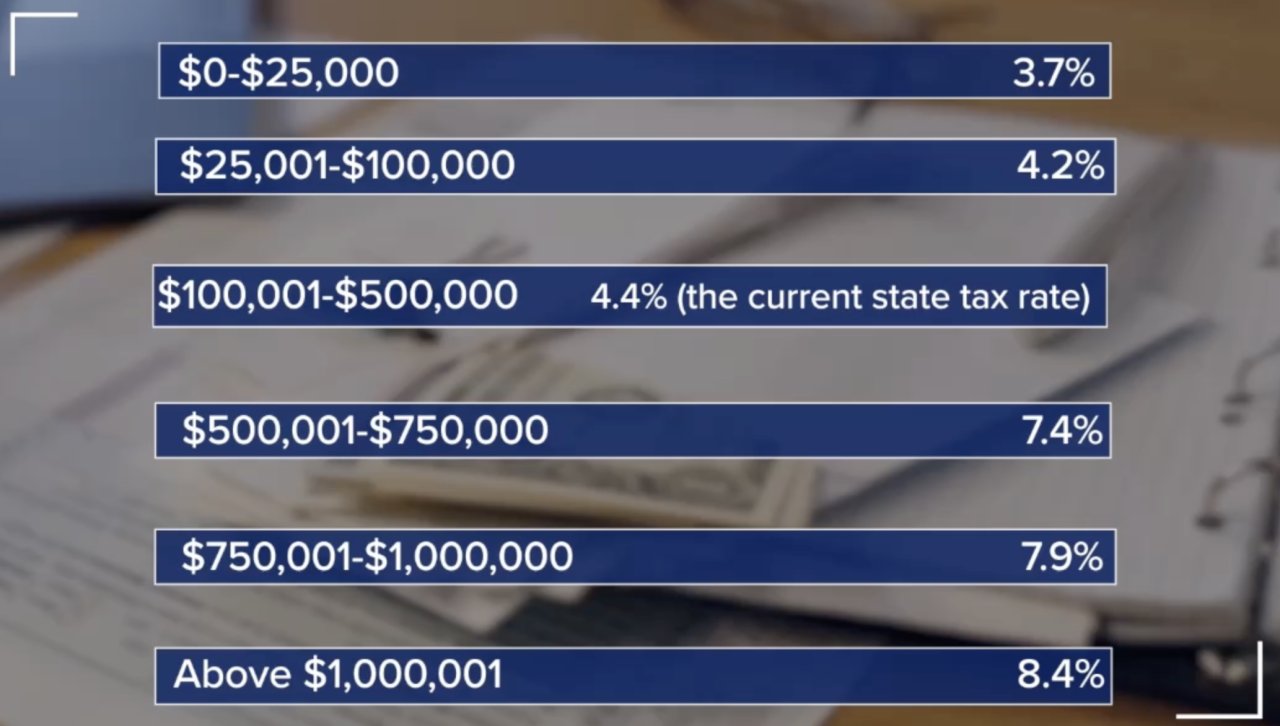
Any revenue made from this change would go to the Colorado Futures Account, a proposed fund that would give money to public education, healthcare and early child care programs.
Amendment 87 is separate from Proposition 136, which is another ballot measure that could cap individual and corporate taxes at 4.4%. If voters approve both, the proposed tax rates within Amendment 87 would be higher than the limit set by Proposition 136.
According to the 2026 Blue Book, the state legislature or a court would have to resolve any conflicts that arise if both measures pass since the "exact outcome is unclear."
In Colorado, a ballot measure needs signatures from 5% of the total number of votes cast in the Secretary of State race in the prior general election.



Denver7 is committed to making a difference in our community by standing up for what's right, listening, lending a helping hand and following through on promises. See that work in action, in the videos above.


