



Avalanche danger has increased Wednesday with several avalanche warnings in place across much of Colorado's mountains as new snow falls on weak snowpack.
Denver7 is continuing to cover avalanche danger levels this week as conditions in the backcountry become more dangerous, especially on Wednesday through the end of the week.
"Wednesday is a day to avoid avalanche terrain," the Colorado Avalanche Information Center wrote on social media.
The avalanche danger level remains at four out of five, or "High," on CAIC's scale. The following places are under an avalanche warning as of noon: the Flat Tops, Park Range, Grand Mesa, Elkhead Mountains, Gore Range, Sawatch, West Elk, Elk Mountains, and San Juan Mountains.

During avalanche warnings, people can trigger large and destructive avalanches, but they may also break naturally. Those warnings will likely stay in place through Thursday.
Until the warning is over, CAIC recommends that backcountry adventurers avoid avalanche terrain, including under slopes with a steep angle, through Friday.
The Elk and West Elk Mountains will likely get the most snowfall and "very large" natural avalanches will break at ridgetops and will reach valley floors, CAIC said.

One concern in the northern mountains will be drifting snow due to strong winds at lower elevations. Humans will be able to trigger a deep avalanche in those same areas where the slopes are wind-loaded.
"Exposed slopes that continue to receive wind-drifted snow will be the most dangerous," CAIC reported. "The Park Range is expected to see the most rapid rise in avalanche danger, and the peak of instability will arrive first, by midday Wednesday."
Denver7 reported on Monday that experts are warning that the snowstorms hitting the mountains this week will create the "largest and most destructive" avalanches of the season.
Denver7 Anchor Shannon Ogden spoke with Brian Lazar, CAIC deputy director, about this storm on Monday. Watch that video below.
The CAIC said peak winds and heavy snow are rapidly loading weak snowpack this week, which is creating dangerous avalanche conditions.
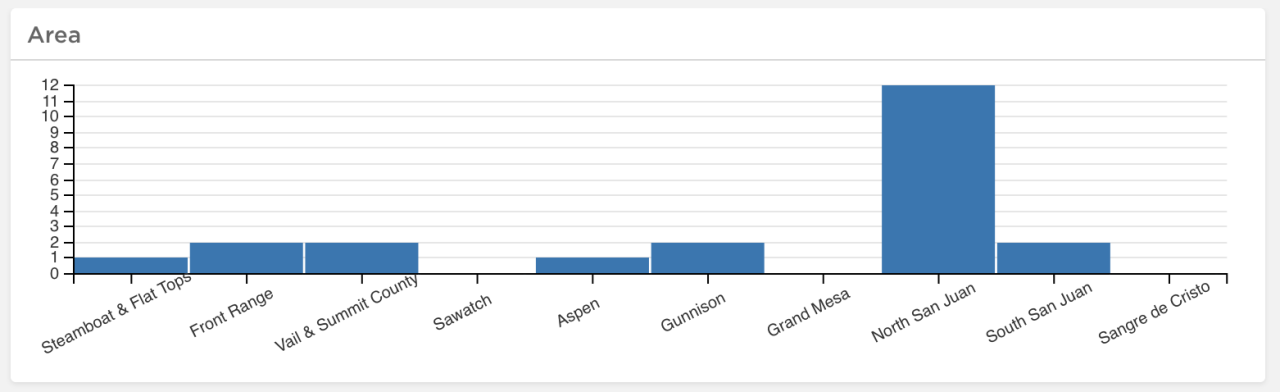
Since Sunday, 22 avalanches have been observed and recorded, as of Wednesday morning. Of those, 12 were triggered by people and nine happened naturally. It's not known how one started.
Below is a graph illustrating where those avalanches occurred.
In other avalanche news, officials are working to find one missing person after an avalanche near Lake Tahoe in California on Tuesday. The slide killed eight backcountry skiers, making it the deadliest avalanche in the United States in more than four decades. Here's more on that story.

