



DENVER — UPDATE (4/2): The University of Colorado rolled out school-sponsored Chat GPT to faculty and staff as planned this week, with the release for students delayed until Aug. 14.
Concerns from students and faculty about issues like data security and the quick timeline led the university to delay the rollout.
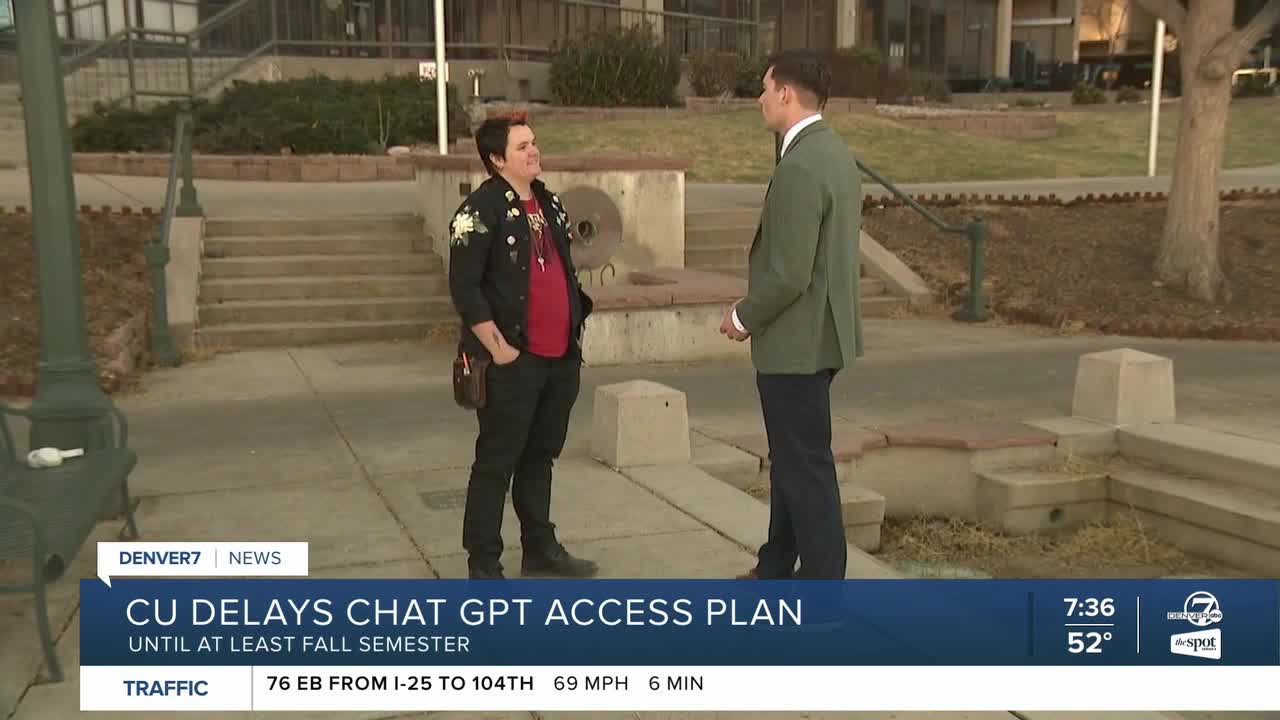
This week, Denver7 followed back up with CU Denver student Flynn Zook, who called that decision "huge."
"It means that students don't just have, like, mass access to this resource, without training, without a conversation happening about this," said Zook. "And it gives us in the arts and us on like the college campuses as a whole, a chance to actually spend some time, like, creating a code of ethics for how this is used in classrooms. And we can go about this in a way that's much more measured and much more helpful long term."
Zook added that artificial intelligence "is a fluctuating technology, so our guidelines and our ideas around it are going to have to fluctuate with it."
"A huge show of faith from the university would be to be so transparent about this contract, which they have failed to do in the prior month and a half since this was announced," said Zook. "And like, actually going through answering beat-for-beat, all of the faculty and student like questions and concerns and being very explicit about that... We need our concerns addressed if we're going to continue moving forward with this. Now you have time to answer the questions."
CU Denver associate professor Sasha Breger Bush sent Denver7 a statement reacting to the student rollout delay, which she calls a "good idea."
"The decision affords us more time to think, learn, debate, and strategize about the role of AI on campus and in our classrooms," said Breger Bush. "The decision also permits more time for shared discussion of the policies and other institutional infrastructure required to ensure ethical use of AI in support of the public service mission of the University of Colorado.
"My hope is that, in advance of any decision to renew the contract, all campus constituencies have substantive opportunities to share their feedback. Decisions of this magnitude require a proportionately large and robust community discussion."
— Previous coverage below:
The University of Colorado is delaying its plan to give Chat GPT Edu access to students across its campuses until August 14 — around the start of the fall semester — after pushback from the campus community.
The university said it will still roll out access to faculty and staff as planned on March 31.
CU sent Denver7 a statement explaining the decision, saying in part, “This decision reflects faculty concerns about potential disruption to the learning environment, and we fully support faculty in setting expectations for their individual classrooms.”
The university’s three-year contract with ChatGPT creator OpenAI is renewable annually and will cost CU roughly $2 million a year.
Before announcing the delay, CU told Denver7 the cost is worth it because it allows every student learn and engage with the technology before graduating and getting a job. CU also stressed that it is not requiring instructors to incorporate ChatGPT into their classes.
Campus concerns
Hundreds of faculty signed a letter of dissent taking issue with the rollout.
Before CU announced it would be delaying the rollout, Denver7 heard from a student and a professor at CU Denver who shared some of those concerns, including the quick timeline for the systemwide rollout. They also worry the partnership sends the wrong message about academic integrity, with studies showing artificial intelligence can dull critical thinking skills.
“My issue is not that you're trying to incorporate AI into the learning curriculum; my issue is how you're doing it,” said Flynn Zook, a CU Denver animation and illustration student, especially concerned about the technology’s impact on that field.
Zook also led an effort to survey students and faculty about the pending rollout and provide community updates.
“That needs to be a conversation and not just a statement of: ’Is it our responsibility to just sit down and embrace this, or like, can we have a conversation about how this actually fits into our education and our lives as a whole?’” Zook added.
“As a teacher, I'm really concerned about what I consider to be outsourcing critical thinking and cognition,” said CU Denver associate professor Sasha Breger Bush. “I’m concerned that we're pretty close to a world where we're just awash in data, but we don't have the wisdom or the knowledge to make meaning and good use of it.”

Faculty have also shared concerns about data privacy. CU says its agreement prevents OpenAI from using “any CU environment to train its large language models.” However, CU also confirmed to Denver7 that faculty using ChatGPT for university business might create records considered to be public through a Colorado Open Records Request (CORA). Student records and activity will be protected under the Family Educational Rights and Privacy Act (FERPA), CU says.
There’s also political pushback against partnering with OpenAI. The company’s president donated $25 million to a super PAC supporting President Donald Trump, and the company also recently struck a deal to partner with the Trump administration’s Department of Defense.
“There's a war on now in Iran, and these technologies are actively being used to support that war,” Breger Bush told Denver7. “And I'm concerned that my university and a public university, Colorado's university, is directly financing those efforts.”
Last week, Zook said CU’s efforts to communicate the partnership felt “very disingenuous to the community on this campus.”
“We have a lot of variety of people, thoughts, beliefs, and I think that's what makes this campus so cool,” Zook said. “They're saying that they care about their students and their community, and like they talk all the big administrative words about like we're doing this for you… and choose to go with a company that actively goes against that ideology.”
CU responds
CU leaders did not sit down with Denver7 for an interview, but spokesperson Michelle Ames responded to the following questions via email:
Denver7: Why is this $2 million contract with OpenAI a worthy investment, as opposed to expanding financial aid, resources for at-risk students and faculty, increasing pay for graduate students or financing other university improvements?
CU: We recognize that access to emerging technologies is increasingly important for teaching, learning and research. We view this effort as a matter of equity in educational tools. This initiative is intended to help ensure that every student has the opportunity to learn this technology and be prepared to engage with it in a rapidly evolving workforce on graduation. For perspective, CU invests $375 million annually in institutional financial aid for students, more than the state of Colorado invests in financial aid for all of higher education.
Denver7: Why was this decision made without a longer conversation and process, including shared governance and more input from CU AI experts?
CU: Adoption of generative AI is already occurring across CU at significant scale. That created urgency around both equity in access as well as security of personal data. Right now, thousands of people across CU are already using commercial versions of ChatGPT (free and paid), so in that way, the community is broadly speaking on the use of generative AI and the use of this specific tool. A cross-campus working group discussed the institutional implications of generative AI and shared perspectives from across the campuses. Taking that input into account, and recognizing the scale of AI use already occurring, and the need to ensure AI usage protects the university and university community to the greatest extent possible, university leadership determined that an enterprise version of ChatGPT guarantees protections not available in the commercial versions.
Denver7: Some faculty are concerned that there are insufficient CU policies regarding academic dishonesty involving AI specifically, and insufficient training for instructors on how to effectively use this tool in courses as it is rolled out to the student population. What is your response to those who are concerned?
CU: All existing university policies including those outlining and prohibiting academic misconduct apply to all generative AI tools, whether the university provides them or not. Each Chancellor is standing up an AI advisory group that would, in part, be involved in resources to support faculty in their management of AI tools, which are already being used in significant numbers by students. In addition, the university is revising its current generative AI policies and our governing body, the CU Board of Regents is also adopting a high-level policy on this topic. All users will be required to take a mandatory training prior to gaining access to this environment.
Denver7: There is concern this partnership could end up subverting academic integrity for students and faculty. Why are the current trainings and guardrails enough to prevent this outcome?
CU: All existing university policies including those outlining and prohibiting academic misconduct apply to all generative AI tools, including the tools thousands of people are already using, whether the university provides the tool or not. Faculty retain authority over how generative AI may or may not be used in their courses. University policies and trainings will continue to evolve as generative AI continues to evolve and we are working toward a more training around issues such as ethical use for students that should launch in the fall.
Denver7: What is CU’s policy and/or protocol for reporting data breaches to students, staff, and faculty?
CU: CU has a data exposure response process that is invoked when a possible data exposure event is identified by CU staff or a third-party (including OpenAI) that handles CU data. This process investigates each situation and determines CUs actions regarding notifications to affected individuals and any relevant regulatory bodies.=
Denver7: Is there a requirement to notify the CU community or an involved party when OpenAI discloses data to law enforcement or as part of a legal process?
CU: OpenAI and CU would provide notifications as required by applicable law. Each response may be different based on the status of the individual involved and the applicable law. For example, under FERPA, if the University or OpenAI are disclosing a student’s education record in response to a judicial order or a lawfully issued subpoena the University has to make a reasonable effort to notify the eligible student of the order or subpoena in advance of compliance, unless the subpoena prohibits student notification.
Denver7: Are these ChatGPT chat logs subject to the Colorado Open Records Act, meaning public records requests could reveal any of this data? How is CU communicating this topic to users?
CU: The Colorado Open Records Act allows the public to view work-related records of public employees regardless of whether they are created through email, Microsoft Office, or ChatGPT, for example. How the record is created does not control whether a record is considered public or not. If you work for the university and use ChatGPT to conduct university business, the records you create might be considered public. We have highlighted this for staff in our existing FAQs.
Denver7: We've heard concern about partnering with OpenAI specifically, because of the company's ties to the Department of Defense and Open AI's president's financial support of the Trump administration. Does CU have a response to this concern?
CU: We have more than 30,000 CU email addresses using some form of ChatGPT right now, most of whom are using the free version. It is important to us we provide secure and equitable access to this environment for our students, faculty and staff, in addition to safeguarding our data.
