

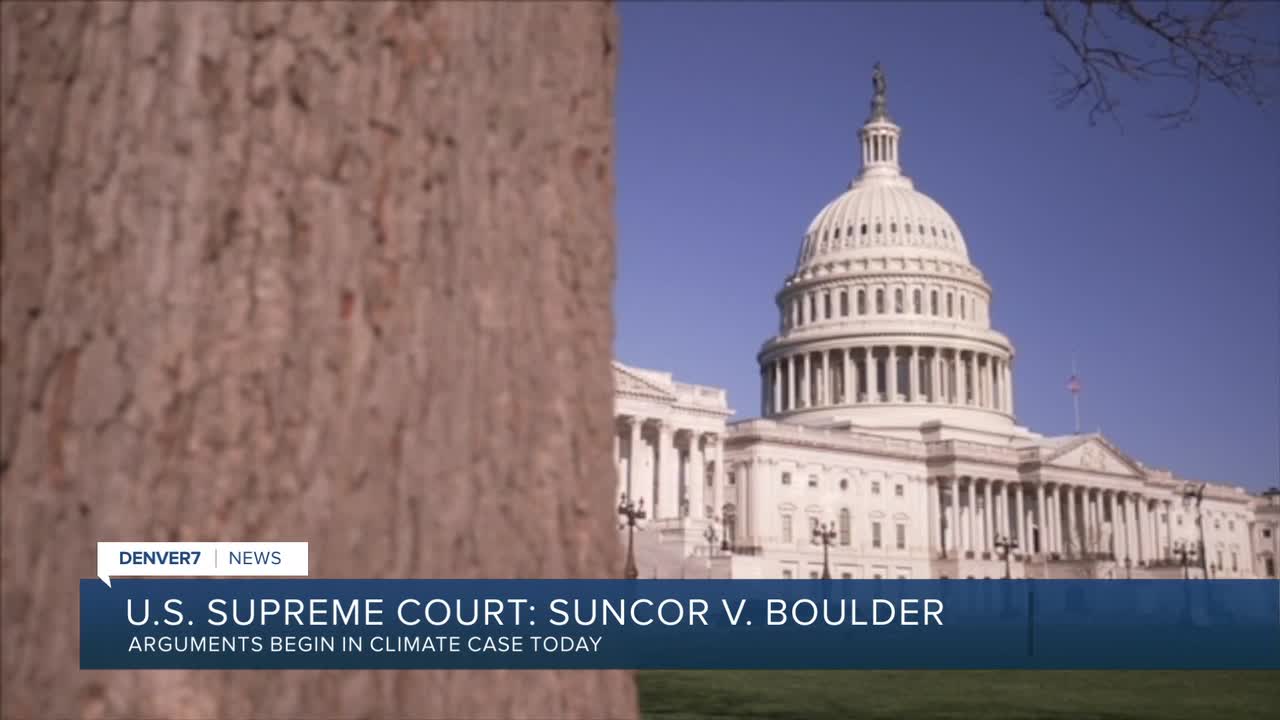


BOULDER, Colo. — Boulder lawyers are in front of the Supreme Court Monday morning, arguing in the term’s first case about climate change and state power.
In Suncor Energy Inc. v. County Commissioners of Boulder County, the justices will consider if federal law can stop state lawsuits that allege injury from climate change while also deciding if the court even has authority to hear this case.
Denver7’s Alex Dowd breaks down what is at stake in this case:
The city and county of Boulder originally filed this lawsuit in 2018, alleging that Exxon Mobil and Suncor Energy contributed to climate change and deceived the public about the effects of fossil fuels. The lawsuit says this cost Boulder millions of dollars in disaster relief from drought, wildfires and floods. They’re seeking to recoup that cost from those companies.
Suncor Energy and Exxon Mobil are arguing that they shouldn’t be financially responsible to local governments since greenhouse gas emissions and climate change are concerns that cross state lines, so this should be a federal issue, not one decided in state courts. If Colorado makes the decision, the companies claim it could be harmful for their industry.
This case won’t change regulations— no matter the result. Boulder’s lawsuit is to recover costs from damages, repairs and emergency services deployed during disasters.
It’s a legal strategy that the court has seen before, according to environmental lawyer and Executive Director of Getches Wilkinson Center at Colorado Law School Chris Winter.
“A really good analogy is tobacco litigation, seat belt litigation, which preceded tobacco, opioid litigation, which is even more recent,” Winter said. “These are all similar kinds of cases that are targeting harmful corporate conduct that happens all over the country, but the harms manifest to Colorado citizens right here. And so it's up to the state courts in Colorado to protect our interests.”
He says there are dozens of cases across the country where local governments are suing energy giants. This court ruling could have an effect on those cases too.
"The EPA has really backpedaled on trying to protect the public's interest in responding to climate change,” Winter said. “Congress hasn't done anything. The federal courts haven't done anything. And so the question really is are the citizens, are all of us going to have any tools at all to try to hold the oil companies accountable to climate change.”
If the court sides with the energy companies, the lawsuit is stopped in its tracks. However, if the justices take the side of Boulder, or if the court is split, the lawsuit will play out in Colorado’s local courts.
A tie is possible. Justice Samuel Alito recused himself since he and his wife have stocks in major energy companies, leaving eight justices to rule on this case.
That’s another reason why long-time court watchers have their eyes on this decision.
“This is a really important moment where we're going to again test the credibility of the United States Supreme Court,” Winter said. “I think is on stage here because we've already seen some signs of corporate influence over the court with Justice Alito recusing himself. I think the American public is very concerned about the legitimacy of the Supreme Court right now, and so I think the way that the Court resolved this case again will tell us something about the direction the court is headed.”
Before the justices can decide on whether the lawsuit can proceed in state courts, they need to decide if they have the power to weigh in at all. Historically, the Court reviews final decisions by state courts, not active ones.



Denver7 is committed to making a difference in our community by standing up for what's right, listening, lending a helping hand and following through on promises. See that work in action, in the videos above.