

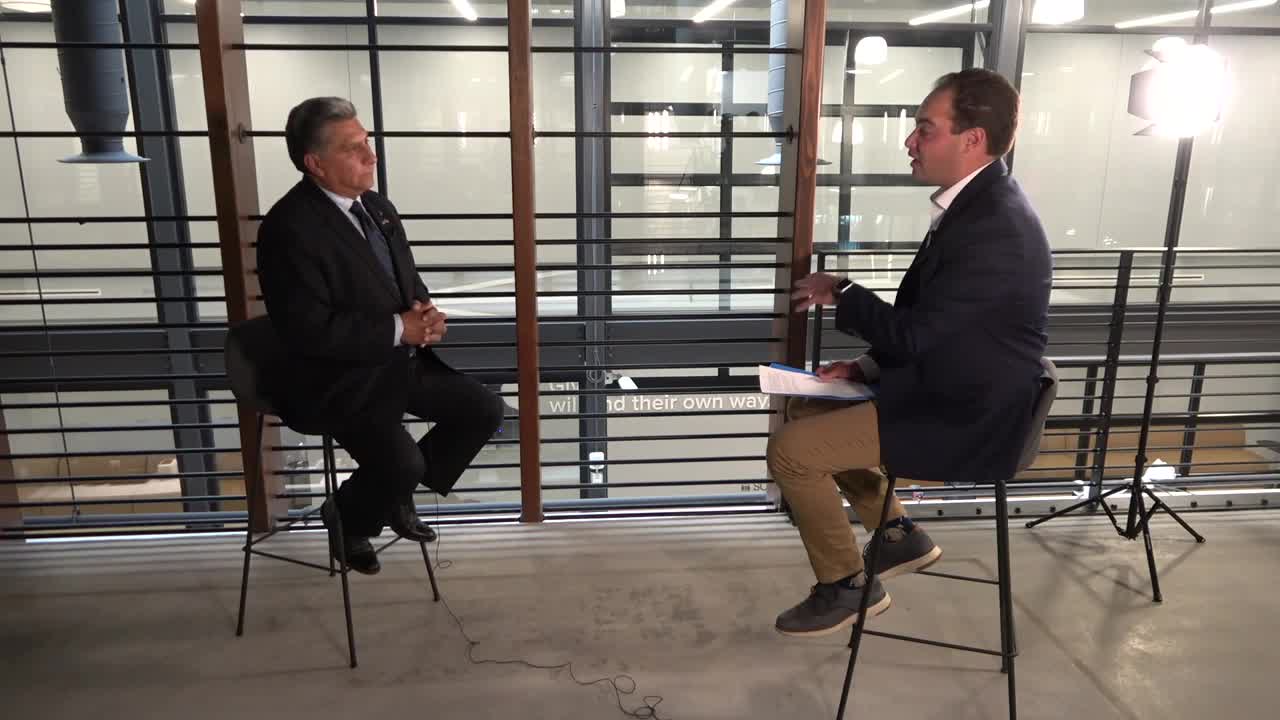


DENVER - With a few days remaining until the Election Day, Denver7 is getting you the voter ready for the election, covering the people and issues on your ballot.
On Friday, Denver7's Tyler Melito sat down with Unaffiliated Candidate for Governor Greg Lopez.
TYLER MELITO: Here we are, four days until Election Day. How are you feeling? What's the confidence level?
GREG LOPEZ: I'm feeling really, really good. When I went out there and I was talking to people, I kept hearing the same thing. We're frustrated with both parties. Both parties don't seem to really care about us anymore, and I totally agree with that.And I'm getting a lot of comments from people on my Facebook page and even on my cell phone. They're texting me and say, "Hey, I voted for you." And these are both Republicans, Democrats, unaffiliated. So I'm feeling good.
MELITO: You were serving in a role for CD Four. What made you say, "I'm going to run for governor" instead of running for re-election against Lauren Boebert?
LOPEZ: When I was in Congress, I tell everybody, Congress is everything you believe it is. Multiply it 10 times, and that's really what it is.When I was in Congress, I realized that both parties no longer really care about helping people; they just want to stay in power. And I tell people, it's like joining the mafia. It's about power, money, and control. It's not about doing the right thing for the American people.I sat on the Budget Committee, and so I understand why we're $40 trillion in debt. That's 12 zeros after the number. A lot of people don't know that.And I also sat on the space science and technology committee. But when I came back, I realized, it's time for the people to be put back in the role of government.And so that's why my governing philosophy is pretty simple. People over politics, do no harm and do what works.
MELITO: How do you think your experience in Washington, and your experience in local government as former mayor and town manager of Parker, will help you serve as governor?
LOPEZ: The other interesting thing, I'm also the former director of the United States Small Business Administration, so I understand the complexities of bureaucracy. I understand how do you sit down with people and get them to understand what it is you're trying to achieve.I have a great reputation with a lot of the congressmen still in Congress as we speak, but I also know how to go about talking to people in the different levels of government. As you may know, I'm the one that stopped the wolf coming into Colorado because I understand the protocol.
MELITO: You yourself were a Republican for 30-plus years. What was the ultimate tipping point for you to leave the Republican Party and run as an unaffiliated candidate?
LOPEZ: The residents of Colorado have spoken. When 50% of the residents that are active voters are unaffiliated, and only 25% are Democrats and 23% are Republicans, they're really telling people we're tired of the parties, we're frustrated.And I'm still a compassionate conservative. My values have not changed. I always cared about the poor. I care about small business. I care about our children. I care about our communities.So just because I changed the letter next to my name doesn't mean that I've changed who I am. I just feel that I can now bring the voice of the majority of the people into the state government, and I can work with both parties. Doesn't matter to me who comes up with the right solution, as long as it helps.
MELITO: What would you say to people who may be concerned that this is just a workaround because you couldn't beat Victor Marx to get the Republican nomination for governor?
LOPEZ: What I would tell them is, we don't know what could happen. I feel very comfortable that, had I stayed with the Republican Party, I would make it onto the ballot. But again, I want to represent the majority of people. I don't want to be stuck in some political ideology; I don't want to answer to political bosses. I don't want to have to defend what's going on in Washington, D.C. when I don't agree with it. And so I think people really want a governor that understands their struggles, understands their challenges every day, and really is tired of playing politics. That's why I decided to become an unaffiliated.
MELITO: There are people who have said that because of your background, you may pull voters from Victor Marx and split the ticket, ultimately playing into the favor of Phil Weiser or another candidate. What would you say to that?
LOPEZ: In democracy, you pull votes from everybody. Your vote doesn't belong to a party. Your vote belongs to you. Look, I grew up a Democrat. I'm the former president of the Denver Hispanic Chamber of Commerce. I'm bilingual. A lot of people think that I'm a Democrat already. They just don't know my values. And so, when someone says you're splitting the vote, I'm also splitting the Democrat vote. I'm getting to the hearts and minds of people, and really, that's democracy. If someone votes for an individual that is not part of their party, that's not splitting the vote. That's democracy working, because people are voting for the individual that has the right vision and the right solutions to what Colorado is facing.
MELITO: You mentioned wanting to be people first. What exactly does that look like?
LOPEZ: What it looks like is we don't have to worry about Washington D.C., and what they want. It's not what the political winds are saying. I want to go and talk to the people in the communities. I've been to Globeville. I've been to Park Hill. I've been to Montbello. I've been down to Pueblo. I've been to Cortez. I've been to Sterling. I go out where the people are. My mom and dad grew up working in the fields. My dad had a sixth-grade education and never learned to read and write. My mom has a 10th grade education, and I don't forget where I come from. I want to help people.I want to improve the quality of life for individuals, not score political points.
MELITO: One of your policy points that caught my attention was wanting to create a Colorado version of DOGE. What would that look like, and what specific parts of Colorado's spending would you rein back in?
LOPEZ: If there's one thing I will tell you, it's that I really believe the taxpayers' money is vital and it's crucial. We need to protect it. We can't be wasting it. We can't allow fraud to happen. And so I believe right now we have enough revenue. I think we have a spending problem. I'm not looking to cut services; I'm looking to eliminate programs that aren't working, programs that are showing that they're not actually moving the needle, and asking why is that? The Joint Budget Committee uses baseline budgeting. What does that mean? That means they only talk about the new money. They never talk about the money last year. We're going to go back to zero-based budgeting. We're going to go back to zero on every line item and ask: Is this money that you're spending actually achieving something? Is it improving people's lives? And if it's not, then why are we spending it?
MELITO: What are the areas where right now Colorado's government is overspending or not spending wisely?
LOPEZ: Let me tell you what really happened. It was the mismanagement of the budget. When COVID hit, there was a lot of money that was given to states because businesses were shut down, and so cities and counties needed revenue, and the governor kept a lot of that revenue, and he used it on ongoing programs. You never use one-time money for ongoing programs, and so now the problem is we've had these programs for two to three years. People think they work, but we don't know yet, and they want to keep funding them. So before I cut anything, I need to make sure that the money that we're allocating is being spent wisely. I will tell you that the government has grown tremendously. The governor's office has increased in employees. The attorney general's office has increased in employees. And these are the types of things that we need to ask: Why are we hiring more and more people internally, and how are we spending?
MELITO: What you're saying is internally there could be cuts. People could lose their jobs at the state level because the state might have overextended itself or hired too many people. Is that what you're saying?
LOPEZ: I am a very fiscal responsible individual, and so I'm not going to continue to waste money. If someone made a bad mistake, I'm not going to continue to make that mistake. We're going to fix it. Look, we need to make an economy where people can go and find other jobs. Just because they work in government doesn't mean they're always going to stay in government. Because sometimes departments do shut down, or sometimes we have to cut back because of the revenue stream. When we kick businesses out of the state of Colorado, and they're leaving by leaps and bounds, our revenue is coming down. But we need to be careful about how we spend our money. And my goal is not to let people go. But if that is the opportunity, or that has to happen, we're going to have to do that.
MELITO: What would you say to the government worker who might lose their job, or to the person at home who might have a program they rely on cut, at a time when prices are so high?
LOPEZ: Here's where we need to get churches and nonprofits involved. We need to help each other. Government is not the solution, because I tell people, government doesn't make money; it takes money. So anytime government programs are being put in play, they're taking money either out of your pocket, or they're taking money out of small business, or they're taking money out of corporations because government doesn't make money; it takes money. I'd much rather have a smaller government, which allows you to have more money in your pocket, so you can have the quality of life that you want. Are things expensive? Yes, but I will tell you, it's because of overreach of the government, and so when government starts getting out of the way, people will be able to see that their dollar will extend further because of government not asking for it.
MELITO: I want to shift to affordable housing. You have mentioned wanting to create 25,000 starter homes at a price around $235,000. How specifically, as governor, would you be able to do that when these projects are developed by private developers or zoned by local communities?
LOPEZ: That's where my background as mayor and a city manager comes in. I was a strong mayor, so that meant all the department heads reported directly to me. I understand zoning. I understand the complexity that developers and builders have to run into. Right, 60 to $70,000 of every new home is in the ground. It's for a water tap. It's for a sewer tap. And people don't know that. They're tapping into an existing main line in the street with a half-inch pipe, and because of that half-inch pipe that goes to their home, they're paying $40,000 just to tap into it. That's not the water that you're going to keep using. But why do you have to pay $40,000 to tap into an existing line that was paid by the citizens already? This is where we start cutting back. We don't need the big front yard setbacks. We don't need the big side yard setbacks. We talk about attachable sidewalks, detached sidewalks. We talk about smaller park dedication. We talk about smaller school dedication. All that costs into the development, and when they know that I understand their language, when they know that I understand how it works, they're more willing to sit down and have that conversation with me.
MELITO: What authority does the governor's office have when those things are mainly controlled by local governments and local water districts?
LOPEZ: That's true. It doesn't. But here's the difference: the governor has two powers. He's got the executive power. But he also has the power of influence. If I go into a community, have a town hall meeting, and talk to them about the need of affordable housing and what I believe needs to happen, I think the community will say, "Yeah, I didn't know we were paying that much. I didn't know that all this was part of the cost of the home."When I talk to mayors and I talk to city council members today, they really appreciate the fact that I understand the challenges that they're having to go through. I'm not going to dictate what they should be doing. I'm going to offer them solutions on how they might go about solving the problem for affordable housing within their communities, and there is a market for it. And right now, people are thirsting for the ability to own a home. That's the American dream.
MELITO: What would you say if you give suggestions to a local municipality, but they say that doesn't work for them?
LOPEZ: Well, I'll just move on to the next community. Look, we're not going to force any community to have a product they don't really appreciate, but I think every community understands that they need a vibrant community, which means they need people to live in that community. So the velocity of money circulates within their economy. That's what makes a community. Small business thrives when you have homes, and you have young families, and so that's the message. I talk to a lot of mayors. They understand that vision, and they wish that the builders and developers had smaller, cheaper homes.
MELITO: Colorado experienced a major drought this past year. If you are elected governor, what steps are you prepared to take to make sure Colorado is prepared for another bad summer or winter?
LOPEZ: I'm nervous about what's happening right now. It's October 30th, and look how warm it is. There's no snow in the mountains. Last year, the ski areas lost 40 percent of their revenue. If you haven't been to Lake Dillon, if you haven't been to Blue Mesa, if you haven't been to Green Mountain Reservoir, it is mud. You're seeing Highway Six, the old Highway Six under Lake Dillon. So I'm here to tell you, we're out of water. The water we're using today is the water that was in the reservoirs. This is water we've been saving, and so we must have a governor that fully understands the Colorado River Compact of 1922 and holds the lower basin states, California, Nevada, and Arizona, accountable for how much water they're taking out of the Colorado River, but we do have a plan. There was a plan that Governor Hickenlooper put together in 2015. Think about that: 2015, to talk about what's going to happen in the future. We haven't done anything with it, and so we need to make sure that when we put plans together, we start implementing them. So we have to look at building additional reservoirs and making sure that we're capturing water, excess water, when the Lord decides to bring us a lot of snow or a lot of rain. But right now, you cannot create water.
MELITO: I want to shift gears to CDOT. You've said that you would like to purchase E-470 and make it a more main road in addition to I-25. How would you go about purchasing that if you've already said the government has a spending problem?
LOPEZ: A lot of people don't know that I sat on the board of E-470. I was the secretary-treasurer. E-470 is owned by governments. It's owned by three counties: Adams, Douglas, and Arapahoe, and five communities: Parker, Aurora, Thornton, Brighton, and Broomfield. So it's owned by the government right now. So I will sit down with them and have conversations with them. Say we can buy this over time. It's not like I need to write a big check. This is what people are talking about is the quality of life. We can buy E-470, take the tolls off overnight, and you watch the amount of traffic that starts using it because it's already there. We don't have to build a new one. In the meantime, we got to look at future development of new roads or new highways because what happens today, we widen roads. But before we widen them, we got to narrow them. We got to create a safety lane for all the construction, and then it takes eight years to finish. And by the time it's finished, all the growth around it has already happened. So when you open it, feels like nothing changed. The congestion is still there. So we must have alternative routes.
MELITO: You mentioned taking the tolls off E-470. That money is used by those local communities.
LOPEZ: Every community wants money. And they're trying to get creative on how they do it. Most communities have anchors. There's an anchor that brings people in to spend their money, and then they go home. And that's the beauty of having a community where people come to visit, but then they go home, because you can utilize their tax revenue to provide better services for those that live within your community. This is economic development. `So economic development projects are always out there, but we're talking about quality of life. There's no reason why a mom must get stuck three hours on I-25 when she's trying to get home to make dinner for her kids or make sure that they do their homework. There is no reason for Colorado not to be able to do that. And the other thing I'm going to do, we've got to start promoting the rest of the state. Not everything has to be in Denver. It could be in Grand Junction. It could be in Pueblo. So we can't always just promote Denver. We got to promote the rest of the state.
MELITO: You have said you wanted to pull Colorado out of the wolf reintroduction program, calling it "ballot box biology." Coloradans passed Proposition 114, approving wolf reintroduction. What would pulling Colorado out look like when voters have already said they want this?
LOPEZ: Voters voted on emotional things, and oftentimes they do. I bet you, if we ask the voters today the same question, it would fail because the people that passed it are in the urban corridor, and the restriction was we want the wolf, but we need you to dump them up in the western slope. And so people are like, wait a minute, and though they voted here in Boulder and Denver, now they realize that the wolf is a pack animal. First of all, the wolf doesn't belong in Colorado, and right now Colorado has a memorandum of understanding agreement with the Department of United States Fish and Wildlife, that we would manage the wolf. We don't have to. So I'm going to give it back to the federal government. Let them manage it, because we don't have the money; we don't have the resources. That's what the 10J rule says about the wolves here in Colorado. So it's an experiment. It has failed. And I'm going to let them figure out what we're going to do with these wolves. Are we going to allow ranchers and farmers to take them because they're killing their cattle? There are 14 wolves that are here illegally; they got brought here by the governor from Canada, and he wrote the Endangered Species Act when he did that.
MELITO: Shifting to schools: You have said you would support expanding school choice. What would that look like, and what would you say to schools that are already in existence who now might have more competition amid declining enrollment?
LOPEZ: First I would remind them that I'm the first executive director of the ACE Scholarship Foundation here in the state of Colorado, and that is to help education. Look, education in our state should not be measured by how many schools you have. It should not be measured by how many students you have in your classroom, education should be measured by how our children are learning. When only 30% of our third graders are proficient in reading and writing, that means seven out of 10 third graders are not able to read and write at the third-grade level. That's the education that I'm talking about. Education is about the child. Education is not about how many schools do we have open, and how many administrative people are we going to have to oversee the educational process, so I would tell those individuals that if they're having to shrink or close schools, it is because they're losing families. That happened to my neighborhood. I've been there over 30 years, and I saw that for a period of about seven years, there were no children in my neighborhood until new families started to move in, and older families started to move out.
MELITO: That circles back to affordable housing, getting those young families to want to come to Colorado versus New Mexico, Wyoming or Utah.
LOPEZ: The word's out that Colorado is the second most expensive state in the nation, so it's not like we're promoting people to come here, and so we need to look at the crisis that Colorado's in. We need to fix all of it. It's going to take time, but you got to have a governor that can govern with a steady hand, someone that can govern with visionary glasses.Not looking, can I get reelected four years from now, it's about can I make it better for everybody, whether I'm here or not? Am I moving the needle and moving it in the right direction? I think that's what people are looking for.
MELITO: What would you say is missing to make Colorado's education system the best it possibly can be?
LOPEZ: I think it's more the administrative arm of the education needs to get out of the classroom. Let the teachers be teachers. Let the teachers engage with their students. Don't tell them how to teach. Tell them that they need to get them to be excited about learning, because every child learns differently. That's why parents are the best individuals to know under what environment their child is going to thrive when it comes to education. And the more options we have, it's about educating our children. It's not about competition between public schools and private schools. It's about educating our children.
MELITO: Shifting away from policy: Victor Marx, one of your opponents, has received scrutiny for his past. You yourself pleaded guilty in 1993 to harassment charges, have been charged with DUI, and others. What would you say to voters who might question your judgment?
LOPEZ: My record shows that I've learned from my mistakes. I'm just like everybody else. A lot of these things happened when I was young, young and stupid. Now I'm 62. I've learned how life works, and I understand that. You must make good, informed decisions. And so I will tell you that me and my wife have been married 38 years. I also will tell you with my DUI, I learned that I will never pay $1,000 for a beer again because that's what it costs when you get caught. I'd much rather spend $400 or $200, have someone come get me and let me sleep it off, but I don't drink as much anymore because as you get older, you understand it's not about those types of evenings. So I would just tell them, look at my record, look at what I've been able to achieve. Will I make mistakes, probably, but I'm not going to make big ones. I've learned from others, and so if you want to make Colorado better, I would ask you to take a chance because we know what it feels like to live under a single party rule.
MELITO: In your 2022 campaign, you had stated that the 2020 election was won by Donald Trump. Do you still believe that?
LOPEZ: I've moved beyond now. I don't look at what happened in the past. We know that for those that believe that something needed to be fixed since 2020, they've had plenty of time to fix it. I have faith in the people, have faith in the voters because the voters have gotten wiser. They're looking at things more deeply, and they're doing their own research. So I firmly believe that as long as we continue to allow people to cast their ballot in whatever manner that is, I have faith in our election system. Think about this for a minute. What if people here in Colorado had a choice to decide whether their ballot got counted by a machine or their ballot got counted by a real person? It's the same ballot, but they get to choose. Do I want mine to go through a machine or do I want mine to be actually counted by a physical person like we used to do, I think that would bring compromise to both sides.
MELITO: Is that something you would consider if elected governor — to give voters that ability?
LOPEZ: Yes, I would like to have that conversation with the clerks and recorders of the entire state, and ask them what's wrong with that opportunity, because if we like choice and we want people to have faith in our election system, why not offer them two different ways? They all get the same ballot. Just two different ways for it to be counted, because it's still the same count.
MELITO: Is it fair to say then, if you were to lose this race, you would accept the result?
LOPEZ: Of course. The people will decide whether they believe it was right or wrong. I'm doing everything I can to get elected. But I've been in these positions before. The last time that I lost, I've never challenged an election. I have no reason to, and I will not do that again.
MELITO: If you are elected, in the first 100 days, what is the single most important thing for the Lopez administration to set Colorado on a new path?
LOPEZ: The first thing I'm going to do is sit down with the leadership of the Senate and the House, both the majority leaders and minority leaders, and we're going to meet on the seventh floor of the Denver Public Library because there's a special table up there. What I love about that table is it doesn't have a right side or a left side; it's round. So we're going to sit around and we're going to talk about what are we going to do to make Colorado better. And I'm going to let them know. I really don't care who comes up with the right idea, but if someone is doing something that's going to hurt people and families, you're going to have a conversation with me, either privately or publicly, because I am the voice of the people of Colorado. The budget, we're going to review the budget. We're $1.8 billion in the red. Think about that, in the red. So we got to figure out what are we going to do with that. Our boards and commissions, CPW's commission is out of control. I've been attending those meetings. Those individuals are not focused on the long term of our state, and so reevaluating all those appointments that the governor makes to make sure that we're appointing the right level-headed type of individuals that are making decisions with visionary glasses, not knee-jerk reactions. The PUC, the Public Utilities Commission, is appointed by the governor. I believe it's time to shift those people because they're putting a lot of burden on the shoulders of individuals. But I will always be talking to both parties. I'll be back out there traveling in the state, and I will be visiting with the Democrat leadership and the Republican leadership because I don't have loyalty to either one of them, and I hope that they will sit down with me because I do believe that we all want to make Colorado better for everyone.
MELITO: If you were to lose, would you like to have a role in the next administration or state government in some form?
LOPEZ: I evaluate things in their totality. If it makes sense long term for me to be a part of the administration, I will consider that. If it makes more sense for me to be independent and still be that voice, that I can go into chambers of commerce, I can go to economic development councils, I can go to homeowners associations, and just share, and explain, and educate. Perhaps that's what I'll do. But at the end of the day, it's about making sure that as long as I live in Colorado, I want to make sure that we make Colorado better for everyone. That's my goal and that's my objective. And as long as I can do that, I will continue to do that.
MELITO: For voters watching this, what is your last 30-second pitch that you are the person they should elect as the next governor of Colorado?
LOPEZ: For the good people of Colorado, I would just tell you this: if you're wanting someone that really cares and understands your challenges, I don't come from money. I don't have a great education, but I do have an understanding of the challenges that everybody faces. And I know that I am not the smartest man in the room, and that's okay by me. But I'm going to make sure that I'm asking the right questions. That I'm making sure that there's transparency. That we are not wasting your money, that we're using your money wisely, and my goal is to make sure that your voices are heard, not mine.That your voices are the ones that are guiding this state into the future, not only for small business but for our children and everybody that wants to come to Colorado, because Colorado can do that. I lived here when it was happening. I know it can happen again.
You can watch Denver7's Full Interview with Lopez below:
You can watch Denver7's interview with Democratic Nominee Phil Weiser here.
You can watch Denver7's interview with Republican Nominee Victor Marx here.

Denver7 is committed to making a difference in our community by standing up for what's right, listening, lending a helping hand and following through on promises. See that work in action, in the videos above.