

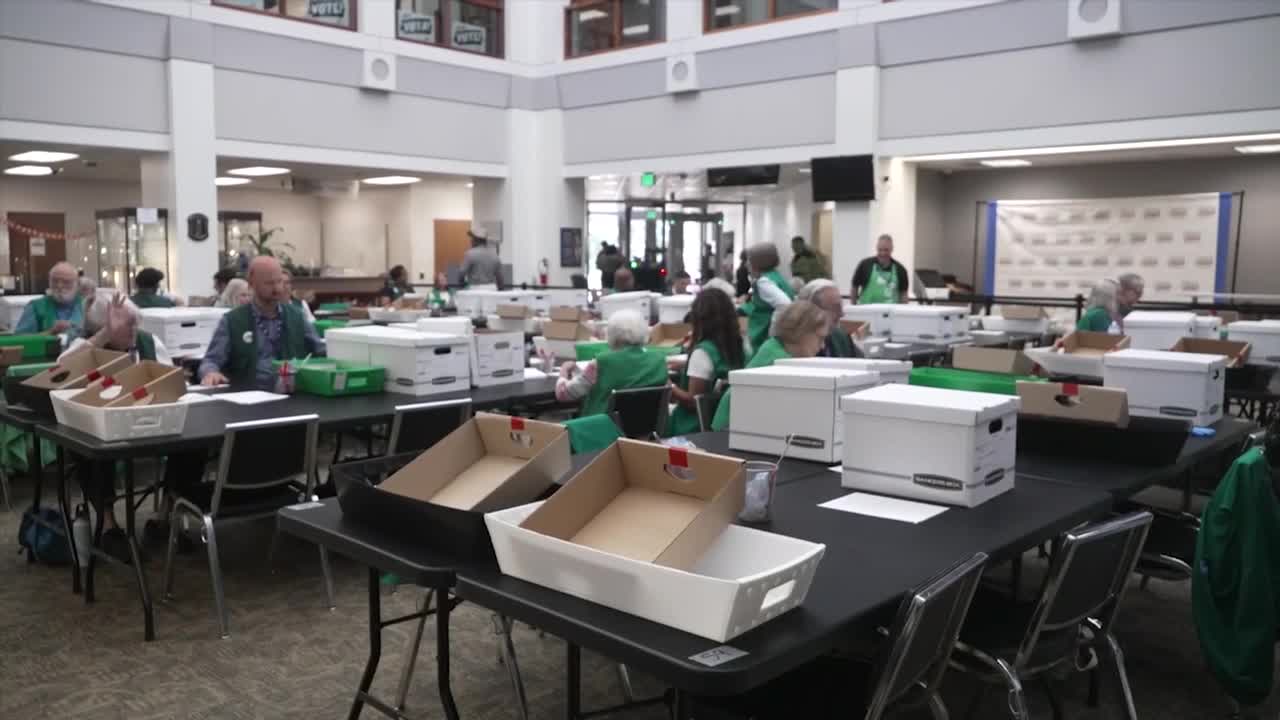


DENVER — Colorado election officials say Monday's U.S. Supreme Court ruling on mail-in voting does not change how voters cast their ballots this November, but warn the decision creates new uncertainty ahead of the midterm elections.
The Supreme Court ruled 6-3 Monday to temporarily lift a federal injunction that had blocked a key part of President Donald Trump's executive order on mail-in voting, opening a path for parts of the order to move forward while legal challenges continue.
Hear more from officials in the video below
The court did not rule on whether Trump's mail-voting executive order is legal or constitutional. Justices said only that states have no standing to challenge it right now. The three liberal justices dissented, warning the order could create confusion and chaos ahead of the midterms.
Colorado elections officials say Monday's ruling does not change anything for the November midterm election, but with the state less than a month from sending its first ballots, they warn that any further court action on the executive order could create confusion and chaos for voters.
"You will still be mailed your ballot. You will still be able to vote by mail, vote in person, or drop your ballot off at a drop box," said Jefferson County Clerk and Recorder Amanda Gonzalez, who is the Democratic nominee for Secretary of State. "That being said, if the Supreme Court did make major changes into how we are able to send out ballots, that could create major issues."
Trump's executive order, signed in March, directs federal agencies to create a list of all eligible voters using citizenship and Social Security records to keep noncitizens from voting in U.S. elections. Under the order, the U.S. Postal Service would only be able to deliver mail ballots to people on those lists.
The ruling does open additional legal paths for states to sue in the future.
Secretary of State Jena Griswold said more than 98% of Colorado voters returned their ballots by mail last election. She said Colorado's mail-in voting process is safe and secure and that Trump's executive order is an unconstitutional federal overreach into state-run elections.
"It does add in a dose of uncertainty," Griswold said. "Trump basically is is trying to take control over who gets a mail ballot, and who doesn't."
Critics of the executive order warned that combining data from multiple federal sources could produce errors and that eligible voters left off the list may have no clear or timely path to getting a ballot before Election Day.
"I do not trust the Trump administration or the Department of Homeland Security to adequately identify which American voter is actually eligible and who is not eligible," Griswold said.
"They [Trump administration] are talking about bringing together data, much of it never intended for identifying voters, from different sources that there is no way to verify the accuracy of," said Gonzalez.
Both Gonzalez and Griswold pushed back on claims of widespread voter fraud used to justify the executive order.
"Any of the mis and disinformation that you are hearing from our federal government is exactly that. There is no evidence that there is any kind of widespread voter fraud. There is no evidence that there is any kind of wide scale voting by people who should not be voting," Gonzalez said.
James Wiley, the Republican candidate for Secretary of State, welcomed the ruling as a step toward greater election security, though he acknowledged its legal limits.
"I think it's really important that we work to increase security with the voter rolls as much as possible, and then make sure to restore trust with the mail-in voting," Wiley said. "I'd love to be able to say that this is a huge step to protect democracy, to ensure that every eligible voter can vote, and it's exclusive to that group of people. But unfortunately, that's not this case."
He also said he would prefer Congress pass legislation, like the Safeguard American Voter Eligibility America Act (SAVE Act), rather than rely on executive action to implement voting reforms.
"I think it's important that the executive use power sparingly, and that makes the use more significant when necessary," Wiley said.
Monday's ruling leaves room for more court challenges, which could also slow the executive order's implementation. It remains unclear how much of the order can be put in place before the November elections.


Denver7 is committed to making a difference in our community by standing up for what's right, listening, lending a helping hand and following through on promises. See that work in action, in the videos above.