

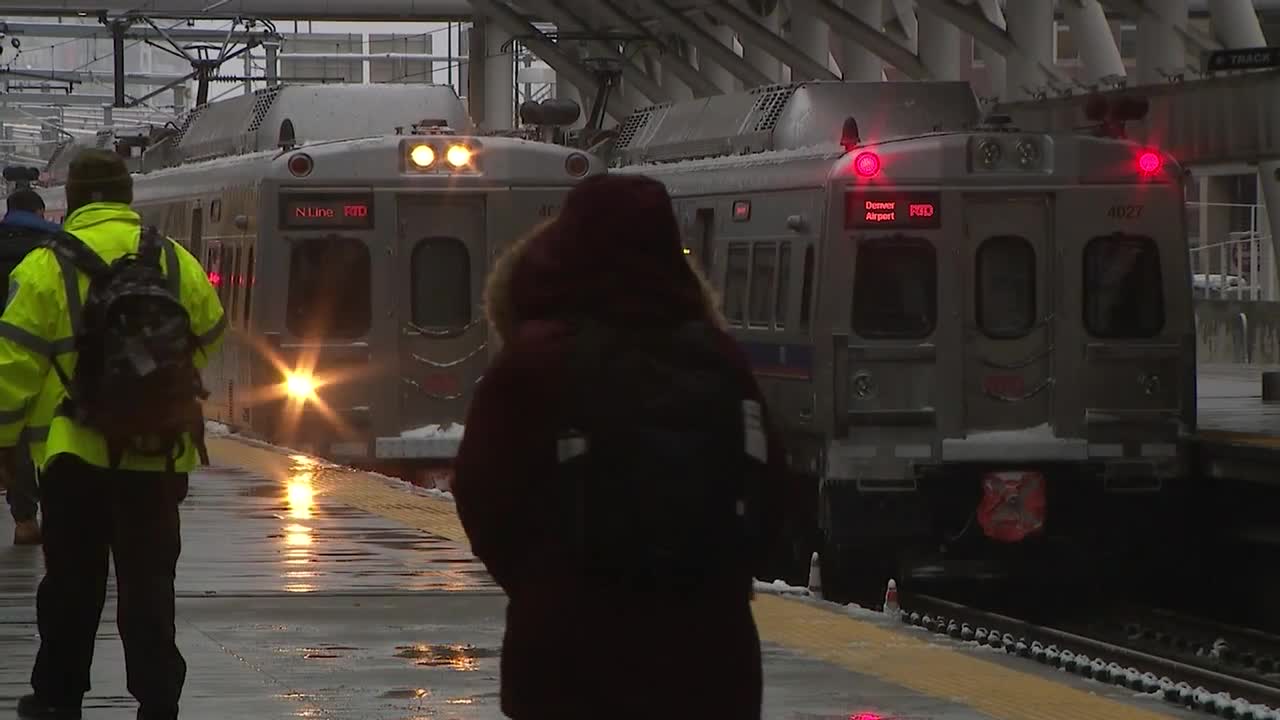


DENVER — Drug use on RTD buses and trains remains an issue throughout the system’s widespread service area across the Denver metro.
Two years after Denver7 Investigates found hundreds of RTD operators received paid time off due to drug exposure, the agency revealed data Wednesday that suggests the issue is improving.
PREVIOUS COVERAGE:
- Data shows hundreds of RTD operators received paid time off due to drug exposure
- 'It’s scary. It’s unsafe': Drug use still rampant on RTD property, Denver7 Investigates learns
RTD data shows drug activity reports on its Transit Watch app have dropped form 2,966 in 2023, to 2,124 in 2024, to only 707 through October of this year. That means 2025 is on pace to generate less than half of the 2024 total.
“What we have done collectively has been intentional about creating a welcoming transit environment,” CEO Debra Johnson told reporters Wednesday.
Johnson cited a few key solutions, including security upgrades at Union Station, expanding a program keeping some station elevator doors open when at rest to deter drug use inside, and expanding the transit agency’s police force.
PREVIOUS COVERAGE | RTD sees reduced drug activity at some stations after elevator pilot program, plans to expand program
Johnson and RTD Police Chief Steve Martingano also spoke about the importance of communication between RTD police and other law enforcement or community partners.
“It's still policing and stuff that's been traditional, but us being more involved is what's really new to those counties and cities,” he said Wednesday.
“Individuals know they can't just get on a train and ride the entire alignment and do whatever they feel that they want to do, because they know that there's other eyes and ears that are out there watching them,” said Johnson, referring to the police presence and the Transit Watch app. “So that is a very positive trend.”
The solutions RTD discussed Wednesday are included in a first-its-kind nationwide study examining how Denver and four other major U.S. cities — Los Angeles, Chicago, Philadelphia and Portland — respond to drug use on transit.
The Transit Cooperative Research Program conducted the study, which was sponsored by the Federal Transit Administration.
“Denver was the first agency to put their hand up,” said David Cooper, the third party researcher lead for the study. “This is a problem all across North America. We are working our ways to manage this. No one has solved this. This is ongoing work that we need to sustain.
“How do we amplify the conversation with our partners when it comes to the sense of getting more support for shelter beds, getting public health infrastructure, when it comes to recovery, when it comes to getting additional policing resources, when it comes to addressing mental health? Those are things that are outside of our realm, but now are in our realm, that we need to address.”
When asked if RTD learned new strategies from the other cities in the study, Johnson said the cities have unique transit systems with unique local laws. However, she also mentioned that RTD will consider adding some sort of fare gate at Union Station.
“We have an open [fare] system,” she said. “We have done some conceptual design relative to closing this facility. And what I mean by that is, in order to get down these stairs [to the bus concourse], you would have to have some kind of fair media to open up the gates. And we have been looking at that. We did design concepts a couple of years ago, and now we're at a point probably in another — I'm talking off the top of my head — six or nine months, whereby we would be in a situation where there could be some form of implementation.”
Denver7 also heard from frequent RTD bus and light rail riders.
One of them, Joe Rios, said he believes the issue has gotten worse in recent years.
“It's good during the days, but at night gets a little rough,” he said. “Violence and just people out there doing drugs and drinking.”
Rios believes that not everyone who witnesses those incidents would report it in an app.
“It's a good system and everything,” Rios said of RTD. “Just need a little more security.”

