



PERRY PARK, Colo. — Denver7 is following up after customers of Perry Park Water and Sanitation District (PPWSD) reached out to Denver7's Douglas County Reporter Tyler Melito with concerns primarily centered around recent, sudden bill increases.
Viewer Ellen wrote, in part:
"Of a $486 bill in July, $25 is for water use. The rest of the charges are all fees of some type - sewer and sewer cap improvements, water cap improvement, radium upgrade, etc. For clarification - this bill is for 2 months. My bill in July 2024 was for $311. In July 2025 it was $303. This July my bill is $486. I have no lawn so do not water my yard."
▶️ Perry Park Water and Sanitation customers voice concern over billing increases
Ellen is not alone. Other customers reporting that their bi-monthly bills are in some cases upwards of $500, more than $100 more than this time last year despite not changing their water usage. In total, PPWSD serves roughly 1,600 costumers per their website.
"The fee increases, is my understanding, is not a function of usage, but all these capital improvements that have been necessary and, in my opinion, ignored over the years, those costs are being passed on to the local residents," said Mary Beth Bradley.
Customers added they did not receive a warning over the bill increases.
"There was no warning that I received or saw, and like I said, I've never had any warning of any rate increase in 32 years," customer Thom Rogers said.
Tyler reached out to PPWSD for comment on the bill increases. Dirstrict Manager Sarah Shepherd said in a written response that the increases were because of a number of factors including a board adopted rate increase during a public hearing on March 18, as well as a radium mitigation fee.
"The Board adopted a 5% increase to water base and consumption rates, a 15% increase to the sewer base rate, and a $45 sewer water capital-improvement fee," Shepherd wrote. "The District intended the charge to be monthly, held an additional hearing on the rate which included a public comment period, and in July, corrected the charge to monthly. A separate $92 radium-mitigation fee per billing cycle (bimonthly, or every other month) was presented in the February rate discussion."
Former PPWSD Board Member Jim Maras shared there are a number of projects PPWSD is working on, but said he believes there needs to be some accountability for the board.
"There's essentially three construction projects going on right now: radium removal, wastewater plant upgrade just down the road here, and then the meter project, smart meters," Maras explained. "I think it's time for the Department of Local Affairs to come down here, get involved, and see what's going on, and try to help the residents get this board back under control and back doing financial management and management of the district."
That stretches to larger concerns customers have over the board's transparency.
"There is just a lack of concern, a lack of openness related to any of these these problems, and I think the residents here really are just fed up with the current board," Bradley said.
Shepherd responding to that comment saying PPWSD is taking steps to improve and allow for more public comment.
"The District has launched a new billing-statement format with detailed updates and notices on the back," Shepherd outlined in the statement. "Website improvements are ongoing and an at-a-glance meeting calendar is planned. It has also begun holding 6:00 p.m. Town Hall-style meetings in addition to its regular third- Wednesday of each month business meetings at 2:00 p.m."
Some customers also say the water coming out of their sinks or that's in their toilets is visually unsatisfying.
"We went to the June board meeting and raised the question about the brown water," described Greg Shoemate. "When you have brown ice cubes, it is disgusting. But when we raised that question, one of the board member's response to me said it all. He said, 'Well, it's fine at my house.' I don't even know what to say to that."
Shepherd shared the brown water is due to "unusually high-water consumption causing more main-line turnover and a higher concentration of minerals at some faucets. Staff also cited flushing season and mainline repairs as contributors."
Some, like Terry Blanco, are worried about what this could mean for the future of the community.
"I think a lot of this people finding out about this, hearing about this, their concern is that water safe?" Blanco said. "Do I want to bring my family here because I don't want health problems? ... I think everyone's going to have property value issues, and is that fair for the homeowners that are trying to retire that are maybe looking to leave because they can't afford the water."
Shepherd, PPWSD District Manager, was unable to interview, but emailed responses to questions Denver7 asked on behalf of residents.
Read the full responses below:
Customers’ recent bill increases are the combined effect of a March 2026 rate action, a new sewer capital-improvement charge intended to finance upgrades to the Waucondah wastewater treatment plant, and a separate radium-mitigation charge. The District is addressing aging infrastructure, regulatory work, inflation, chemical and hauling costs, and the relatively small number of customers supporting not just one but two water-treatment and two wastewater-treatment facilities because of the unique layout and geography of the community.
The District did publish statutory notices and offered Zoom access and public comment periods for all rate hearings. The March vote occurred at a 2:00 p.m. regular meeting and the published agenda limited audience participation to three minutes per participant as is typical with public comment periods to allow equal opportunity for input by the public.
Regarding the new $45 sewer capital-improvement fee, the District did publish incorrect information in its winter newsletter and March resolution, describing the sewer capital- improvement charge as bimonthly. The District intended the charge to be monthly and approved a correction in July with an additional hearing on the rate.
Why did bills increase so greatly?
At our March 18, 2026 public hearing meeting, the Board adopted a 5% increase to water base and consumption rates, a 15% increase to the sewer base rate, and a $45 sewer water capital-improvement fee. The District intended the charge to be monthly, held an additional hearing on the rate which included a public comment period, and in July, corrected the charge to monthly.
Like many water utilities in Douglas County, Perry Park WSD is facing increased inflation, higher chemical and treatment-byproduct hauling costs, capital improvements plan implementation related to aging infrastructure dating in part to the late 1960s, and the financial challenge of maintaining two water-treatment plants and two wastewater-treatment facilities for a limited customer base. The District is also launching a radium-mitigation project, to keep radium levels below EPA and CDPHE standards. The geography and development layout of the District requires that there be a water and wastewater system on both the East and West sides of the community to physically transport water and wastewater.
A separate $92 radium-mitigation fee per billing cycle (bimonthly, or every other month) was presented in the February rate discussion. This fee is project-specific and will end once the related project is complete and paid in full.
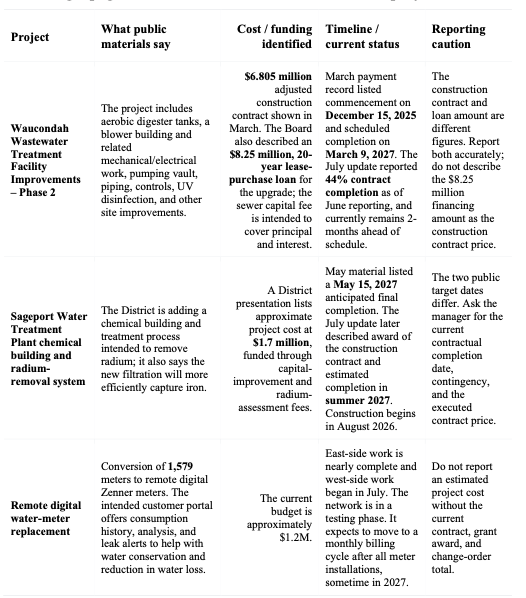
The District’s infrastructure is aging, much of it dates to the late 1960s, and the District recently adopted a 20-year capital-improvement plan to address issues before they become emergencies versus planned needed improvements. Many Districts across the State are in a similar position with regards to capital improvement needs.
Are future customers contributing fairly?
New lot owners must pay tap and development fees that cover costs to connect to the District’s system before receiving service. These fees were increased to reflect infrastructure improvement needs and costs to connect to the system. Once connected to the system, new owners begin paying for the same fees as others to support the entire system’s costs and water usage. Adding customers to the overall pool of payers can broaden the group paying operating expenses, thus meeting project funding needs faster.
If a customer uses a septic system instead of being connected to the District’s wastewater system, those customers are excluded from the sewer capital-improvement charges and other sewer fees.
Water and Sanitation Districts in Colorado rely on a limited source of funding mechanisms, which include fees as well as property taxes, which can only be collected from current customers and property owners. Mechanisms such as lease purchases can be paid for by fees or general operating or special purposes taxes to spread out costs amongst the pool of customers and owners over longer periods of time.
Unfortunately, water and wastewater systems require ongoing improvements and maintenance to operate safely and effectively and serve the public. The District has also applied for $3 million in federal funding for the Sageport project, but the request is only under consideration, not awarded. Additional grant funding options are monitored, but the District does not qualify for many grants because the median income of its residents exceeds the amount required to qualify for funding.
Project-level funding reports are reported in financial packets and in the District’s budget. The District is working on preparing easy-to-understand fact sheets for customers to understand the costs and funding for each project and the cost to deliver water and wastewater service to each home. We will continue to improve and repeat communications for customers that explain when project-specific charges will end and help announce projected new-connection revenue for the remaining development within the District’s boundary.
Were customers warned, and is communication improving? What notice was provided?
Yes. The District posted a notice dated February 18, 2026 that the Board could consider increases at an open March 18 meeting at 2:00 p.m., in person and via Zoom. Customers and interested persons could provide input, comments, or objections and obtain information about a proposed increase from the District office.
The March 18 agenda listed “Final Rate Increase Discussion and Vote” and provided Zoom access and allowed audience participation at the end of the agenda and stated a three-minute limit per participant. The minutes show questions were taken before the vote, which passed 3–0 without further discussion or comment.
What is being done to communicate better?
The District has launched a new billing-statement format with detailed updates and notices on the back. Website improvements are ongoing and an at-a-glance meeting calendar is planned. It has also begun holding 6:00 p.m. Town Hall-style meetings in addition to its regular third- Wednesday of each month business meetings at 2:00 p.m., which may be joined in-person or via zoom to observe the board conduct its work and receive reports from its staff and consultants in public; the District cited June 17 and July 15 as examples.
By adding multiple communications channels and making improvements to the website, the District is improving its customer communications.
Is the Board considering more public comment?
The board has held and will continue to schedule Town Hall style meetings in the evenings to accommodate the community’s desire for ample time to make public statements and ask questions of the Board and District staff and consultants and for the District to present educational information to the public.
What is being done about brown/discolored water?
The issue of water discoloration and the combined-radium compliance are completely separate issues. At the February rate discussion, staff attributed recent discoloration to unusually high-water consumption causing more main-line turnover and a higher concentration of minerals at some faucets. Staff also cited flushing season and mainline repairs as contributors.
The July update states that annual mainline flushing can cause temporary discoloration and directs residents to contact the District if the discoloration persists. The March 18 minutes say a customer who raised discolored-water concerns was told to contact the office to arrange an appointment for investigation.
Discolored water from a sink, shower, or toilet is a common occurrence when flushing the water delivery system and in NOT unique to Perry Park. Flushing is necessary to remove sediment and rust, maintain water quality, and check that fire hydrants work properly. We notify customers on their water bills, via email communications and website postings for flushing days. The District offers every customer who experiences discolored water with an inspection, which includes a water test and discussion with one of the District’s operations team members regarding the customer’s unique home, indoor and outdoor fixtures, water usage and water quality.
Shepherd said the water district understands customer concerns and is working to improve customer communication, with efforts including "email updates, newsletters and additional fact sheets related to the District’s Capital projects, cost breakdowns for service delivery and water rate comparisons with peer service providers."
She pointed to the "news" page on the website for information on annual budgets that list capital project costs, past year financial audits, water rate details and more. Shepherd also said the disctrict is scheduling additional evening town hall meetings.
Customers can always call or email the district office with any questions or concerns, she said.


