

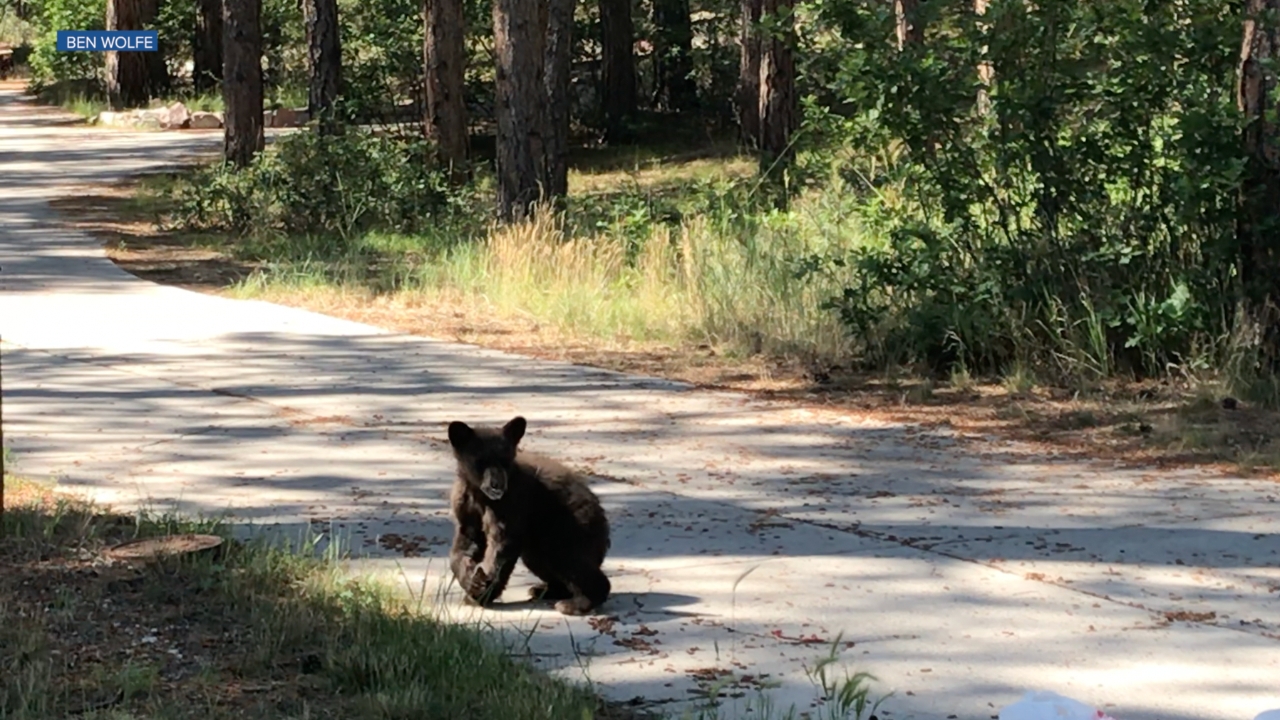


LARKSPUR, Colo. — Larkspur residents have been dealing with a bit of a bear problem this year, one primarily due to the drought.
"No, never. As a matter of fact, I even had one break into my pens, and they've never done that," said Larkspur resident Sarah Heckathorn when asked by Denver7's Douglas County Reporter Tyler Melito about whether she has ever seen a summer like this. "It's heartbreaking because they're only trying to survive, and there's nothing for them to eat."
Watch Tyler Melito's report in the video player below:
Heckathorn has lived in DougCo for 26 years, and she is not alone when it comes to noticing an uptick in bears in neighborhoods.
"They're a neighbor who stops by uninvited," said Ben Wolfe. "They're a neighbor when you leave the garage door open, they go on in and see what's going on in there."
Wolfe has lived in Larkspur for 23 years, and he told Melito that while the bears are a treat to see, there have been some touch-and-go moments.
"I had an instance where my dog chased a bear, and this is a tiny little beagle, and she chased it right up one of the trees that you see in the back there," Wolfe described.
As a realtor, Wolfe shared the advice with Melito that he gives to customers looking to buy a home in the area.
"I tell them, 'There are bears out here; we are living in bear country,'" shared Wolfe. "'Make sure that you don't put your trash out the night before. That's the biggest issue.' I tell them that you're going to see bears, and they are not aggressive. Virtually every time that I've seen a bear, it has already seen me, and it started heading in the opposite direction."
Wolfe added that he would like to see more done by the state to educate.
"I would say that Department of Wildlife could be a little more proactive when people move into areas of Bear Country," Wolfe outlined. "That would be nice if they actually put together some sort of informational mailer ... that they're just on the mailing list."
Heckathorn agreed. As someone who does wildlife rehabilitation for a living, she said she does the best she can to ensure bear safety, and noted how trash bins left out have become a popular destination for bears.
"Trash makes it easy for them to get a little snack," said Heckathorn. "I have to practice what I preach. So if the bears are getting into my trash on trash day, I can't say anything to anyone else because I caused the problem."
Heckathorn noted the difference between bear straps for trash cans and bear-proof bins.
"Trash can straps don't work," Heckathorn said. "They might work in the short term, but what you really need is the pop-up locking lever mechanisms."
While she is not a customer of Waste Management (WM), she shared with Melito how several of her friends are, and the trash pickup providers have both not been responsive to customer requests to bear-proof bins, nor have they been picking up trash from customers who go out and buy their own bear-proof bins.
Melito reached out to WM for comment regarding the bears and their efforts to ensure a smooth trash pickup process. A spokesperson wrote in a statement:
"WM offers bear-resistant carts in many areas across Colorado. In Denver-metro and Douglas County, we have not experienced significant demand for these specialty carts. We continually monitor customer interest and will evaluate adding bear-resistant carts as a service option if we identify sufficient baseline demand."
Heckathorn, however, said she isn't sold on WM's response, citing that she knows several people who have reached out.
"I don't know why Waste Management would say that because it's not factual, and we all know that," Heckathorn told Melito. "People were calling and calling and calling, and all they (WM) would do is take a note."
Melito also reached out to Colorado Parks and Wildlife (CPW) about the growing number of bears being spotted in Colorado neighborhoods.
A CPW spokesperson sent the following responses to Melito's questions (questions are in bold):
#1 - This summer has seen a lot of changes in bears specifically, but a lot of wildlife's routines. How has CPW worked to make sure everyone stays safe? Our wildlife officers have been busy in the communities responding to calls and providing advice. We have hosted forums, published multiple press releases about bear behavior, and always welcome calls to our offices with questions.
#2 - In a number of communities, regarding bears, people have expressed frustration with bears wreaking havoc on their trash when they leave it out for pickup days. What message do you all have for folks to ensure they can keep bears off their property? We urge residents to only place trash out on the curb on the morning of pickup in order to reduce the amount of time it sits outside. Trash can be secured in a locked, indoor area in locations with high bear conflicts. Keep windows and doors locked to prevent break-ins. Don’t leave trash in cars overnight. Remove all food attractants from their property, including bird feeders, dirty grills, and food left out for pets.
#3 - Does CPW work with various waste management companies across the state to develop practices and policies regarding animal safety when it relates to trash? If so, what does that look like for bears?
We do occasionally partner with utility companies in an advisory capacity when asked about how to prevent wildlife conflicts. Waste companies have been represented on our bear working group board from its inception. CPW has had meetings with waste representatives across Colorado to specifically discuss challenges, trash hauling, and how to lessen wildlife interactions.
#4 - Has this summer led CPW to rethink any of its practices to ensure both animals and humans could live without one encroaching on the other in the future? Not at this time; we continue to provide education and advice on how to coexist with wildlife in a way that’s both healthy and safe for everyone.
You can learn more from CPW regarding living with bears here.


