

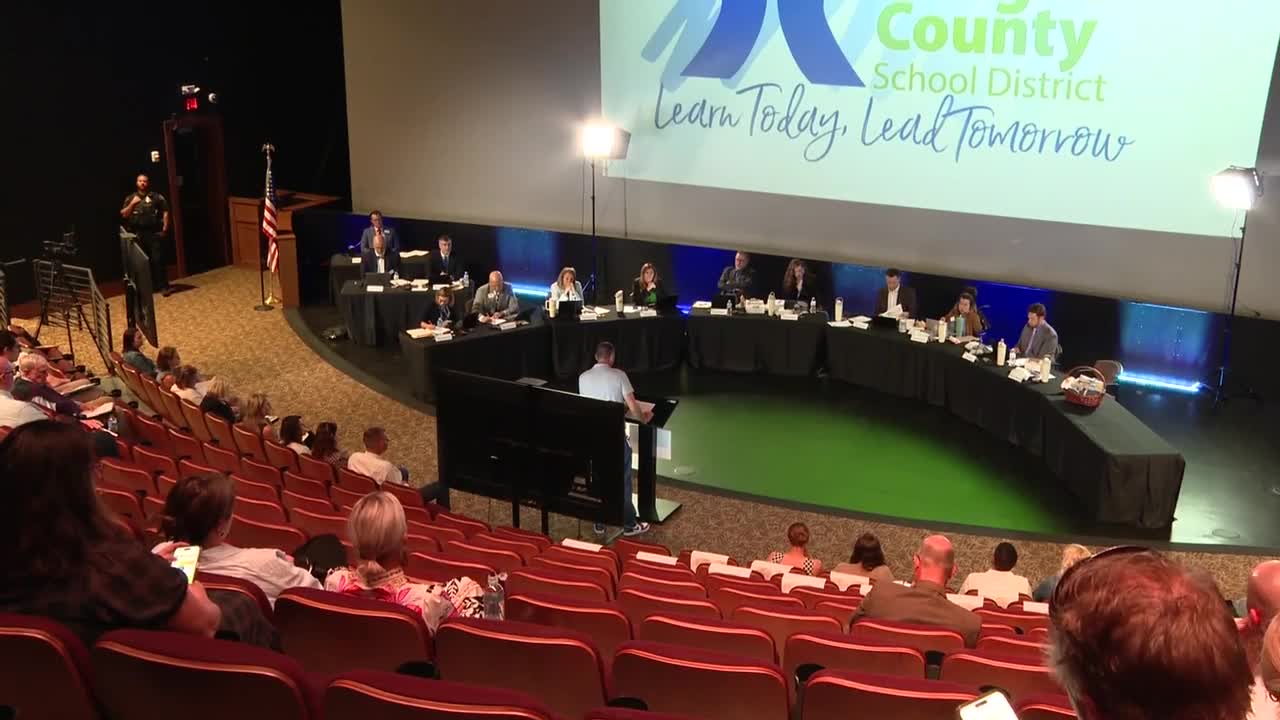


LONE TREE, Colo. — At their regularly scheduled board meeting Tuesday night, the Douglas County School District (DCSD) Board of Education unanimously approved a resolution putting a Mill Levy Override (MLO) before voters this November.
Voters will decide whether or not to approve a $54 million MLO, which would increase taxes in the process.
The district says an MLO would do the following things for the district if it passes in November:
- Retain and attract top-quality teachers and staff by providing salaries more competitive with neighboring school districts and better keep pace with inflation.
- Increase and maintain school security support, including school resource officers.
- Reduce student waitlists for Career and Technical Education programming, including the trades.
- Restore student programming such as instrumental music in elementary schools.
During the meeting, DCSD Superintendent Erin Kane gave a full presentation, laying out why an MLO is important.
While the vote approving the resolution was unanimous, board members did recognize the concerns of some in the community.
"$300 a year, $100 a year, that might break some people," said DCSD Board of Education Secretary Kyrzia Parker. "So while I support the MLO, I feel like that has to be said."
This isn't the first time an MLO has been presented to Douglas County voters this decade. In 2022, residents voted against an MLO, but in 2023 they approved a $60 million MLO.
In addition, in 2024 voters approved a $490 million bond.
While both are paid for by taxpayers, the difference is that an MLO pays for day-to-day operating costs like people and programs, while a bond pays for physical construction and infrastructure. MLO's are also recurring, while bonds are one-time payments.
Despite these recent measures by the board of ed, supporters of the MLO say there is still more needed.
"Even though we have passed one in 2018 and 2023, we are still 2,000 per pupil behind other districts, and our teacher salaries are the lowest in the Denver metro area so I get it," said Kelly Mayr, a Registered Agent for Douglas County Parents, an organization supporting the MLO.
Mayr, who has kids currently in the district and who have graduated from DCSD, notes that the actions of previous school boards put DCSD in a massive hole.
"Unfortunately, because of what we've done in our district in the past, where we went from 2006 all the way to 2018 without passing an MLO or bond, we are so far behind," Mayr outlined. "We're all looking at the gas prices and all the things that are going on, and unfortunately, I do not see an end in sight for that. But we can't starve our schools."
And adds that while property taxes may have gone up in Colorado in 2026, that doesn't mean all that money is going to someone's local school district.
"People say, 'Well, my property taxes just went way up, so why isn't that all going to our school district?' But that isn't how it works," Mayr explained. "So the property taxes go up, and that money goes up to Denver and gets reallocated, and it doesn't actually change the bottom line here. The only money that we control that stays directly here is through an MLO."
But the MLO has detractors on both sides of the aisle.
Tiffany Baker had four kids go through DCSD. She runs the popular Douglas County Facebook Page 'Douglas County Watch'
"For me, it is all about affordability," Baker told Denver7's Douglas County Reporter Tyler Melito. "For the people that would vote no, like myself, it's not that we're against teachers. It is that we are consistently being asked to put more money into taxes, and there might be other things that we have to pay for."
Baker lives in Highlands Ranch. She recognizes that while DCSD is one of, if not the best, school districts in the Denver Metro and that can improve property values, she told Melito many of the people she talks with are worried about being priced out of Douglas County if taxes continue to rise.
"This is not just a one-time ask," Baker said. "An MLO is an ongoing tax, so we don't know exactly how much this would cost all in, and it is scary for some of us. In my own family, I am a caregiver for two people with fixed incomes, so I can relate to understanding what a fixed income looks like, and not everyone in Douglas County is independently wealthy."
She also expressed worry about school consolidation across the district.
"In Highlands Ranch, where I live, there are a few schools that have consolidated recently due to declining enrollment," Baker detailed. "So we have like a unique situation here, where in Highlands Ranch we have schools that are consolidating. Yet in other parts of the county, there are needs for new schools to be built in developing areas. So maybe our district is just too big, but there's a lot of us that really have the, you know, a concern about increased taxes."
Matt Smith is another detractor of the MLO. He is the First Vice Chair of the Douglas County Republican Party.
"I think it's a bad time for it, the economy is not great," Smith told Melito. "What I'm seeing, you know, across corporate is that everyone's tightening down. They're not trying to spend more, so I think it's the wrong time to try to ask taxpayers for more money."
Smith has a child currently enrolled in Douglas County High School and while he wants the best education for them, he points to the district's declining enrollment as a red flag.
"Eventually, we're going to hit a pendulum to where we're overfunded and one thing that's true with government is they never give money back, so taxes never come down after they go up," Smith explained. "At some point something has to give, and it can't always be on the back of the taxpayers."
During Tuesday's meeting, a number of teachers and administrators across DCSD shared their support for the MLO, citing what it could mean to ensure teachers stay in the district, are able to live in Douglas County, and students have access to the programs they need most.
How would an MLO effect a person's property taxes?
If passed in November, starting in 2027, residents would pay an extra $33.70 for every $100,000 their home is valued out. So for example, if someone has a $500,000 home, they would pay an additional $168.50 in taxes per year.


