

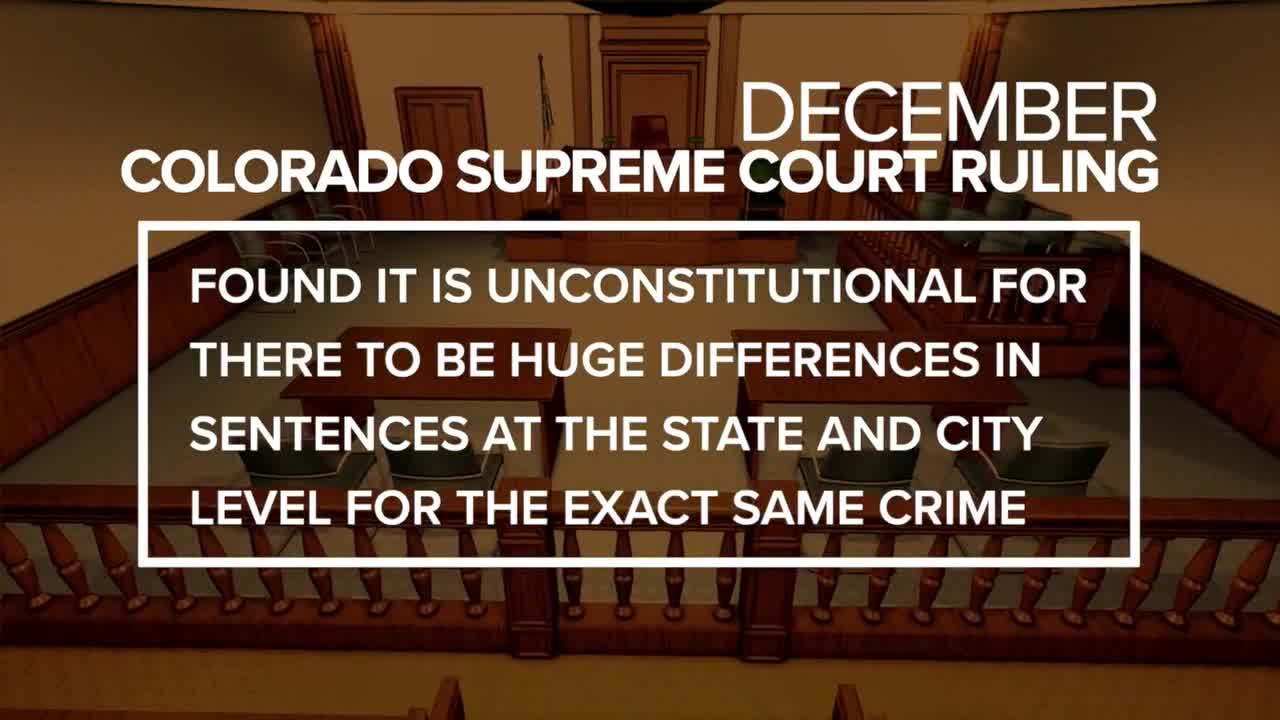


DENVER — Denver city leaders are working to align municipal code with state law following a Colorado Supreme Court ruling that found it unconstitutional for municipal courts to impose harsher sentences than a state court would for the same crime.
“It came out right before Christmas, so it kind of snuck in under the wire there, but it's actually under our state constitution equal protection provision. The Supreme Court looked at a couple of situations where people were charged with crimes under city criminal ordinances that carried a potential sentence that was quite a bit higher than what you could get if you were charged with the exact same conduct under state criminal law,” Sarah Parady, Denver city council member, said.
Parady said the court found that differences in sentencing between the state and cities can create a higher risk for racial and other disparities.
Parady said most sentences deemed excessive pertain to lower-level offenses.
“It impacts Denver, because we have extremely long sentences for a lot of conduct… that, under state law, would be limited to, like, a 10-day sentence. So, we need to get our constitutional ducks in a row,” Parady said.
Parady said in many cases, Denver defendants faced 10 months in jail when a state sentence would have been 10 days.
“Almost a year in jail, and that includes offenses like shoplifting less than $300 a single time, park curfew violations, like just things that are really very minor…so, you can be charged at the state level, but they would carry a 10-day sentence. So, it's a really big sentencing disparity, 10 days versus 10 months for those sentences,” Parady said.
Parady said Denver city leaders have been working on the issue for two years, long before the Supreme Court’s December ruling.
“It's not as straightforward as you might think, to kind of line up different ways that crimes are defined. You know, the city and the state often use different language. One might be broader than the other, but we've been working on it for quite some time, and so I'm pretty hopeful that we might be able to quickly pass some legislation that takes that 300 day sentence off the books, now that we know that it's often unconstitutional, and replace it with sentences that line up with state law where applicable, and just gives guidance to our prosecutors, public defenders, courts, so that they're not sort of doing this case by case, and then hopefully other municipalities can follow us on that,” Parady said.
Parady said city leaders hope to finish aligning most Denver municipal sentences with state sentencing guidelines within the next few months.

