



DENVER — For the first time in nine years, Denver has recorded a decrease in overall homelessness, the city announced Wednesday morning.
The data came from the annual Point-In-Time (PIT) Count, which is a nationwide effort to track sheltered and unsheltered homelessness on a single night in January. In Denver, Metro Denver Homeless Initiative leads this charge. The City of Denver reported that this year's results "show significant reductions in homelessness across every major category."
Watch Wednesday's full press conference with Denver officials and organizations in the video below.
The 2026 PIT Count, held on Jan. 26, found that overall homelessness in Denver dropped by 12.5% compared to the 2025 PIT Count. This marks the first documented instance of a decrease in overall homelessness in nearly a decade, the city reported.
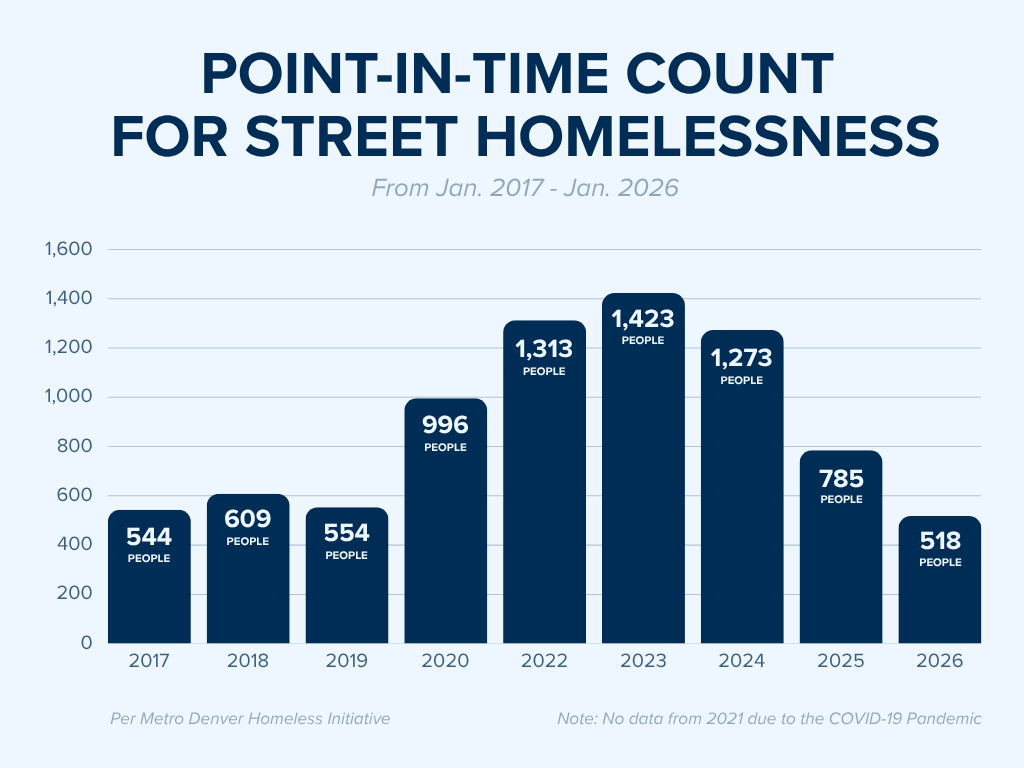
This year's count found 6,411 people experiencing homelessness in Denver. Of those 92%, or 5,893, were in shelters. The remaining 8%, or 518 people, were unsheltered. The latter is a 64% decrease from 2023, the city said.
The data from the PIT Count also reported:
- Homelessness, both sheltered and unsheltered, is down roughly 30% among newly homeless and chronically homeless individuals, meaning fewer people are falling into homelessness and that, when they do, cases are resolving more quickly
- Sheltered homelessness among youths fell by 28%, with street homelessness falling 57%
“This is a historic accomplishment, and it is one we celebrate with every city employee, partner, and Denverite who shares the belief that our neighbors deserve better than to sleep on the streets,” said Denver Mayor Mike Johnston. “These numbers represent real people who are defined not by struggle but by resilience, and they are a testament to a city that will never stop taking on the toughest challenges. I am incredibly grateful to everyone who made this possible, and I know that together we will make street homelessness a thing of the past in Denver.”
He said the city is on track to meet the goal of reducing street homelessness by 75% by 2027.
"The idea that we could end the cycle of street homelessness in Denver now feels like a very real possibility," he said.
RELATED STORIES:
- City of Denver turns to performance-based pay to improve homeless shelters
- Denver City Council members propose budget amendment that would give $9 million to create family shelter
- Transitional tiny home village set to close in June 2026 due to City of Denver budget cuts
- Denver7 follows up ahead of All in Mile High shelter closure
In a press release Wednesday morning, the city acknowledged that there is still more work to be done.
To keep up this momentum, the city placed more emphasis on street outreach programs. It also thanked the dedication of individuals and groups who have helped unhoused people over the years.
The city offered up these ways that the public can help continue this downward trend in homelessness:
- Say something: If you see someone in a crisis, don’t assume that someone else has already called for help. Call 311 and let responders know what’s going on so the city can get someone out to help
- Do something: There are several organizations around Denver who utilize volunteers to feed, support, and assist people experiencing homelessness
- Give something: Don’t have time but want to give back? Your donations are welcome at organizations across Denver
“Denver’s success is the metro’s success,” said Jason Johnson, executive director of the Metro Denver Homeless Initiative. “The results speak for themselves. Homelessness is down across the region, thanks in no small part to Denver’s investment in housing, prevention, and coordination.”
The city said Denver has helped more than 8,500 people access shelter and about 7,700 people transition to permanent housing since Mayor Johnston launched the All in Mile High initiative in 2023. He announced the project, which was initially called the House1000 initiative, on July 18, 2023 less than 24 hours after he was sworn in as mayor. At the time, he estimated the plan would cost about $40 million.
The Urban Institute, a third-party research nonprofit, published a report in September 2025 showing that All in Mile High reduced large homeless encampments by 98%.
On Thursday, City Auditor Timothy O'Brien's office released a report where he credited the program with reducing unsheltered homelessness by 45% since 2023, but he sharply criticized the initiative’s financial transparency, planning and equity.
Denver7's Tyler Melito covered the auditor's report on Sunday. Watch his report below.
The report reads that the mayor’s office underreported approximately $20 million in program expenses. Senior Auditor Jackson Rossmith said the review found that from July 2023 through June 2025, the city spent an estimated $178 million on All In Mile High, with $20 million missing from the official cost report.
"Twenty million dollars in underreported costs is a lot of money, especially when the Mayor’s Office is cutting budgets,” O’Brien said in a release. “It is alarming there’s been no central oversight of spending and measurements of success keep changing.”

Denver
Denver auditor, mayor in sharp disagreement over homelessness initiative costs
Mayor Johnston's office called parts of the report "willfully misleading."
"We disagree with the Auditor’s findings and wholeheartedly stand by the accuracy of the finances we reported," the office responded. "Every penny of our expenses is accounted for and not a dollar has been spent out of or over budget. The Auditor’s Office does not insist otherwise in this report. Instead, the disagreement appears to lie in which expenses should be counted toward All In Mile High."



Denver7 is committed to making a difference in our community by standing up for what's right, listening, lending a helping hand and following through on promises. See that work in action, in the videos above.
