

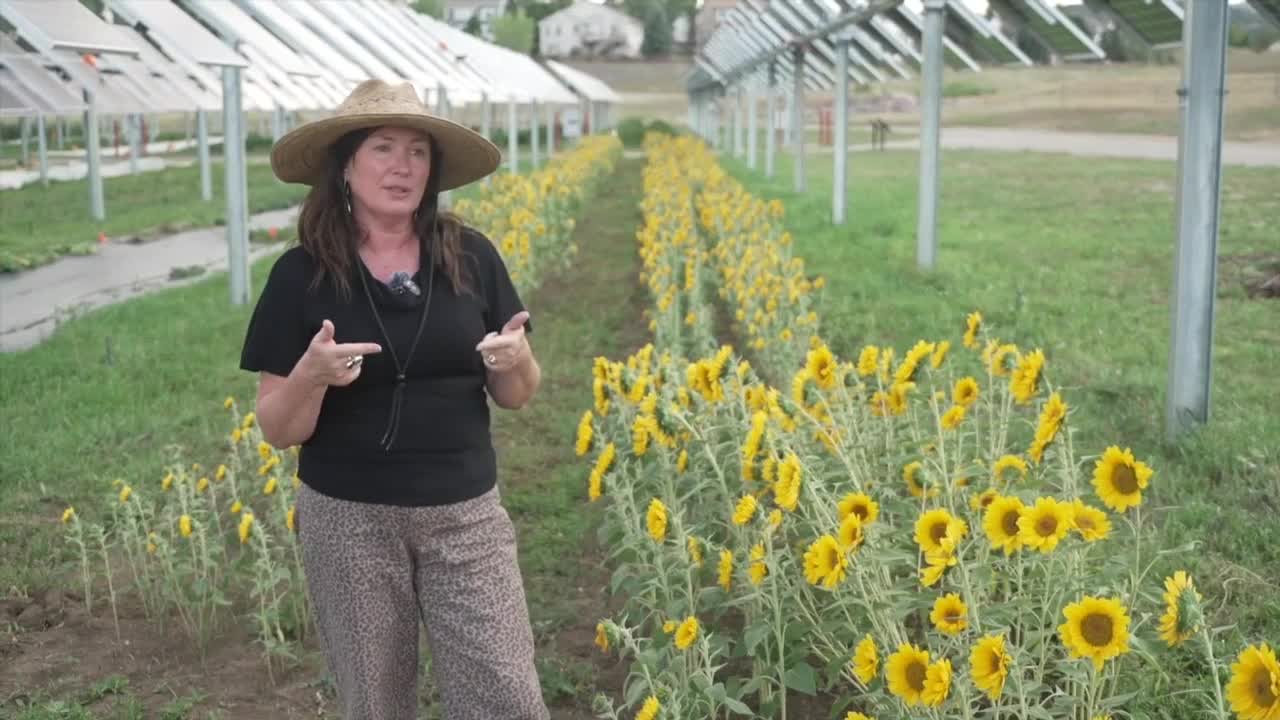


LITTLETON, Colo. — At the Solar Garden at Chatfield Farms, more than 2,200 solar panels do double duty: generating 1.2 megawatts of clean energy while providing intermittent shade for crops growing beneath them — a farming method known as agrivoltaics.
Lauren Hazlett, head grower for the Solar Garden, said the shade has been an unexpected advantage for both crops and farmers.
"The fact that you can go underneath here, and kind of plan your day around where the shade is, is something that no other farmer has for sure," Hazlett said.
That shade is also benefiting plants that many assume need full sun.

"Things like tomatoes, cucumbers, peppers, things that people think want sunlight all day, they actually can't take our Colorado sun. They really like having that little bit of shade," Hazlett said.
Josie Hart, associate director of sustainable agriculture at Denver Botanic Gardens, oversees the Solar Garden and works with the National Lab of the Rockies to document how different crops grow under shaded versus non-shaded conditions.
"We've basically been seeing that a lot of the crops actually are thriving and doing better than our sort of full sun outdoor crops," Hart said.
The garden grows hundreds of pounds of produce every week across its three growing acres, and then all the food is donated to hunger relief organizations across the Denver metro area.

"We're donating 100% of the food," Hazlett said. "The whole idea is that we are increasing food access for a lot of people that don't necessarily have it.”
The energy generated at the site is split: 20% powers Chatfield Farms and a portion of the Denver Botanic Gardens, and the remaining 80% is donated to low-income families across Denver through the nonprofit Energy Outreach Colorado.
"They identify families that are in need of energy assistance, and then they get a discount on their Xcel (Energy) bill for all of their electric use," Hart said.
For Hart, the project points toward something larger.
"Solutions like this, where we're co-locating a lot of different things, are going to be more and more impactful and important because we know that the world is getting hotter and we know it's harder to grow crops," Hart said.
This story was reported on-air by a journalist and has been converted to this platform with the assistance of AI. Our editorial team verifies all reporting on all platforms for fairness and accuracy.

