

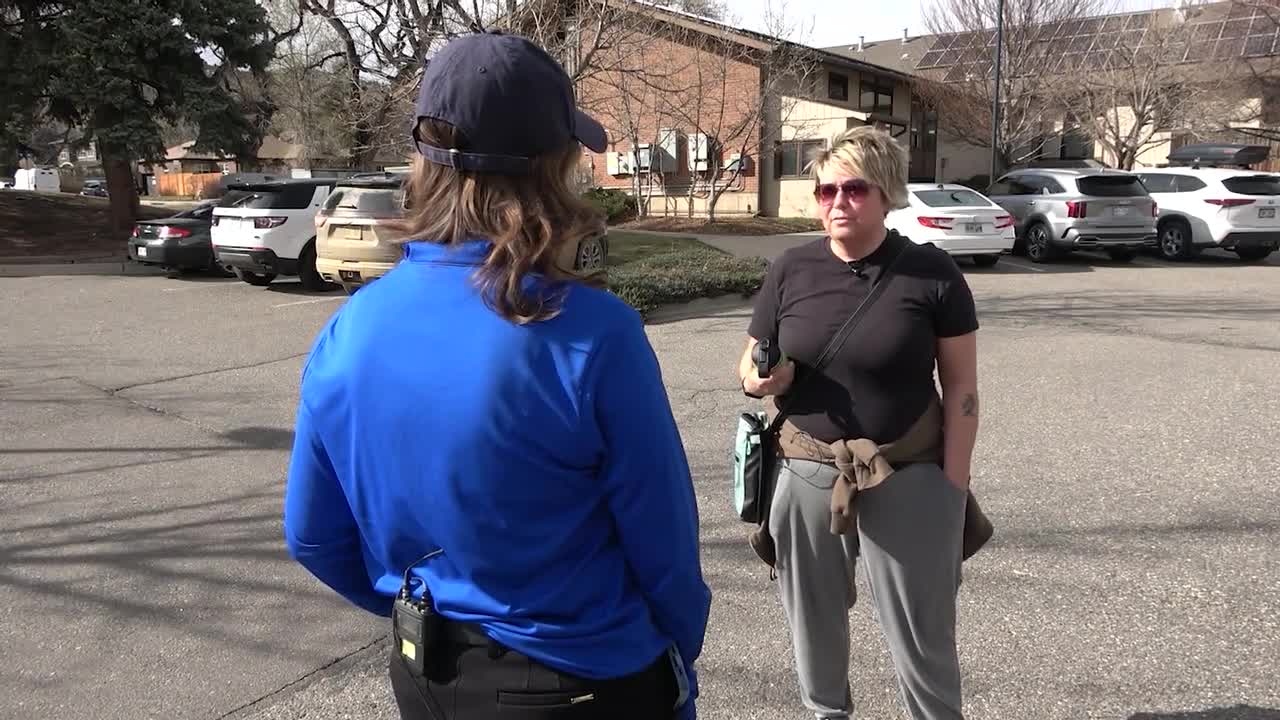


On Saturday, the North Boulder Recreation Center became a temporary resource center for customers impacted by Xcel Energy's Public Safety Power Shutoff (PSPS).
That's where Denver7 met Shannon Fletcher, a Boulder resident without power.
"About 2:12, boom, the power went off," Fletcher said.
More than 10,000 customers were without power by 6 p.m. Saturday, according to Xcel's outage map.
But Fletcher questioned whether the shutoff was necessary, saying the winds didn't seem as severe as during previous wind events like the one in December.
"Is it necessary to keep everyone's power off when it's not even that windy?" Fletcher said.

Denver7 took that question to Robert Kenney, president of Xcel Energy Colorado, who said wind speed alone doesn't determine when a shutoff is triggered.
"So it's not just the winds by themselves," Kenney said. "We're looking at winds coupled with low relative humidity and dry fuels on the ground."
Kenney said it's that combination of factors that trigger safety shutoffs — shutoffs that are becoming more common.

"Well, I'd say this, we're seeing more extreme weather events," Kenney said. "We are seeing them more frequently because historically, we've not done them at all."
Fletcher said she hopes Xcel will consider alternatives to widespread shutoffs that are becoming a more common inconvenience for homeowners like herself.
"I hope that there are some better solutions than kind of doing a big blanket shut off," Fletcher said.

Avoiding widespread shutoffs is what Kenney said Xcel strives for.
"We're adding sectionalization devices to our system so that we can deenergize smaller portions, which would then impact fewer customers," he said.
We also talked with Kenney about other mitigation efforts.
The company is working on undergrounding about 50 miles of power lines, something Kenny explained can be logistically challenging, especially with Colorado's mountainous terrain.
"The other challenge is it takes a long time," he said. "And then another challenge is that it costs significantly more than overhead lines. But that doesn't mean we're not going to look where we can do it."


