

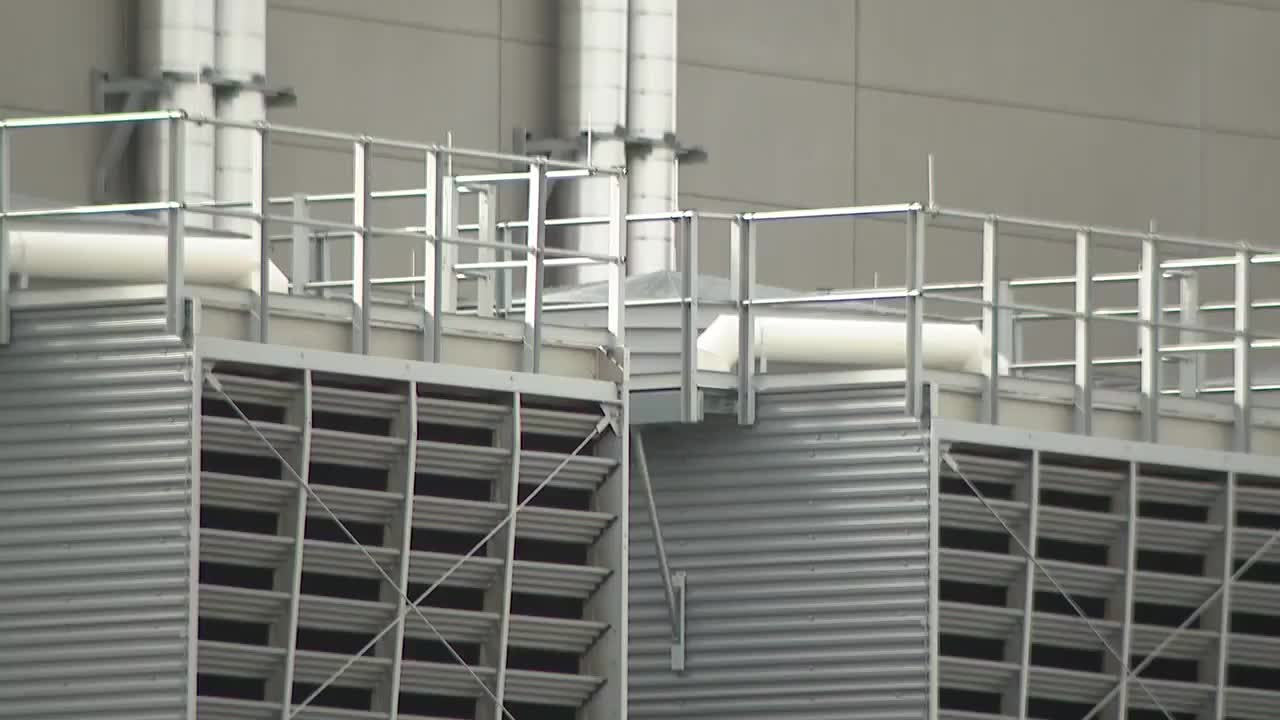


AURORA, Colo. — During a meeting Monday night, Aurora City Council banned sprinklers from running October through April and restricted the use of evaporative cooling systems in new large buildings, like data centers, in an effort to reduce water usage during a historic drought.
The seasonal irrigation ban requires most residents to turn off sprinklers by Oct. 1 through April 30, while public spaces like parks, school grounds, athletic fields, and golf courses have until Oct. 15 to stop outdoor irrigation.
The ban on evaporative cooling systems applies to new commercial, multi-family, and industrial construction and does not affect single-family homes.
Watch Maggie Bryan's report in the video player below:
Evaporative cooling works by turning water into vapor, absorbing heat in the process. The systems are commonly used because they are energy efficient, but they can also consume large amounts of water.
Shonnie Cline, a spokesperson for Aurora Water, said the purpose of the ordinance is to urge large buildings to be more water-efficient.
"The whole purpose of this ordinance is just to ensure that we're not going to have water users that come in that use large volumes of water for evaporative cooling," Cline said. "There's lots of industries that use evaporative cooling. The one that everybody thinks of off the top of their head is data centers."
Cline said Aurora Water already has thresholds in place for large water users that effectively discourage evaporative cooling, but the new ordinance makes the prohibition official.
"Part of the reason why data centers historically have used evaporative cooling, in particular in places where there's a lot of water ... it's because it is the least expensive thing for them to do. Water has been historically cheaper than power," said Cline.
The ordinance comes as Aurora residents continue to push back against data centers in the area, including a proposed 860,000-square-foot data center near East 48th Avenue and E-470 called the Trident Project.
"We're concerned about energy use. We're concerned about water," said Violet Brooks, a resident living at The Reserve, a senior living community near the site. "I expected this to be my last home. I never expected to have to move, and now that's exactly what I'm looking at."
"It's a total disaster," said Garry Zimmerman, a resident at The Reserve. "I can't imagine how anybody could possibly see that that was a smart idea."
Vantage Data Centers, the company proposing the Trident facility in Aurora, told Denver7 it plans to use a closed-loop cooling system, which circulates water through pipes to cool equipment without evaporation.
While closed-loop systems use less water, Cline said the alternative comes with a slight tradeoff.
"There is a slight power differential when you move to, like, a closed-loop system, which uses far less water, and while you have that less water use, it definitely does use a little bit more power," Cline said.
The seasonal irrigation ban also includes restrictions on ornamental water features such as ponds and fountains, in both residential and commercial spaces. Swimming pools and hot tubs are not included in the ban. Residents are still allowed to hand-water trees and bushes during the restricted period.



Denver7 is committed to making a difference in our community by standing up for what's right, listening, lending a helping hand and following through on promises. See that work in action, in the videos above.