




DENVER — On Tuesday, Colorado Parks and Wildlife (CPW) released five orphaned bear cubs in the San Luis Valley region.
One of the bears was injured in the Aspen Acres Fire and was taken into CPW care in July when he weighed only 31 pounds. At the time of the bear's release, his burns had healed and he weighed more than 120 pounds.
The other cubs came from Rye, Beulah, Westcliffe and Walsenburg.
Most bears end up in CPW's care after their mothers have died, which could be as a result of car crashes, landowner conflicts, or euthanasia. Rarely are cubs abandoned by their mothers, but it has become more prevalent in 2026 "which has been the worst year of natural food production for bears that CPW has recorded," a press release said.
Historic drought, late spring freezes, and several large wildfires were all listed as reasons for the widespread food failure by CPW.
As of Nov. 20, CPW recorded 12,149 reports of bear sightings and incidents in 2026 — more than double the number from the same timeline last year, which was 5,267.

Mountains
Bear attacks woman in her 80s after breaking into her home in Estes Park: CPW
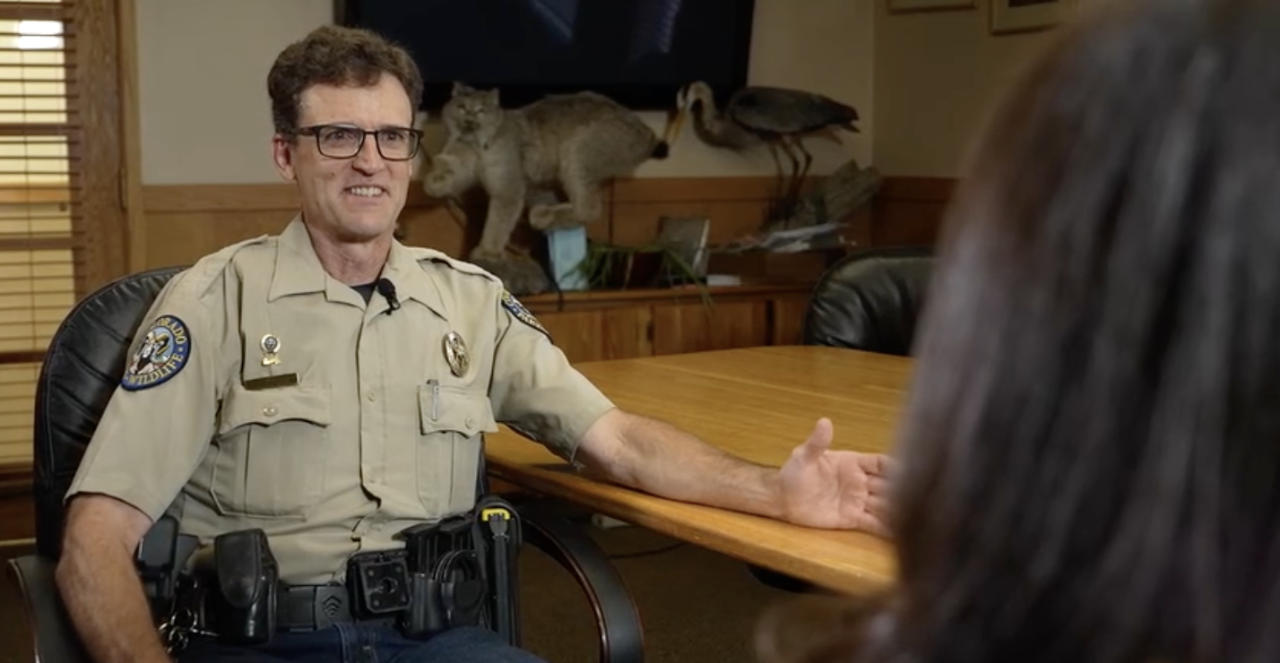
Casey Westbrook has worked with CPW for 27 years and is currently an Assistant Area Wildlife Manager covering six counties across the Denver metro.
Bears are an animal Westbrook holds in high regard due to their adaptability and intelligence.
“That, to me, has always been very intriguing: is to see how they operate and maneuver within their world. It's pretty cool," Westbrook said.
This year, Westbrook said the call volume and reports have been very different — both when it comes to where the bears are appearing and the age of the bears.
"Older bears than normal," Westbrook said. “For the Denver metro area, it's very common to have dispersal age bears. That two-and-a-half, three-and-a half-year old bear that moves through a community, maybe stays for a little bit, and then moves on because it's looking for its place in the world. What I've seen this year is yes, we have those, but we've seen a lot of older, mature bears that normally would have a territory elsewhere that have found their way here looking for resources, looking for food primarily.”
Black bears call Colorado home, and enter a period of hyperphagia in mid-August as they prepare for hibernation.
"I kind of refer to them flippantly as walking stomachs," Westbrook said, referring to bears in hyperphagia. "That desire for food is greater than their concern or fear about impacts from being around people.”
All year, Westbrook said the drought has been top of mind when it comes to the natural food supply for bears.
“Typically across Colorado, we have regional food failures. That's not uncommon, right? The difference this year is the scale at which it happened, and part of that is last winter we didn't have the snow melt, or the snow accumulation to cause the snow melt," said Westbrook.
Westbrook explained that normally bears feed on light foods when they come out of hibernation, but the drought reduced the availability of resources in the spring. After the spring, Westbrook said a hard freeze killed off what would have been future food production.
"Bears over time can adapt to things like climate change on a grander scale, at least to a degree. But this year was just a perfect storm of not only drought, but then a freeze," said Westbrook. “Those two things don't seem like they would fit together, but they absolutely played a role together, and I think that's what kind of exacerbated the problems for the year.”
Then, Westbrook said the effects of the freeze impacted the vegetation that normally grows in the middle of summer, limiting options for bears in Colorado.
“What we saw was very early spring bear problems, then a slight lull when we had our calving and fawning season with our deer and our elk because that is something that bears could turn to, so there was a lull in activity or conflict there because they were able to eat that," Westbrook said. "But then the rest of the summer up until now, the natural food sources haven't been there, so that's been a pretty motivating factor for those bears to come find food from people."

Local
Colorado law cracks down on consequences for luring bears with food
Carrying capacity is the maximum number of a species that can live in a certain environment due to habitat availability and is determined by a limiting factor, which Westbrook said for bears in Colorado is their food resource.
In response, bears went searching for the calories they needed this year, and many times discovered human food. For instance, videos of a bear eating baked goods at a farmers market in Aspen went viral earlier this year.
"I tend to think that that bear has probably begun to be habituated to people in order to be willing to go into that situation in the first place. Can't blame the bear, right?” said Westbrook. “Those foods are as close to natural foods as we're going to get, and so I don't expect the bear to know the difference. The only thing that is really shocking about it is just with all the people around. It's concerning from the aspect of having that number of people in that proximity to an animal and not knowing which one's going to be unpredictable. The crowd can be just as unpredictable as the bear."
As a bear biologist and host of a podcast centered around animal attacks, Wes Larson has closely followed the headlines regarding bear encounters from across the country.
"I grew up here in Montana, and bears kind of always loomed large for me," Larson said. "They were just always the animal that we thought of when we were hiking, when we were exploring, even just around my neighborhood — I would think about bears... I just became naturally fascinated with them, with other predators, with animals that were potentially dangerous.”

Larson said the adaptability of black bears and their ability to quickly switch between food sources is one of the things that makes the species so special.
"But it's also something that can put them into conflict with humans," Larson said.
When a black bear is browsing on berries in Colorado, it is considered a low-risk activity according to Larson. The risk dramatically intensifies if a bear decides to break into a home in search of food.
“They understand that this is an unknown. This is something that could lead to their death, and generally, not always, but generally, the bear has to be pushed to take those kind of risks," Larson said. "I think that's what we're seeing this year is they're adapting to new food sources, which carry a much higher risk, but they're being pushed to do that because they're losing a lot of their natural food sources.”
Denver7 asked Larson how much of a role climate change plays in the conversation surrounding bears and their natural food sources.
"Climate change is something that lots of people have been screaming at the top of their lungs for a long time, bear biologists included," said Larson. "The thing that black bears again have in their favor is that adaptability... If I'm making a list of the animals that are the first we're going to lose from climate change, they're not on that list.”
Larson said black bears will have to change their behavior as a result of climate change.
"Because of climate change, we're having these really long-lasting, historic droughts. They're happening more and more frequently. Colorado's in the middle of a terrible one, and they're losing a lot of their typical natural food sources as a result, and they have to adapt," Larson explained.
According to Larson and Westbrook, one of the best ways to protect bears and the people living alongside them is securing food and trash throughout a property.
"Bird feeders, trash, beehives, anything that a bear might be able to get into. Making sure that it's bear-proof, and then the other part of that is if you're outside recreating, making sure that you have a way to get out of a potentially dangerous encounter with a bear," Larson said. “Carry bear spray, know how to use it. Just be ready to use it if you have to. It's very, very, very unlikely that you're going to have a bad encounter, especially with a black bear. If you do happen to be that one in a million person, bear spray is very likely to get you out of it, and it gets the bear out of it too. So, carry it and use it if you need it."

Recreation
'It was circling around me': Jeffco's Apex Park closed due to aggressive bear
Westbrook said it is difficult to predict if bears in Colorado will come out of hibernation early or not.
“The very young may not go into hibernation in great condition this year, which means they may not come out next spring. While that's sad, it doesn't affect our breeding population, which is the important part to keep in a population going in the first place," said Westbrook. “We'll see some bears that don't make it out of hibernation. I think we'll see some bears that, especially the females, they have a delayed implantation.”
According to the National Park Service (NPS), black bears utilize a reproductive strategy called delayed implantation, where a fertilized egg is dormant until a mother bear enters her den. The female will only become pregnant if she has gained enough weight in the fall.
“Bears are unique in that their breeding season is June or July generally, and when an animal actually has a fertilized embryo, a fertilized egg, that embryo just kind of stays in the system, but it doesn't attach to the uterine wall, which is what it needs to do in order to develop," Westbrook said. “It stays as a free-floating essentially embryo inside the mother until the mother goes into hibernation, and so at that point the body decides: are there enough resources in the mother to not only support herself through hibernation, but then also to support the development of a cub?”
Still, Westbrook said there will be bears of breeding age on the Colorado landscape next year.
"This one this one year, while it's been hard to watch, is not necessarily detrimental to the population as a whole," said Westbrook. “Hopefully it's not going to happen twice."
