

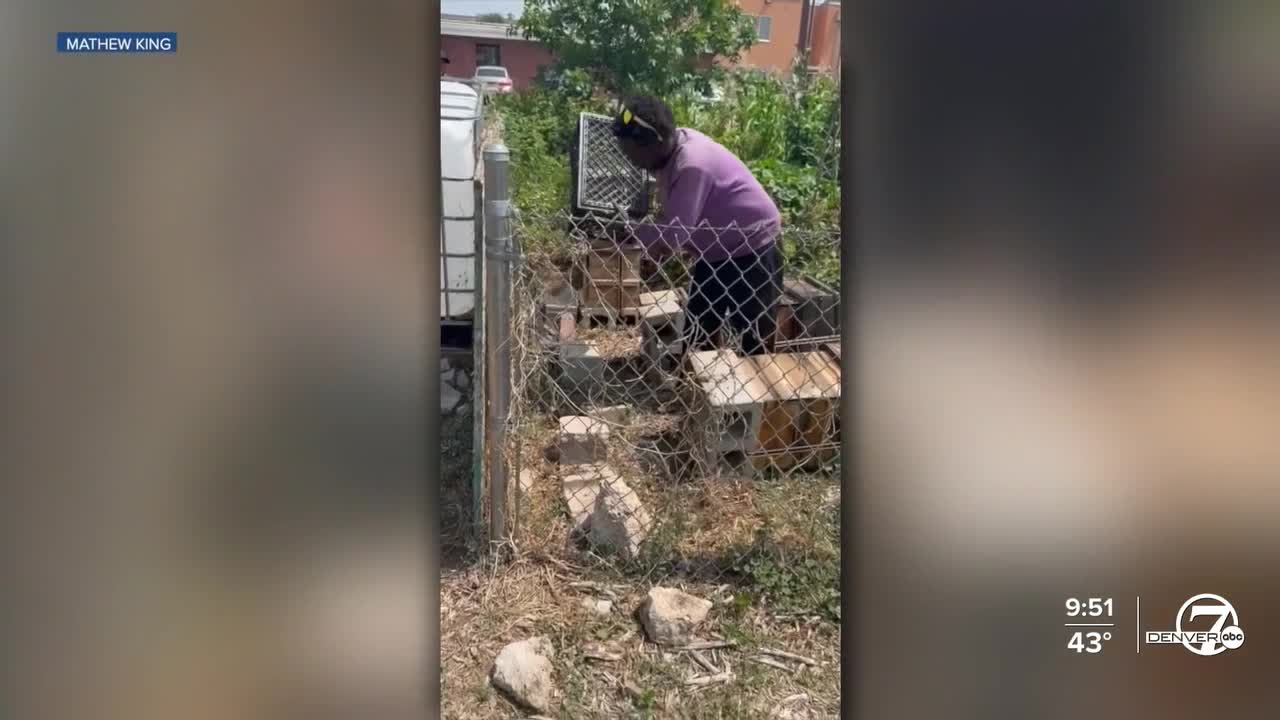


AURORA — Newly obtained 911 calls reveal what residents were hearing from dispatchers as they repeatedly asked for help while a person damaged an Aurora community garden in August: Police weren't available yet.
“Where are your police officers?” Mathew King asked during one of several 911 calls from the Denver Urban Gardens site near East 16th Avenue and Yosemite Street.
“We have the call in, sir,” the dispatcher responded. “We don’t have an officer available to send just yet. We’re going to get them sent as soon as we do.”
Moments later, King told the dispatcher the person was continuing to damage the garden.
“He’s destroying our garden and doing thousands of dollars of damage,” he said.
“I am really sorry this is happening, sir,” the dispatcher responded. “We don’t have an officer to send. As soon as we do, we’ll get them headed that way.”
Denver7 Investigates obtained the 911 calls and dispatch records as part of follow-up reporting into the Aug. 8 incident.
The records confirm the timeline Denver7 first reported in August: The initial call came in shortly before 1 p.m. Police were dispatched at approximately 3:48 p.m., and the first listed police unit arrived around 4 p.m., more than three hours after the initial call.
What callers told Aurora911
In the initial call, King reported someone at the garden was “being destructive and throwing rocks” and said gardeners had reported abusive behavior and damage to property.
However, when the dispatcher asked whether anyone was hurt or in danger, King, who was not yet at the garden, said he was not aware of anyone being in danger and described the disturbance as verbal. The dispatcher instructed him to remain separated from the person and call back if anything changed.
About 15 minutes later, King called back after arriving at the scene.
“I’m watching him tear apart our garden,” he told the dispatcher, later adding, “He’s doing a lot of damage.”
The dispatcher told King to continue keeping his distance and said they were “still just waiting for an available officer in that area to be dispatched.”
During another call, King reported the person was breaking cinder blocks and had rocks in hand.
King said people at the garden felt threatened, but when the dispatcher specifically asked whether the rocks were being thrown at people, King said they were being thrown at objects.
The dispatcher again urged everyone to stay away.
“Property can be replaced. People cannot. So please, please don’t approach him,” the dispatcher said.
The call remained classified as Priority 3.
City says the call was properly classified
In detailed written responses to Denver7 Investigates, the city has maintained that the call was appropriately classified based on the information dispatchers received.
The city previously defined Priority 3 calls as incidents involving a low threat to personal safety but requiring a police response for issues including property crime, disturbances or active or recent nonviolent criminal activity. The city said the garden call could have been categorized as either a disturbance or vandalism, but both would have been Priority 3 calls.
The city also said the call would have been upgraded if callers had reported behavior shifting to direct threats against people.
“The call was processed appropriately, based on the problem description that a male was in the community garden causing a disturbance and vandalizing,” the city wrote in its response to Denver7. “Had callers reported that behaviors shifted to direct threats against people, the call priority would have been upgraded.”
Aurora Police and Aurora911 declined Denver7 Investigates' requests for on-camera interviews for the follow-up story.
APD said in its latest written response that it agrees with Aurora911's categorization and that the response “aligned with established priority guidelines.”
The department said the primary reason for the wait was the number of higher-priority emergencies happening elsewhere in Aurora.
“The primary factor influencing the response time was the high volume of Priority 1 and Priority 2 calls occurring at the same time,” APD told Denver7. “Those are incidents involving immediate danger to life or safety, and our dispatch process works much like triage in a hospital — the most urgent, high-risk situations must be addressed first.”
APD said officers remain committed to those incidents when call demand is high, which can delay responses to lower-acuity calls.
The city previously told Denver7 that between 1 and 4 p.m. on Aug. 8, there were 11 Priority 1 calls and 15 Priority 2 calls. The city also said officers spent an average of 87 minutes and 44 seconds on scene at calls that day.
APD does not track Priority 3 response times
Denver7 Investigates also asked APD how the department evaluates long waits for Priority 3 calls.
APD confirmed it does not track response times for those calls.
“These calls often involve situations like property damage or other non-urgent issues where there is no immediate threat to public safety,” a city spokesperson said in a written response. “Because of that, the timeline for engagement or closure isn’t always tied to a single response window — it can span minutes, hours, or even days depending on the nature of the case.”
The department said tracking Priority 3 calls in the same way as higher-priority calls “would not provide meaningful data about service quality or resource allocation.”
Mayor Pro Tem Alison Coombs, however, told Denver7 Investigates she questions whether response times should be tracked when a crime is actively happening.
“I do wonder if any crimes in progress should be classified as Priority 3, or if we should always be checking our response times for crimes in progress that are reported,” Coombs said.
Coombs said the incident exposed a policy question for council.
“I think it does reveal a policy gap that we need to look into as a council, in terms of how we classify calls, and again, particularly of crimes in progress,” she said.
A new investment in alternative response
Coombs also told Denver7 Investigates that the original community garden story prompted her to ask the city manager what it would cost to add additional mobile response teams.
Coombs emphasized that the garden incident was not the only reason she believes Aurora needs more behavioral-health response capacity.
The city has since moved toward adding another Aurora Mobile Response Team (AMRT).
The city told Denver7 that Council gave preliminary approval to a fourth AMRT unit in the proposed 2027 budget. The additional team would cost approximately $243,000, according to Coombs.
AMRT pairs a licensed mental-health professional with an EMT or paramedic to respond to qualifying nonviolent calls where police action is not required.
Coombs said Aurora currently provides AMRT service seven days a week but not 24 hours a day, and that another team would expand that coverage.
Would another team have changed what happened at the garden?
On that question, Coombs and APD do not agree.
When Denver7 asked whether another mobile response team could have made a difference during the garden incident, Coombs said, “I think so.”
“They would have been able to come and at least see the situation and determine whether it’s something they could handle,” she said, including whether clinicians could de-escalate the situation or whether additional help was necessary.
APD told Denver7 the additional behavioral-health capacity would not have changed the outcome in this particular case.
“Expanded behavioral-health response capacity can be helpful in some situations, but its impact really depends on the specific circumstances on any given day,” APD wrote. “In this particular incident, it would not have changed the outcome.”
APD also cautioned that clinicians cannot replace law enforcement when safety concerns or potentially escalating behavior are involved.
At the same time, the department acknowledged a larger challenge facing police.
“APD, like many police departments, often becomes the default responder for a wide range of social and behavioral-health issues,” the department wrote. “That system is strained, and long-term, sustainable behavioral-health care is needed so that police are not the catch-all for situations better served by other professionals.”
APD characterized alternative-response programs as a partial support rather than a complete solution.
Back at the garden
Two months after the incident, much of the physical damage has been repaired.
King showed Denver7 where the damaged beehives had stood and where the garden's water tank had been put back in place. He said Denver Urban Gardens found money for some replacement equipment.
But King said the longer-term test will be what happens when someone at the garden needs help again.
He compared the problem to a leak: Addressing it quickly limits the damage, while allowing it to continue makes the eventual repair more difficult.
Asked whether the city's changes will make a difference, King was cautious.
“We’ll just have to see,” he said. “I don’t know.”
What happens next
The funding for the fourth Aurora Mobile Response Team is part of the proposed 2027 budget.
City Council is scheduled to vote on final budget adoption Nov. 9 and Nov. 23.
Meanwhile, the man arrested in connection with the community garden damage and multiple crimes across the area remains in the Adams County Jail and is due back in court Thursday for a review hearing.

