


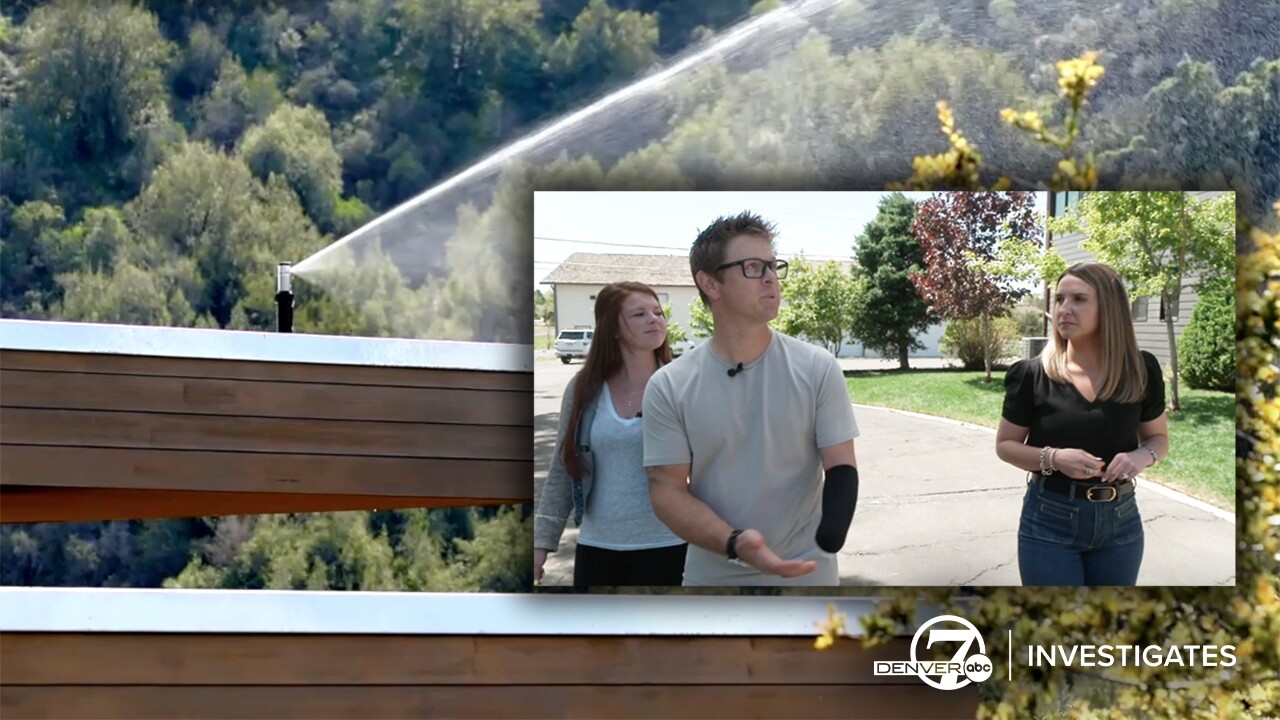

ARVADA, Colo. — One of the driest winters on record has Colorado facing elevated wildfire danger and is leading some homeowners across the state to turn to automated exterior sprinkler systems for protection. And insurance experts continue to stress the need to be prepared and adopt multiple fire mitigation steps.
Kersten and Hunter Bishop call Arvada home. They told Denver7 Investigates that they decided to invest in Frontline Wildfire Defense after last winter’s high wind power shutoffs and the memory of the 2021 Marshall Fire, which damaged and destroyed more than 1,000 homes and businesses in Boulder County.
▶️ WATCH: Denver7 Investigates' Jenn Kovaleski learns more about how this technology can help homeowners protect their houses from wildfires.
"We had a really bad winter," Hunter Bishop said. "It really kind of brought about the fear that the Marshall Fire could happen again."
Frontline’s automated exterior sprinkler system mounts along eaves and rooflines and can trigger automatically or by remote. The company said it targets the most dangerous wildfire threat to homes: wind-driven embers.
Harry Statter, the company's CEO and founder, explained that the sprinklers wet materials outside the home so when those embers land, they don't ignite.

Statter said the sprinklers have backup power designed to keep it running even if the electrical grid shuts down, and the system connects to real-time wildfire tracking data nationwide.
The company said Colorado has become its second fastest-growing market in the country, behind California.
"There's a fire history in Colorado and folks are aware of it," Statter said.
The company said their systems costs tens of thousands of dollars, though financing options are available. A partnership between Frontline and insurance company STAND has launched in California, offering lower insurance premiums to homeowners who install the system.
That partnership has not yet expanded to Colorado.
Arvada couple invests in system
The Bishops said Hunter's father built their Arvada home in the late 1960s.
Losing it would mean erasing decades of family memories, a concern they said became harder to ignore after watching the Palisades Fire tear through Southern California. The fire destroyed thousands of homes in LA County and killed more than 30 people.

"That was a huge fire. And it was, I think, eye-opening," Kersten said.
It spurred the couple to think of what they could do proactively to protect their Arvada home from a fast-moving fire.
"There's a lot of memories with this property," Hunter said.
The company said their systems costs tens of thousands of dollars, though financing options are available. A partnership between Frontline and insurance company STAND has launched in California, offering lower insurance premiums to homeowners who install the system. That partnership has not yet expanded to Colorado.
Company sees success after California fire
The Palisades Fire became a proving ground for Frontline's technology, Statter told Denver7 Investigates.
Cell phone videos provided to Denver7 Investigates showed California homes equipped with Frontline systems still standing while neighboring homes burned to the ground.

Of the 61 homes in that area that were equipped with sprinklers at the time of the fire, 59 survived with minimal or no damage.
"Seems the sprinkler systems did their job — I can see it's still wet," one homeowner said in a cell phone video after returning to find their home intact.
Statter said the results demonstrate the system's potential to protect homes at a larger scale.
"We could provide protection at scale, right? And that's what we're doing across the western U.S.," Statter said.
Insurance experts say other mitigation steps remain important
Colorado insurance experts say systems like Frontline's are promising, but caution that they should not replace proven wildfire mitigation strategies.
"Everyone is on high alert that we're in for a scary wildfire season and for insurance, what that means is we need to be prepared," said Carole Walker, executive director of the Rocky Mountain Insurance Association.

She said homeowners should look at the system as a tool in the toolbox, while not bypassing proven mitigation techniques. She added that homeowners should also maintain "the right amount of defensible space around your home, have the right fire-resistant roof."
Statter agreed that no single solution is enough on its own.
"It takes a comprehensive set of mitigations to really, truly protect a home," Statter said.
