



AURORA, Colo. — A Colorado Supreme Court ruling is forcing Aurora to change hundreds of criminal sentences after city leaders took a hardline stance on certain lower-level crimes.
In December 2025, the Supreme Court unanimously decided cities cannot impose tougher penalties than the state for the same crimes in a case called People vs. Camp and Simons.
WATCH: Denver7 Investigates' Jennifer Kovaleski reveals new data and presses city leaders on the far-reaching impacts of the landmark decision.
Denver7 Investigates has also learned that three people in Aurora who were potentially serving harsher sentences at the time of the court’s decision have since been released, a city spokesman confirmed after motions were filed in city court.
“We do know when the ruling came down that there were a number of people that were in jail… being held on illegal sentences,” Aurora Mayor Pro Tem Alison Coombs told Denver7 Investigates' Jennifer Kovaleski.

In one case, a city spokesman said the court lowered the municipal sentence to reflect the new maximum allowed under the ruling.
The city said one sentence was imposed by a judge after a jury trial. The two other cases were plea agreements. Aurora did not say what crimes the three people were convicted of or how much time they were serving. Denver7 Investigates has filed a records request for that information.

Cases behind the Colorado Supreme Court ruling
Both Michelle Camp and Danielle Simons — who were at the center of the People vs. Camp and Simons case — faced far more jail time and higher fines in city court than at the state level. Camp’s case was out of Westminster and Simons was in Aurora.
Attorney Ashley Cordero represents Simons, the Aurora woman whose case helped set the precedent and sparked a statewide debate over local power.

"For those of us that practice in that court and represent these people every day, it's huge," Cordero said.
Simons was charged with motor vehicle trespass and trespassing in two separate cases, according to court records.
"The summons alleges that Ms. Simons was found sleeping in a vehicle for one of her cases. And that's very much tied to her status of being unhoused," Cordero said.
Under Aurora's city code, Simons faced up to 364 days in jail and fines up to $2,650 for each offense.
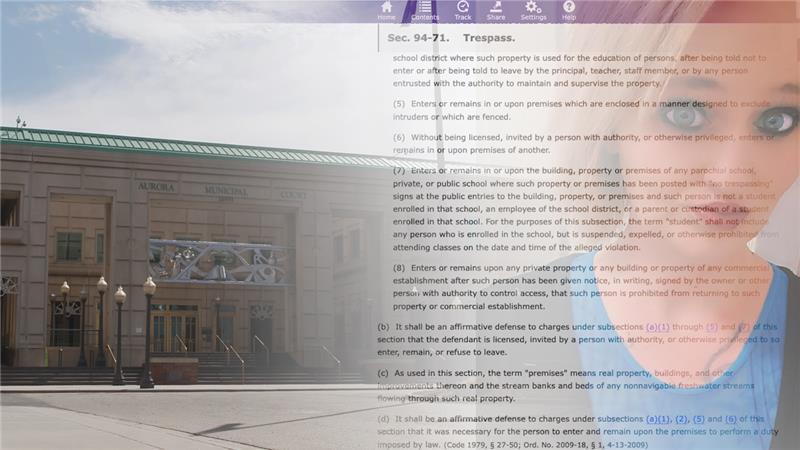
By comparison under state law, those same crimes carry far lighter penalties and much smaller fines: Up to 120 days in jail, a $750 fine, or both, for one charge, and a maximum of 10 days in jail with up to a $300 fine, or both, for the petty trespass offense.
"When you're thinking about how to resolve your case, a maximum of 10 days in jail and almost a year in jail is life-changing," Cordero said.
The ruling is impacting cities statewide, but in Aurora, it is changing hundreds of cases and overturning ordinances, many that were passed by City Council in 2022 and 2024 to crack down on motor vehicle and retail theft.
“We made a decision as a council to address some things we were seeing … and make those penalties harsher. And to me, the state really came in and said, 'You can't do that anymore,'” Aurora City Councilman Curtis Gardner said.
Gardner voted for those tougher penalties, saying the goal was to deter crime.
“I really believe that if I'm looking at up to an entire year for committing a crime, my mindset might be different than if I'm only looking at a week and a half," Gardner said.
Aurora Mayor Pro Tem Coombs voted against the ordinances and said the Colorado Supreme Court ruling should have prompted more immediate action.
“I would have rather we resolved these issues more quickly than we have,” Coombs said. "It's clear to me that there have been unjust and unequal sentences imposed.”
Coombs is now part of the new council majority with a different vision from the city's previous tough-on-crime approach.
"These are not folks that are out terrorizing the community. In a lot of cases, there are folks that are dealing with significant poverty," Coombs said.
Aurora court records reveal number of cases
Denver7 Investigates requested every case filed in Aurora since the tougher retail and motor vehicle theft ordinances took effect.
The city prosecuted 800 theft cases, records show. In many of them, defendants were given suspended sentences with the threat of up to a year in jail used as leverage, but most served far less time.
The city issued nearly $55,000 in fines for theft, but 70% of that money went unpaid, according to data provided by the city.
Motor vehicle theft cases were less frequent, but penalties were far more severe.
Active cases potentially impacted by the ruling
Denver7 Investigates asked for an on-camera interview with both Aurora’s city attorney and public defender. They declined but referred us to a city council study session where both explained the impact of the Supreme Court ruling.
In the meeting, both sides discussed between 300 and 500 active cases with suspended sentences that could be affected by the court’s decision. The city said it filed notices with the court to outline the new maximum penalties in those cases.
“My hope is that the city can address all those folks who have the sentences still hanging over their heads for the suspended sentences,” Coombs said.

Simons’ case is still pending in Aurora.
"Hundreds of folks in Aurora... so, the impact of this is going to be big," Cordero said.
Coombs said the city is now working to rewrite its criminal code to match the maximum sentences allowed under state law.
Denver city leaders push for criminal sentencing reform
The decision is having a ripple effect across the state, including in Denver, where some city leaders are pushing for a complete overhaul of criminal sentencing in response to the supreme court ruling.
On the steps of the City and County Building in early March, three Denver councilmembers held a press conference and laid out the proposed law changes.
"This provides clarity, consistency, and coherence in Denver’s municipal code,” Denver District 8 City Councilwoman Shontel Lewis said.
WATCH: Denver7's Jennifer Kovaleski takes a look at how the ruling will impact Denver and other cities
The new ordinance would cap jail time for lower-level offenses at 10 days, matching state law, and the Supreme Court decision. Advocates say many of the crimes are tied to poverty-related offenses like camping, trespassing, or minor property damage.
"We’ve had, for many years on the books, a 300-day sentence for things like public urination — and that is just wildly out of step with any rational use of our criminal justice system," Denver Councilwoman at Large Sarah Parady said.
"It is wrong, and it is unconstitutional, for Denver to impose harsher sentences than the state for the same conduct," Kym Ray of the Colorado Criminal Justice Reform Coalition said.
The Denver City Attorney's Office said the current bill goes beyond what is required under the Supreme Court ruling. The proposed changes still need a full vote from the council. The city attorney’s office said it is working with Council on the legislation.
