

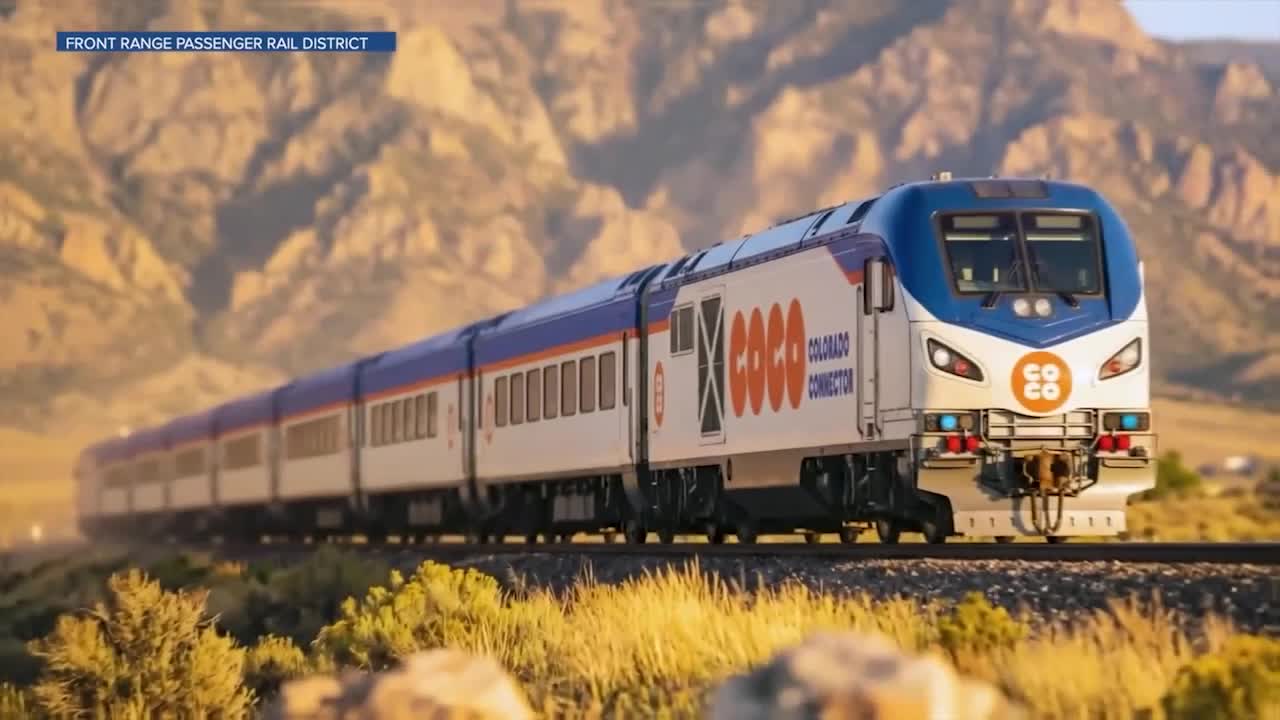


DENVER — The Front Range Passenger Rail District's Board of Directors voted Friday to put a sales tax measure on the November ballot to fund the expansion of the Colorado Connector, known as CoCo, between Denver and southern Colorado.
If approved, the tax would add new daily trips and bring the passenger rail project one step closer to linking a dozen Front Range communities by train.
It's been years in the making — a train connecting Pueblo, Colorado Springs, Denver, Boulder, Fort Collins and so many others in between.
What the tax would cost, and what it would pay for
For those like Caitlin Braun, executive director of the Broadway General Improvement District in Denver, the tax would amount to 33 cents for every $100 spent, if voters approve it.
"I'm really interested to learn more about it," Braun said. "I've had a couple meetings I've attended where I'm learning about it."
Braun's neighborhood near South Broadway could see the Colorado Connector make stops near the future Denver Summit FC stadium on game days — something she said could be a plus for the area.
"I see a lot of opportunity to move people to the stadium that's being built, to move people to the area, kind of open doors for people who maybe don't have traditional vehicles, and increase connectivity to the district," Braun said.
Braun said she's excited to learn more about how the rail stop would fit in alongside the planned Denver Summit FC Stadium and the nearby Burnham Yard development, where the Denver Broncos' new stadium is planned.

Local
Broncos fans raise tailgating concerns over new stadium plans
"What I'm hearing from the community right now is honestly a lot of curiosity — how it's going to tie in with RTD, what the final product is going to look like, who's going to maintain it," Braun said. "People wanting more information."
Braun said she's also been following Coco, from the community engagement push behind the project.
"I've recently learned about Coco, and it's obviously gaining a lot of momentum," Braun said. "They're doing a ton of outreach in the community, which is always appreciated. I'm really just curious to see how they keep pushing forward and see how it could all tie in."
Braun said local registered neighborhood organizations are still working through what the project would mean for the area.
"I think right now our local RNOs are all kind of discussing it, what it would look like to come to the community," Braun said. "It's on our radar. It's something we're keeping an eye on."
She said she's hoping to see the rail project, RTD service, and the new stadium developments come together rather than compete for space.
"We have RTD on one side of the tracks, we have the connector possibly coming to the other side of the tracks. The stadium's going to be built over here, and I think there's potential there for a good flow," Braun said. "But I want to see all these projects kind of come in together and work together."
Students up north say they could benefit, too
The rail line wouldn't just serve Denver's neighborhoods and stadiums. BrookLyn Reese, a Colorado State University student, said she and her classmates in Fort Collins could really benefit from the service.
"Connecting students to a resource that is more financially accessible, when students, notably, are struggling with food insecurity and housing insecurity, is incredible," Reese said.
Reese said easier, cheaper travel could give students more independence to connect with peers at other universities.
"That means that a student can reach out not only to other communities and be able to more easily travel to those communities, but also even within the university structure," Reese said. "Students being able to take a train further south to talk to students at other universities means students have more agency in being able to act as students. That improves their education. That improves their ability and agency in advocating for themselves, which is specifically of interest to ASCSU."
Reese pointed to CSU's focus on sustainability as another reason her fellow students are on board.
"Some of the pros that I was made aware of — we are a very environmentally focused campus," Reese said. "The environmental impacts of having more modes of travel is always beneficial. Even students being able to travel through another more affordable means, especially as gas prices are rising, is quite cool."
Reese said safety came up in conversations about the project, too.
"Student safety was another conversation, in terms of just college, alcohol — having a train is really cool," Reese said.
Reese and her student organization have backed CoCo since a resolution in support of the project passed on April 29, and she said they've been delighted by its progress since.
What's next
For Braun, that progress can't move forward without more input from the neighborhoods it will run through.
"I think right now our local RNOs are all kind of discussing it, what it would look like to come to the community," Braun said.
With the tax measure now headed to the November ballot, voters within the Front Range Passenger Rail District will ultimately on the sales tax now attached to the expansion.

