

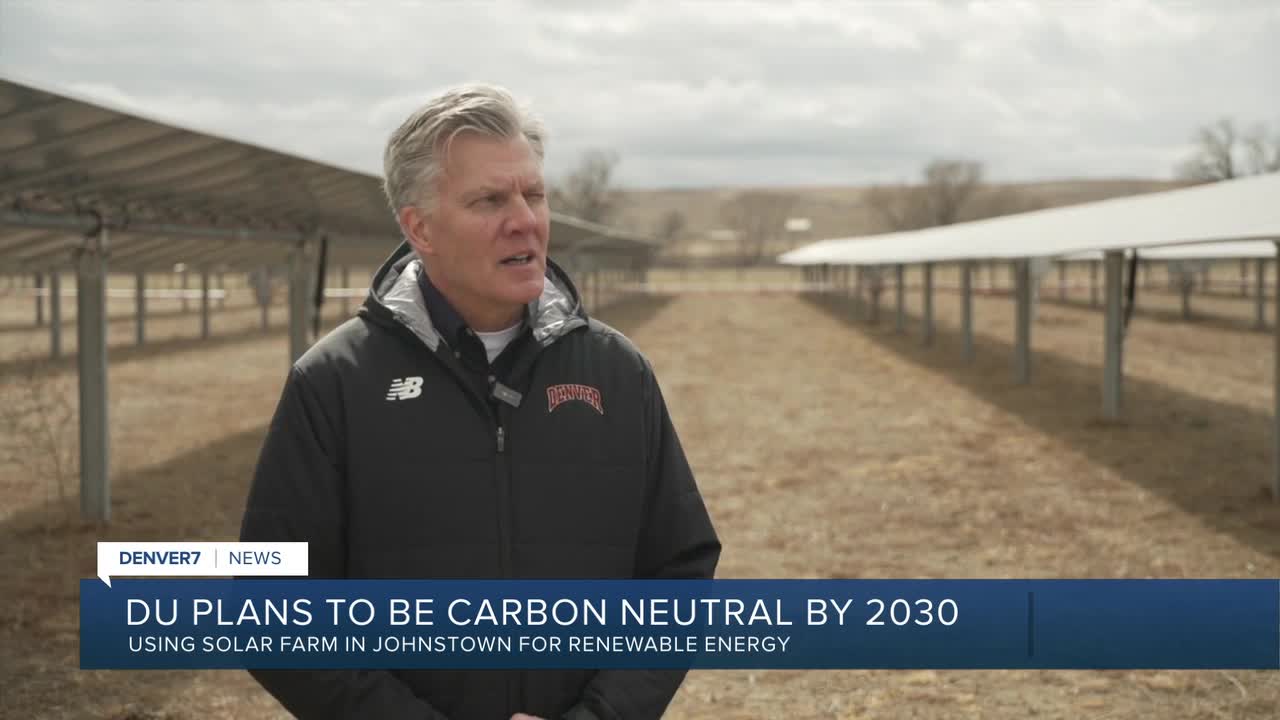


JOHNSTOWN, Colo. — A 3.2-megawatt solar field north of Denver that can produce roughly the equivalent of electricity for 750 homes is the first of several off-site arrays the University of Denver is buying into as it races to meet a 2030 carbon-neutrality goal.
The installation in Johnstown, built and operated by Pivot Energy, uses about 7,000 solar panels mounted on single-axis trackers that rotate the panels to point towards the sun throughout the day. All of the solar power generated during the day is fed into the Xcel Energy grid. The university receives bill credits for each kilowatt-hour produced and buys that renewable electricity at a fixed rate under a 20-year agreement.
“This is one of six sites that will be built this year and next year that we’ve partnered with the University [of Denver] on,” said Mat Elmore, senior vice president of strategic accounts at Pivot Energy. “All of those together will effectively offset 100% of the electricity-based emissions from the campus.”

The projects are part of a larger partnership in which Pivot develops, finances, builds, owns, and operates the arrays while the university purchases the power. The arrangement was made possible by Colorado Senate Bill 21-261, which allows organizations to buy electricity from off-site renewable arrays.

“We started working on their campus by doing 18 different rooftop solar arrays,” Elmore said, noting that rooftop and parking-lot projects can only go so far with the limited space available on campus. “For the most part, solar energy cannot offset 100% of what is consumed at a building… so, we need these off-site arrays to basically fill the balance.”
Lynn Bailey, the university’s director of energy and sustainability, said the off-campus sites will allow DU to eliminate electricity emissions from its more than 70 buildings subject to the city’s Energize Denver Building Performance Policy, as well as meeting the school’s goal of becoming carbon-neutral by 2030.
“The main reason I'm optimistic is because of projects like this,” Bailey said. “We're really moving the needle on renewable energy across campus… I’m very confident we'll meet the goal.”
The university has more than two dozen projects under contract with Pivot and is pursuing additional measures to reduce their carbon footprint, including converting natural gas systems to electricity, conservation efforts, and carbon offsets for travel.
The solar fields also brings local economic benefits. Pivot leases the land from local farmers, providing steady revenue to the community for 30 to 40 years. Pivot pays into property taxes for the county and has donated over $15,000 to local scholarships and nonprofits.
“We’re in a fundamentally different place than we were 15 years ago,” Elmore said. “In 10 to 20 years, we’re going to see the majority of power produced in this country be from renewables.”

