

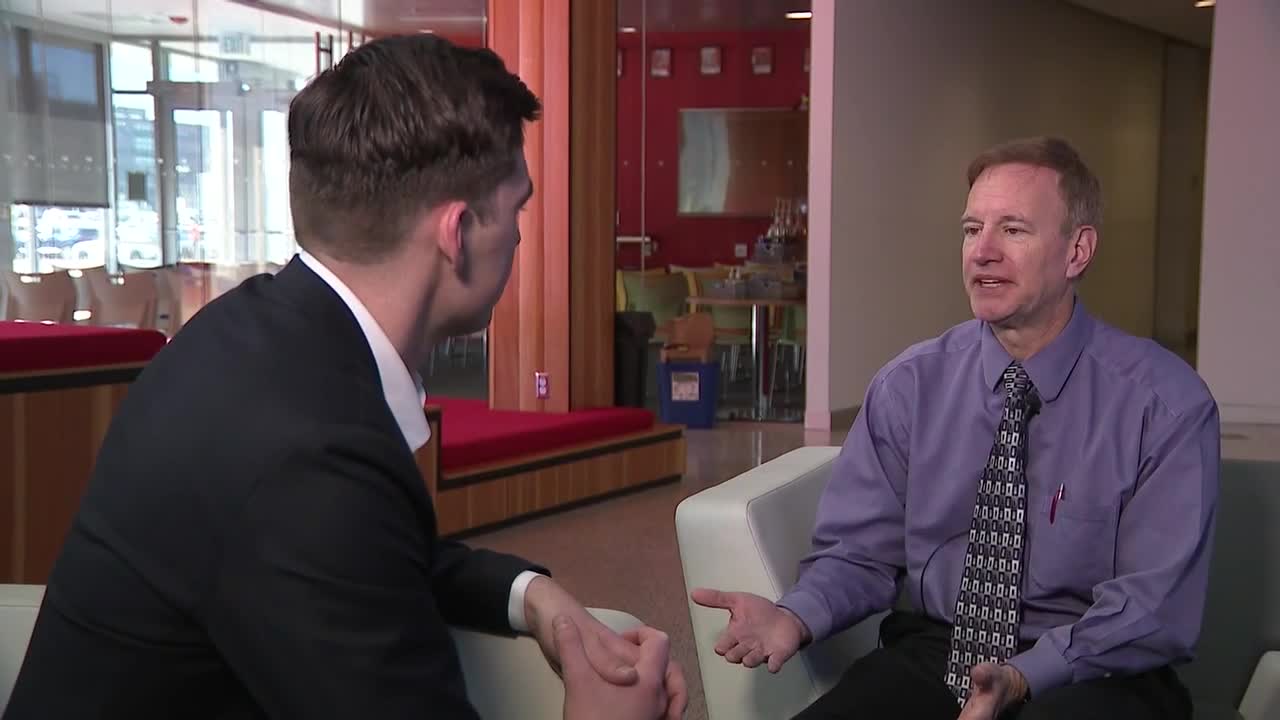


DENVER — Denver7 has been speaking with professors at Metropolitan State University Denver about how artificial intelligence is changing higher education.
Those professors have signaled that student assessment is something that needs to be re-evaluated to ensure academic honesty and make sure students are using AI as a tool to learn, not as a crutch.
“It’s not as if this is a new problem,” MSU’s Executive Director of Online Leaning Professor Sam Jay said. “It's a problem that we're going to have to be willing to invest a lot of resources and time and effort into. And so I get excited about it because it's kind of time to right the ship anyway.”
Jeff Loats, a professor and director of the Center for Teaching, Learning and Design at MSU, said the university is “faced with a huge shift in the ground beneath us.”
“We have this very, I think, noble mission of trying to offer higher education to a lot of people in a lot of circumstances,” Loats explained. “We are now suddenly faced with a situation where an online assessment — whether it's for an in-person course or an online course — if the assessment is online, we don't know how to do that in a valid way.
Loats went on to say he hopes higher education goes through a “huge change in the next five years.”
“I think if we keep doing what we're doing now for the next five or 10 years, we're going to, it's going to break, it's going to fall apart,” Loats said. “People aren't going to trust what we do anymore.”
Denver7’s Ryan Fish brought those concerns to MSU Denver Vice Provost Shaun Schafer who is also a journalism professor. He said conversations about how to adjust student assessment in the age of AI have been happening for years, and continue now.
“What AI has really shown for us was like, ‘Yeah, our assessments were not nearly as solid as we thought, they were fragile, they were easy to overcome,’” Schafer said. “And now that we know that, we have a really great opportunity to look at these different approaches that we can use.”
Schafer said his own class has flipped from in-person lectures and online assignments to online lectures and videos and in-person assignments.
“I suspect we'll see a lot more case studies,” Schafer said. “I think we'll see a lot more of like, ‘Apply this to your life, apply this to your community,’ sort of assignments. Because those are much harder to do with AI.”
Schafer acknowledged it’s difficult for instructors to drastically change how they teach their courses, and some are more bought into the idea of using AI as a learning tool than others.
The vice provost also said at this point, it’s impossible to have a definitive set of guidelines for all instructors across more than 100 majors to advise how to use AI as part of their courses and how to assess their students. He said MSU is looking at how to set some guidelines for general education classes first before getting more specific.
“I don't want to give up on the human judgment component of evaluating people's work, because you are going to continue to work in a human market,” Schafer said. “And so I'm one of those people who's very reluctant to say, ‘Oh, yeah, I can turn that over to AI.’ But I certainly understand how people go, ‘Well, what if that took my grading from 10 to 15 hours a week down to one? And I now spent 10 to 15 more hours on my research or on improving what I teach in the class?’ And so, yeah, that's been pretty provocative.”

