

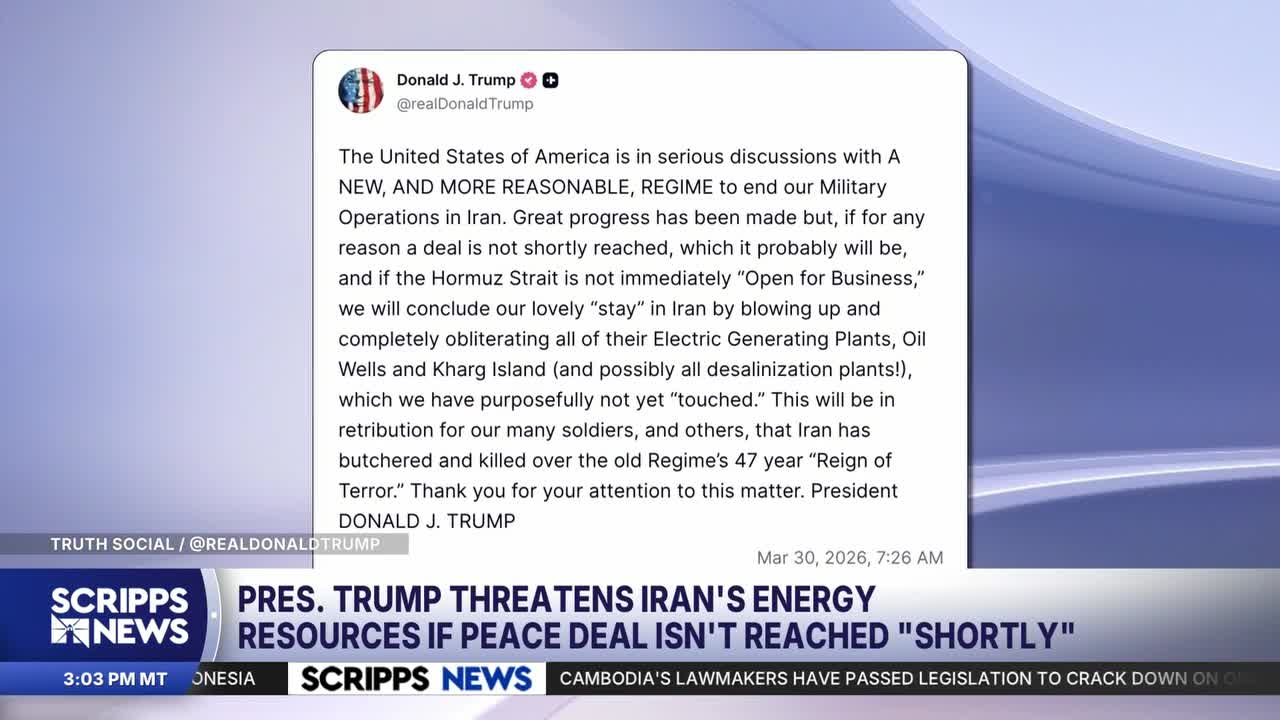


Just over a month into the war in Iran, the White House says peace talks are progressing as it balances diplomatic efforts with continued military pressure.
The president said the United States “is in serious discussions with a new, and more reasonable, regime to end our military operations in Iran.” At the same time, he warned the U.S. could strike Iran’s electric generating plants, oil wells, Kharg Island and desalination facilities if no deal is reached or if the Strait of Hormuz is not kept “open for business.”
IN CASE YOU MISSED IT | Trump issues new threat to Iran's civilian infrastructure if a ceasefire isn't reached 'shortly'
Speaking to reporters Sunday night, President Donald Trump said Iran is largely agreeing with a U.S. 15-point plan. Publicly, however, Iranian officials say there have been no direct negotiations with the United States, only proposals exchanged through intermediaries. A spokesperson for Iran’s Foreign Ministry called the U.S. proposal “a set of very excessive, unrealistic, and irrational demands.”
Still, White House press secretary Karoline Leavitt said the people who the U.S. is engaging with appear more reasonable than the previous leadership. She, however, declined to detail how the administration is defining “reasonable.”
"I'm not going to detail the private and sensitive conversations that are taking place between the United States and Iran right now," Karoline Leavitt said.
She added, "What we're hearing from them is more reasonable. They have agreed to some of the points the United States laid out, as the President said last night aboard Air Force One. But again, as for the specifics, as these negotiations are ongoing, we're not going to broadcast them to the world unless the president chooses to do so, which he has the full right to do as the leader of the free world."
RELATED STORY | Iranian strike wounds at least 10 US troops and damages planes at Saudi air base, official says
Meanwhile, the White House is crediting diplomacy for the movement of some tankers through the Strait of Hormuz, saying about 20 vessels have been allowed to pass. Two Chinese-owned tankers recently crossed the strait, according to ship-tracking service MarineTraffic, and the administration denies Iran is selectively allowing traffic.
However, an Iranian parliament commission has advanced efforts to impose a toll on vessels passing through the strait and assert greater control over the waterway, according to Iranian state media. The U.S. has pushed back on the idea of tolls and is urging allies to take additional action to keep the passage open.
About 20% of the world’s oil supply moves through the Strait of Hormuz.
