

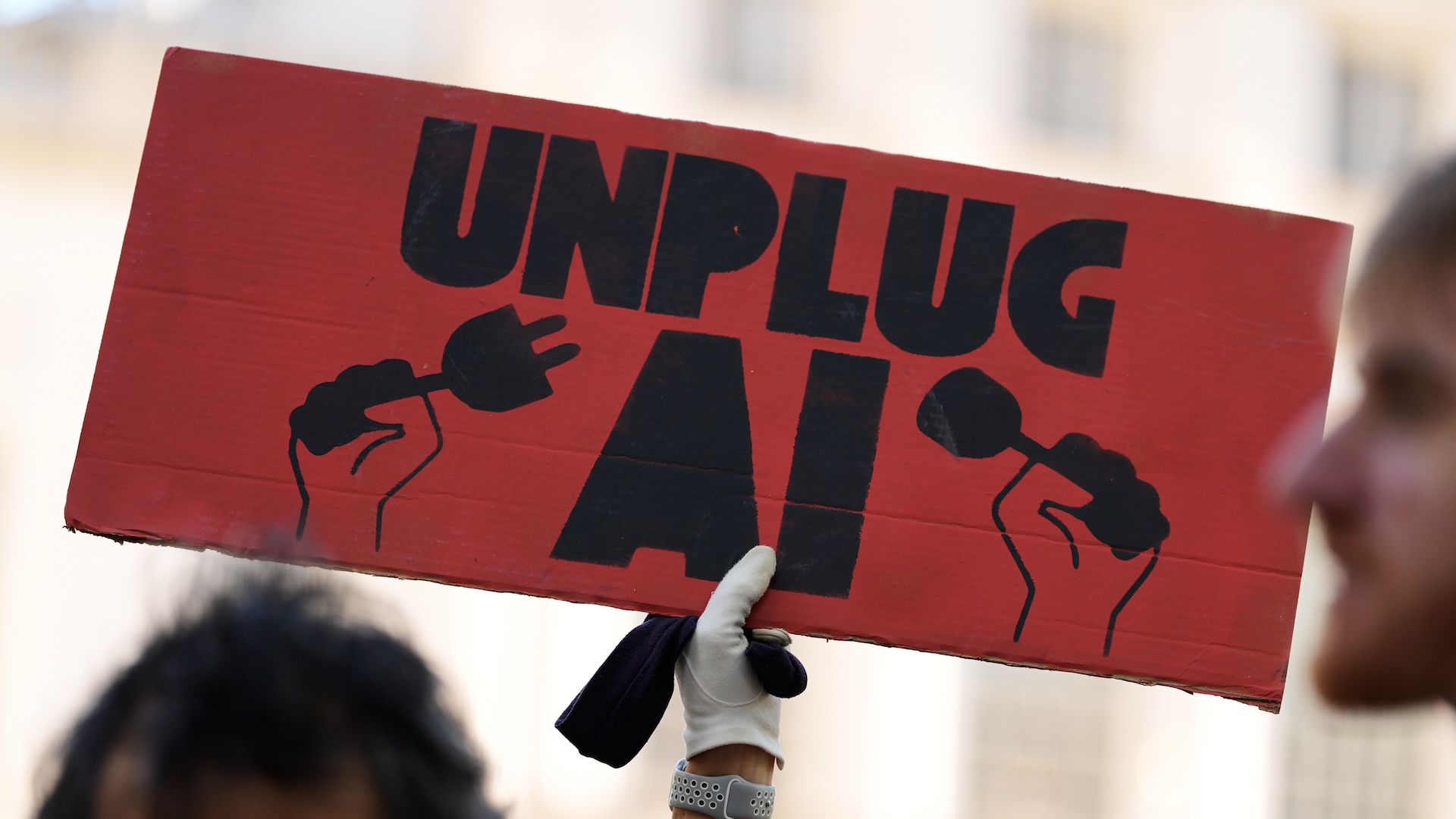


Worries around artificial intelligence cross party lines, with the vast majority of Americans saying the U.S. government should prioritize keeping AI under human control and protecting workers.
A new poll from The Associated Press-NORC Center for Public Affairs Research finds that most Americans, 64%, think AI is developing “too fast,” while 27% say its development has been “about right” and only 8% say it's moving “too slow.”
The risk that powerful AI models could evade human control and hurt humanity, once the stuff of science fiction, has been emerging as a more pressing concern. Even leaders of the companies that are developing frontier AI models are calling for a slowdown so that government regulation can catch up. President Donald Trump has pushed back against slowing down AI development because of concerns that China will gain an advantage with the technology. Data centers powering AI projects have also taken a prominent role in major political races as the midterm elections approach.
About 8 in 10 U.S. adults say it's “extremely” or “very” important for the U.S. government to ensure that AI stays under human control, and they are about as likely to want the government to prioritize protecting the country's workforce. Most U.S. adults also think minimizing environmental harm and growing the U.S. economy are highly important. About half say this about promoting technological innovation, and slightly fewer say that about competing with China.
There's bipartisan concern about the speed of AI's development, but few Americans think either major political party has an advantage in handling artificial intelligence. Trump, a Republican, also gets a low rating on his handling of the issue, with 67% of U.S. adults disapproving of his performance on AI.
Stephanie Stewart, a junior-high science teacher in Sunset, Utah, said she is frustrated by the president’s opposition to AI regulation.
“There is no handling of the issue except for we’re just going to allow these companies to do whatever they want, and we’re not going to regulate them,” said Stewart, 53.
RELATED STORY | Most Americans use AI, but few are willing to pay for it
Most say protecting workers should be a priority for the government
Ron Theusch, a truck driver who lives in rural Alden, Minnesota, said his No. 1 concern with AI is the potential loss of jobs — including his own.
“I can just see a train of self-driving trucks 24/7, just running up and down I-35, loading and unloading. I can just see that happening,” said Theusch, 58.
Most Democrats and Republicans agree on the importance of protecting workers and keeping AI under human control, the poll found.
“There was a movie called ‘Terminator,’ where the robots came back and killed everybody,” Theusch said. “People relate to that ... I don’t know where it’s going to land. I really don’t have anything I can do to control it, you know. It’s going to evolve.”
There's less consensus about the importance of other priorities when it comes to AI. Republicans are more likely than Democrats to say it’s highly important to grow the U.S. economy and to compete with other countries like China. Democrats, on the other hand, are more likely to say it’s at least “very” important to minimize environmental harm.
“I don’t understand how, because they’re doing something as well as us, that we can’t be more human about it and more humane about it than just to say, ‘Well, they’re doing it, so we have to do it,’” Stewart said of U.S. competition with China.
And while about three-quarters of Democrats say AI is developing “too fast,” only about half of Republicans share that worry. People under 30 years old also express higher levels of concern than people 60 or older, the survey found.
“I think I have all the normal concerns, right? I think it’s wonderful for certain applications, but I also feel like it will be overused and can create a lack of personal connections. It can make people lazy because information is just given to them without really having to research things on their own,” said Kelly Opp, a 62-year-old Republican in Albuquerque, New Mexico.
“Like everything else, once you get that ball rolling, it progresses fast on its own, but I think that it will continue to keep progressing. So the speed doesn’t really bother me,” she said.
RELATED STORY | Trump administration accuses Microsoft of fraud, bars it from green card program
Americans have little confidence in Democrats or Republicans on AI
As a teacher, Stewart regularly uses AI to help with her work, including with creating assignments or assisting with tests. But she is deeply concerned about AI's effects on children.
“You’ve got to protect kids. You’ve got to protect teens. You've got to protect privacy ... we need to try to do something,” she said.
Americans have little trust in either party when it comes to the handling of AI issues. About 4 in 10 Americans say they don’t trust either the Democratic Party or the Republican Party on AI, according to the poll, while nearly 2 in 10 trust both parties equally, and the rest are split between trusting the Republicans and the Democrats.
Even people who identify with the parties are ambivalent about their ability to handle the issue. Only about half of Republicans and Democrats say their party is better equipped to handle AI issues, and roughly 3 in 10 in each case say neither party is.
“I am kind of moderate. And I see that there’s good on both sides," said Stewart. "Anyone back in Washington is weak on doing anything for anyone but themselves right now. So, no, I don’t think the Democrats would do a better job per se. Maybe they would definitely tout it. But until I see anything coming from anyone, I’m going to be like, ‘Yeah, no. You’re all just sitting there.’”
RELATED STORY | Nearly 500 communities across the country have paused data centers
Trump pushes for more development
Meanwhile, President Trump has touted what he’s dubbed ‘super intelligence,’ with the midterm election just weeks away.
“It is seen as an economic issue for voters. It's data centers; they see those as raising their utility costs. It is this idea that the technology could threaten American jobs, and it's why the president's rhetoric doesn't really line up with where most voters are, and even most Republicans running for office this time around,” said Scripps News Group political director Andrew Rafferty.
Trump has advocated for supporting its development, pointing to guardrails within existing law enforcement, warned anyone not using his terminology is “the enemy” and doubled down on data centers during his midterm campaign blitz.
“We're also taking historic action to ensure that big tech data centers benefit local communities,” he told a crowd in Ohio last weekend.
“We’re getting rid of artificial intelligence and we’re changing it to super intelligence,” he told a crowd rallying in San Antonio, TX Wednesday.
It comes after the President announced the ‘Super Intelligence Force’ led by DNI Jay Clayton, and that companies signed on to an accord at the White House amidst concerns raised within the industry on the pace of development.
“It is nice to be able to make AI assisted progress on lots of things. The more bearish case, though, right now on AI, I think stems from public anxiety, and I think very legitimate public anxiety, because right now, whether they want to be or not, the public and the policymakers who represent them are just not in the loop and not in control of what's happening in frontier AI right now. It's just a small number of people at a very small number of companies making decisions about obscure technologies behind closed doors that are in control,” said Stephen Casper, an assistant professor at Harvard University.
Thursday, Trump awarded national medals to leaders in technology, including those at the forefront of AI, at ‘Science: A New Golden Age Summit.’
It included Elon Musk, the founder of Google and heads of Nvidia, AMD, Microsoft and Dell.
“From day one my administration has taken decisive action to ensure that America continues to dominate the frontiers of science and technology,” Trump said.
The summit also included more than $6 billion in investments in the government, industry, academia and philanthropy, according to the White House, and the launch of initiatives.
“These initiatives will equip scientists with the tools to harness SI-driven scientific revolution, support the best and brightest American STEM students and early-career scientists, revive the pursuit of ambitious national scientific missions, and encourage the creation of new scientific institutions,” the White House’s fact sheet stated.
