

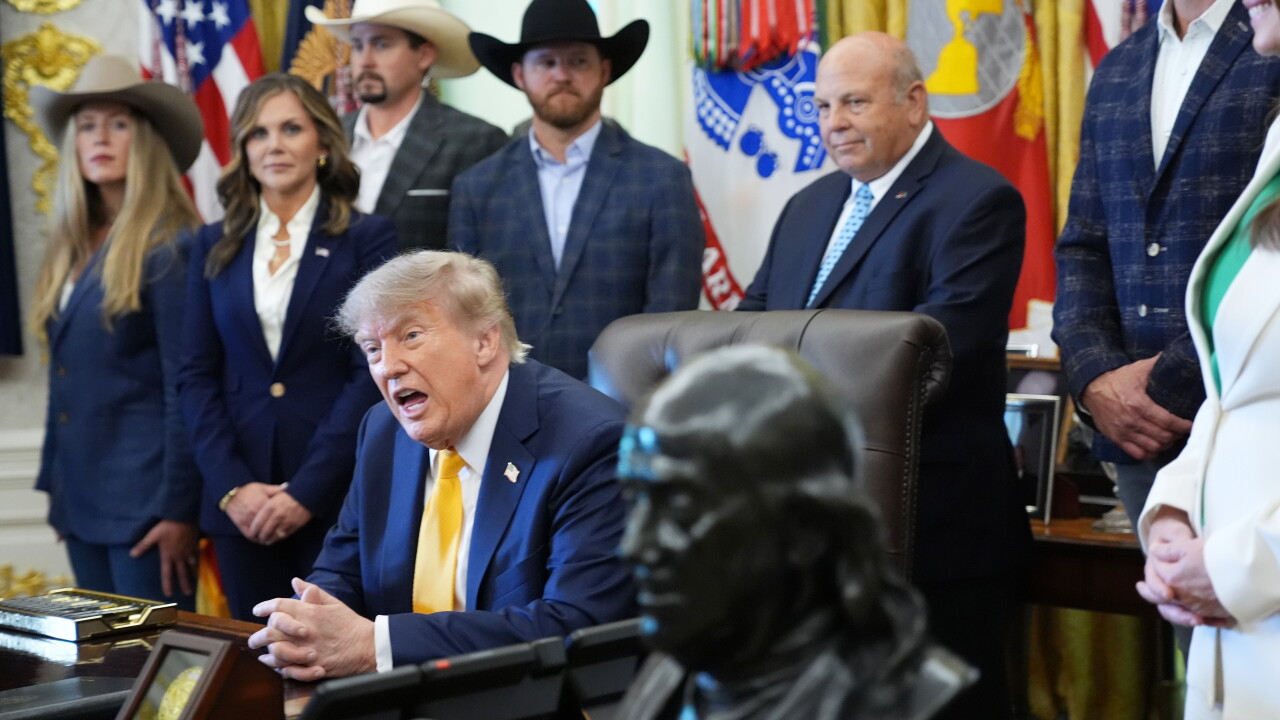

President Donald Trump's administration has made $15 billion worth of promises to agriculture producers in the last few weeks of the midterm elections, initiatives intended to help offset higher costs for diesel and fertilizer that farmers have endured largely due to his tariffs and the war in Iran.
Whether that will motivate more voters to turn out in agricultural states where traditionally Republican seats are now seen as competitive is unclear. It may explain his increased attention on rural areas, including visits Sunday to Iowa and Kansas, two days before the election.
A look at the Republican administration's pledges to farmers:
Who these efforts will help
Besides the more than $15 billion worth of payments and initiatives announced by Trump's Department of Agriculture, the agency plans $13.8 billion in safety net program payments for eligible producers for the 2025 crop year, offsetting shortfalls for farmers who grow key crops such as corn, soybeans, wheat and rice.
Of the $15 billion, more than half will go toward an $8 billion one-time payment plan for farmers buffeted by soaring diesel prices. The USDA said it will release more details about the payments this month. It is not clear when the payments will go to farmers, who rely on diesel for trucks, tractors and combines.
RELATED STORY | The GOP counts on farmers' votes. As a costly harvest season raises concerns, Trump heads to Kansas
Gregg Ibendahl, a farm management specialist at Kansas State University, said he estimates the payments to “more than cover the increase in fuel costs,” and that the money could help with high fertilizer prices.
At least $5 billion was announced in guaranteed loans for ranchers and fishermen. An additional $1.8 billion in payments is for producers and landowners who participated in conservation programs, $573 million will go toward fertilizer manufacturing projects and $57 million is for expanding meat processors. For specialty crop producers, $86.6 million in grants will be awarded to innovative projects.
On Thursday, the agency said it would purchase up to $472.5 million in agricultural commodities to support producers and give to charitable programs.
The USDA also announced other efforts, such as expanding sales of a diesel normally used only for off-road use, helping ranchers by making cattle sale data more transparent and strengthening wolf management policies to protect livestock.
Why farmers are struggling
It has been a frustrating year for farmers. Increased costs for fertilizer and fuel have made it difficult to turn a profit. Last year, tariffs drove up expenses for other equipment that farmers use, and the trade war with China resulted in a near boycott of U.S. agricultural goods.
On Friday, diesel was averaging $6.32 per gallon, down slightly from its peak in September but 70% higher than the price a year ago, according to motor club AAA. Filling up a 100-gallon tank now costs $260 more than it did one year ago.
“That input side risk, I think, is the thing that really has hurt farmers this year, as well as the fact that there has been a lot more uncertainty about what’s going to happen in the world,” Ibendahl said.
He said he expects these ad hoc payments to be a big help for farmers who otherwise would not make a profit this year, but they do not address the broader issues driving up prices.
“It’s hard to go to your lender in the next spring and say, ‘OK, well, we’re looking pretty good this year, but it’s all because of these extra temporary government payments, so how much can you make me a loan (for) next year for my crop?’” he said.
Alexandra Middlewood, an associate professor of political science at Wichita State University, said she has heard mixed reactions from farmers, who are happy their business will survive this year but see these programs as one-time bailouts rather than a long-term solution.
What farmers may vote on
Rural voters, including farmers and those who rely on the agricultural economy, have been an instrumental voting group for Trump.
Michael Smith, a political science professor at Emporia State University, said many rural voters like the president, but some of his policies have hurt the agriculture industry. Immigrant deportations have threatened the agricultural labor force, and cuts to foreign aid and SNAP food stamps hurt the market for agricultural products.
“Some people who admire Trump really just admire the person, the man,” he said. “But it doesn’t mean they necessarily like his policies. Well, Trump himself isn’t on the ballot this year. His policies are.”
RELATED STORY | High inflation and the Iran war put pressure on Republicans ahead of the midterm elections
Cost of living and access to health care are top issues for rural voters, Middlewood said. She added that there is a perception the administration has not done enough to address these issues, even as Trump boasts at campaign rallies about a booming economy.
Middlewood, who is based in Kansas, does not expect frustrated rural voters to shift to the Democratic Party, given how long the state has been a Republican stronghold. But some voters may decide to sit out of this election or vote independent, which would hurt Republican candidates.
“Independent voters make or break elections," she said. "And so that’s really what it’s going to come down to this year is those independent voters and who they’re breaking for.”


