

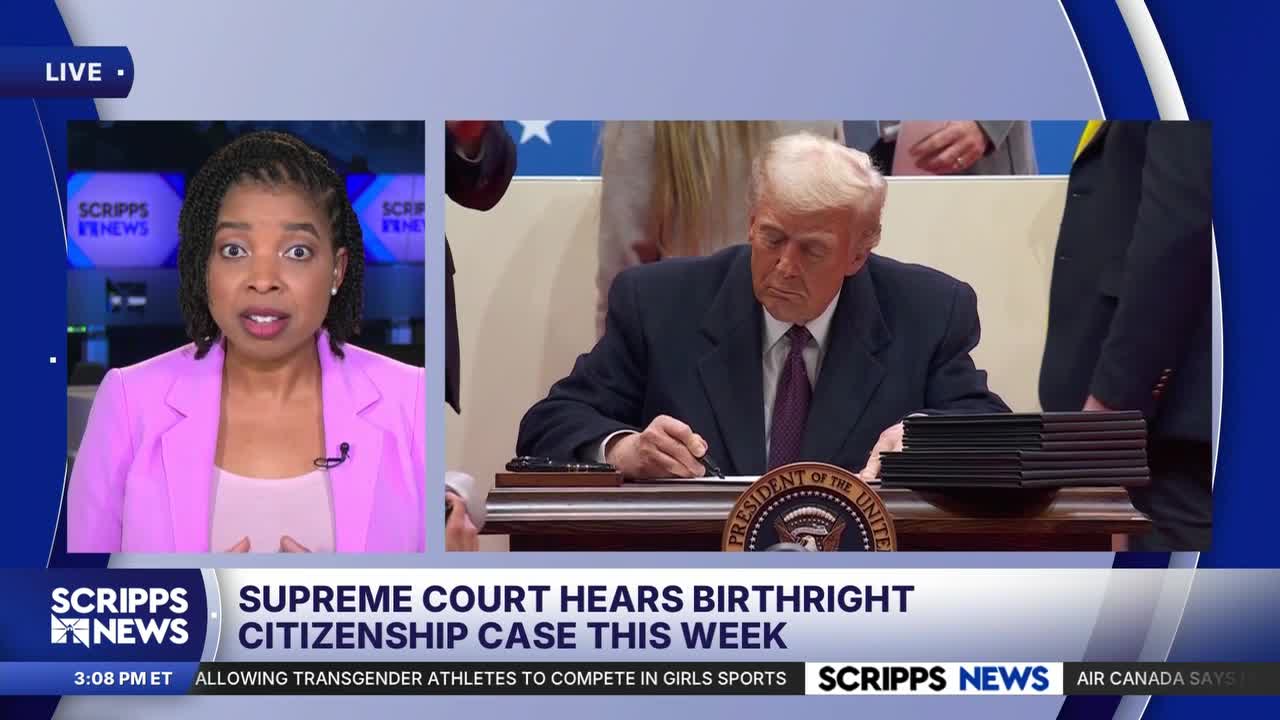


The Supreme Court this week will hear arguments in a birthright citizenship case, coming as the Trump administration takes steps to prevent babies born in the U.S. to undocumented migrants from automatically becoming U.S. citizens.
President Trump has focused on the issue of birthright citizenship since taking office. He signed an executive order seeking to limit birthright citizenship on day one of his second term.
In a Monday social media post, the president criticized judges and justices who ruled against him in this case and other cases as "dumb." He argued — not for the first time — that birthright citizenship is based on a portion of the 14th Amendment that only applied to former slaves and their children at the time.
Birthright citizenship "is about the BABIES OF SLAVES! We are the only Country in the World that dignifies this subject with even discussion. Look at the dates of this long ago legislation - THE EXACT END OF THE CIVIL WAR!" President Trump wrote.
RELATED STORY | Supreme Court considers letting Trump administration revive restrictive immigration asylum policy
The Trump administration has repeatedly argued that the 14th Amendment only applied to former slaves and their children and was not meant to be applied to people who are here in the United States illegally.
That allegation may preview arguments from DOJ officials on Wednesday at the high court. In filings ahead of the hearing, the U.S. Solicitor General wrote that "the Citizenship Clause of the 14th Amendment provides that those 'born… in the United States, and subject to the jurisdiction thereof,' are U.S. Citizens. The Clause was adopted to confer citizenship on the newly freed slaves and their children, not on the children of aliens temporarily visiting the United States or of illegal aliens."
The ACLU, one of the respondents in the case, says the 14th Amendment has been standing for well over a century and has been applied to babies born in the United States for close to 125 years. In that time, the ACLU argues, there have been very few instance where a baby was born in the U.S. to undocumented migrants has not been able to get U.S. citizenship.
"Families are worried that their babies are going to get arrested as they're coming out of the hospital after giving birth," said Cody Wofsy, the deputy director of the ACLU's Immigrants' Rights Project. "I think years or decades ago, that might have been a little speculative, but now given the incredibly aggressive and abusive enforcement practices we've seen from the Trump administration in immigrant communities and particularly targeting people of color, I think that families have a lot of well-founded fears and concerns about what's going to happen to their child."


