

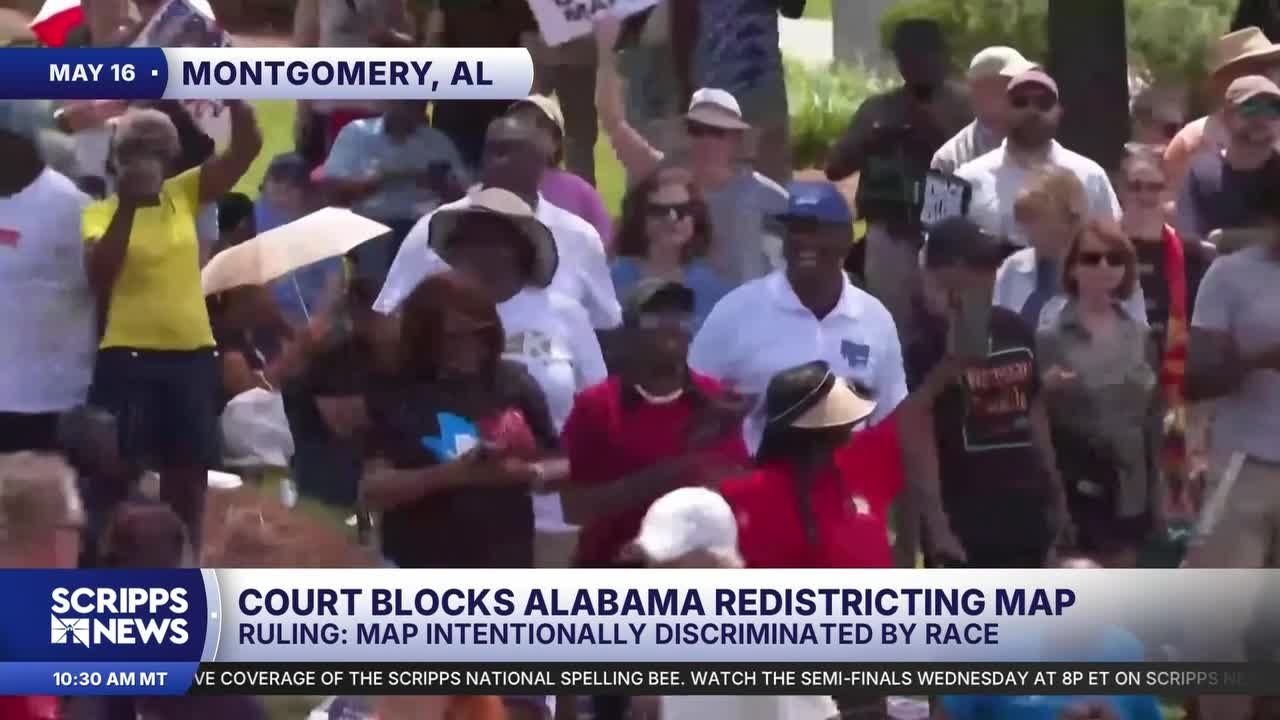


Federal judges on Tuesday blocked Alabama’s plan to use a congressional map that could give Republicans an advantage in a key U.S. House race in the midterm elections.
A three-judge panel in the state’s long-running redistricting case issued a preliminary injunction that prevents the state from switching maps, ruling that the Republican-backed plan “intentionally discriminated based on race” by including only one Black-majority district. The judges instead required Alabama to continue using a court-ordered map in place for the 2024 elections that includes two districts where Black residents comprise a majority or close to it.
“Ultimately, we cannot see our way clear to requiring Alabamians to cast their votes in the 2026 elections under a districting plan tainted by intentional race-based discrimination,” the judges wrote.
The ruling is a setback for Republicans, who want to use a map for the November midterms that would give the GOP a chance to reclaim the seat now held by Democratic U.S. Rep. Shomari Figures. However, the state could appeal the ruling to the U.S. Supreme Court.
RELATED STORY | Alabama lawmakers pass plan for new US House primary if courts allow different districts
Figures said he is pleased with the ruling but expects an appeal. “This is a significant step in the right direction, but there is still a long way to go before this fight is settled,” Figures said.
The court order is the latest development in the twisting legal and political saga following a U.S. Supreme Court ruling that struck down a Black-majority district in Louisiana and weakened the federal Voting Rights Act. That ruling has led Republicans in several Southern states, including Alabama, to take steps to reshape voting districts with large minority populations that have elected Democrats.
The redistricting frenzy is part of a broader push by President Donald Trump to try to hold on to Republicans’ slim House majority in the November elections.
Alabama court fight stretches back several years
The three-judge panel in 2023 ruled that a map drawn by Republican state lawmakers intentionally diluted the voting power of Black citizens. The court said the state, which is about 27% Black, should have two districts where Black voters are the majority or close to it. The court-selected map was used in 2024.
After the Supreme Court's recent ruling in the Louisiana case, Alabama officials moved to implement the 2023 state-drawn map. The Supreme Court’s conservative majority agreed to lift the injunction that had blocked the map's use and sent the case back to the three-judge panel for reconsideration in light of the Louisiana ruling.
In the meantime, Alabama Gov. Kay Ivey set Aug. 11 special primaries using the new map.
Upon further review, the panel said there was “undisputed evidence” of intentional racial discrimination. It said the special congressional primaries should instead proceed under the previous court-approved districts.
The decision to temporarily block the map switch came after a seven-hour court hearing Friday in which judges sharply questioned state lawyers about the timeline and the impact of the Louisiana ruling.
Using the same districts that had been in place for the previous election would prevent “an expensive, aggressive, and perhaps logistically impossible voter reassignment effort,” the judges wrote.
“Candidate and voter confusion is troublesome and warrants significant consideration, but we do not see that a preliminary injunction will worsen it. To the contrary, we expect a preliminary injunction to lessen it,” the judges said.
Deuel Ross, director of litigation for the NAACP Legal Defense Fund, said the court ruling “again vindicated the constitutional rights of voters in the Black Belt, and our clients look forward to voting under a fair map this fall.”
Redistricting changes affect primaries in several states
Other states also have considered adjustments to their primary elections to allow time for congressional redistricting after the U.S. Supreme Court’s decision affecting the Voting Rights Act. Louisiana’s congressional primaries, scheduled for May 16, were postponed until later this summer by Republican Gov. Jeff Landry so that state lawmakers could consider a new U.S. House map that would eliminate a majority-Black district.
In South Carolina, the Republican-led legislature is considering a plan that could throw out the votes from its June 9 congressional primary and instead hold a new primary in August under revised districts that could improve Republicans’ chances of winning an additional seat.
Tennessee also moved quickly to enact new U.S. House districts after the Supreme Court’s ruling, carving up a Black-majority district based in Memphis that had elected the state’s only Democratic representative. The new map gives Republicans a chance to sweep all nine of the state’s seats. As part of the plan, Tennessee temporarily reopened the candidate qualifying period for its August congressional primaries, allowing new candidates to enter the race and existing ones to either switch districts or drop out.
RELATED STORY | Supreme Court orders review of rulings limiting enforcement of Voting Rights Act
Since Trump first urged Texas to redraw its U.S. House districts last summer, about a half-dozen Republican-led states have enacted new voting districts, though some still face legal challenges. Democrats countered with new districts in California and also expect to gain a seat from new court-imposed districts in Utah.


